China has long dominated the production and refining of rare earth elements, which are critical for the global green transition. To reduce its dependence on China, the United States has doubled down on efforts to increase rare earth production in recent years to ensure its energy security. However, in June, China targeted the U.S. rare earths industry as part of the ongoing trade war between the two countries.
Rare Earth Elements
Rare earths are a group of 17 elements that are vital for defense, clean energy technology, industrial manufacturing, and other applications. There are two rare earths categories: Light Rare Earth Elements (LREEs) and Heavy Rare Earth Elements (HREEs). LREEs are widely available, whereas HREEs are heavily concentrated in China and Myanmar. Although there is not a great scarcity of rare earths, they are difficult and expensive to extract, refine, and process at scale.
China currently dominates the rare earths supply chain, which has helped the Asian giant accelerate the deployment of clean energy capacity, manufacture electric vehicles (EV), build strategic military systems, and develop data centers. This means that the rest of the world has become heavily dependent on China for rare earths, even as many countries seek to develop their own production and refining capacity. China currently supplies around 90% of the world’s LREEs.
Rare earths are used to produce high-performance permanent magnets for a range of applications, including electronics and robotics. According to the International Energy Agency (IEA), the demand for neodymium, praseodymium, dysprosium, and terbium has doubled since 2015 and is projected to increase by over 30% by 2030.
The IEA’s Executive Director, Fatih Birol, explained, “Rare earth elements are indispensable to many of the technologies shaping the Age of Electricity, and our increasingly digitalized economies, yet their supply chains remain among the most concentrated of all critical minerals.”
The Growing U.S. Rare Earths Industry
In 2024, the United States imported 80% of its rare earth element demand. The U.S. has just three rare earth mining locations at present: Georgia, California, and Wyoming. Rare earths are produced as a byproduct of heavy mineral sand mining in southeast Georgia; however, they are then transported abroad for refining. The same is true for California, where the rare-earth bastnaesite is extracted via hard-rock mining.
Meeting the U.S. demand for rare earth elements from domestic operations will require developing and scaling up new technologies and building refining operations, rather than simply developing new mining projects.
To this end, USA Rare Earth announced plans in December to bring forward commercial production at its rare earths project in Texas from 2030 to late 2028, thanks to faster-than-expected progress at its processing facilities coupled with the rising U.S. demand for rare earths. The Round Top deposit in Texas is the largest known domestic supply of HREEs.
The company plans to develop a comprehensive mine-to-magnet supply chain spanning Texas, Colorado, and Oklahoma, mining dysprosium and terbium. The firm has already experienced strong results from solvent-extraction piloting at its processing lab in Wheat Ridge, Colorado.
China Targets U.S. Rare Earths
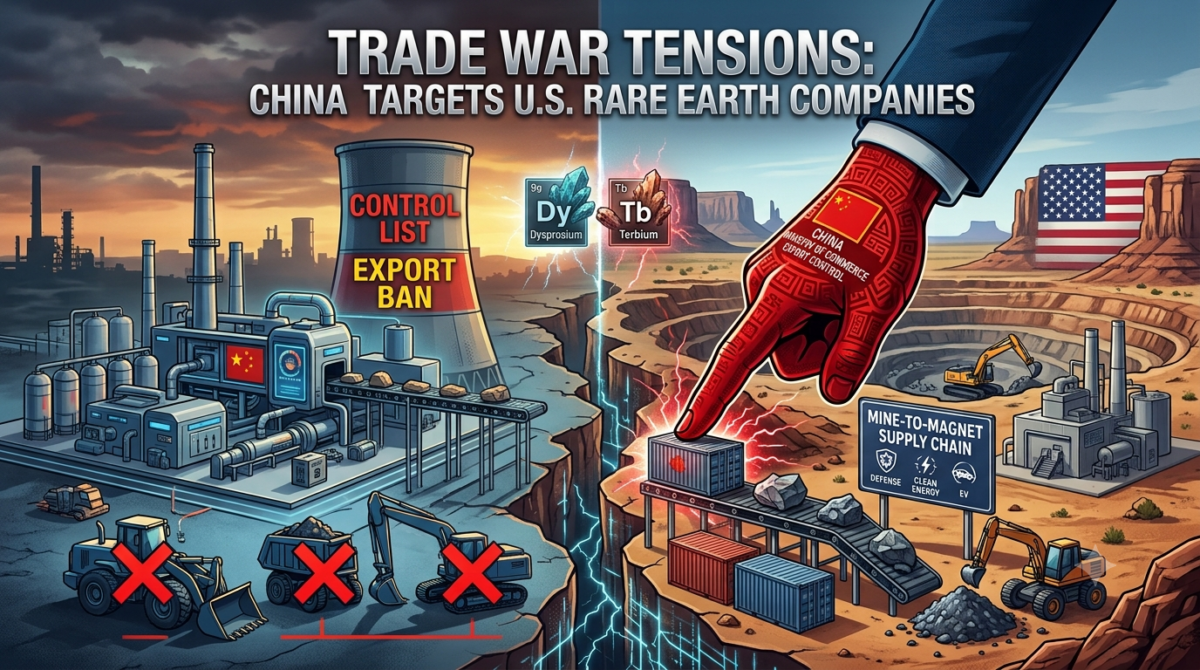
In June, China took aim at a U.S. government program that seeks to reduce dependence on China for rare-earth magnets. The Chinese government added 10 U.S.-based companies to its export control list. The move came two weeks after the Pentagon blacklisted some of China’s best-known companies for their alleged ties to the Chinese military.
China’s Ministry of Commerce banned Chinese firms from exporting “dual-use” items that can be used for civilian or military purposes to certain U.S. companies, including USA Rare Earths and the rare-earth mine operator MP Materials Corp. The Commerce Ministry said the move was intended to “safeguard national security and interests and fulfil international obligations such as non-proliferation”.
In addition to the export ban, China’s Ministry of Finance barred Chinese government procurement from 46 U.S. companies, including Boeing and General Atomics.
Nick Marro, a global trade lead analyst at the Economist Intelligence Unit, explained, “We can interpret this as a tit-for-tat response, and that fits into China’s playbook any time we’ve seen escalation from the U.S. side in terms of trade and investment tools.”
There are concerns about what the move could mean for the U.S.-China trade war. President Trump and Chinese President Xi Jinping agreed to a trade truce in October, which was extended in May during a summit between the two leaders in Beijing. However, the recent moves by both sides could undermine that deal.
Trump has repeatedly threatened to impose stricter trade measures on China over the last year and has imposed heavy tariffs on imports of certain products. China has been quick to retaliate and has been working to diversify its trade partners. However, the United States remains heavily dependent on China for rare earths and other critical minerals, which means further escalation could carry significant supply-chain risks for U.S. manufacturers and consumers.
Keep In Touch with Shale Magazine
As the new era of energy unfolds, you can bet we’ll be the boots on the ground to keep you informed. Subscribe to Shale Magazine for sharp insight into the arenas that matter most to your life. And don’t forget to listen to our riveting podcast, The Energy Mixx Radio Show, where our very own Kym Bolado interviews the most extraordinary thought leaders, business innovators, and industry experts of our time.
Subscribe to get more posts from Felicity Bradstock