
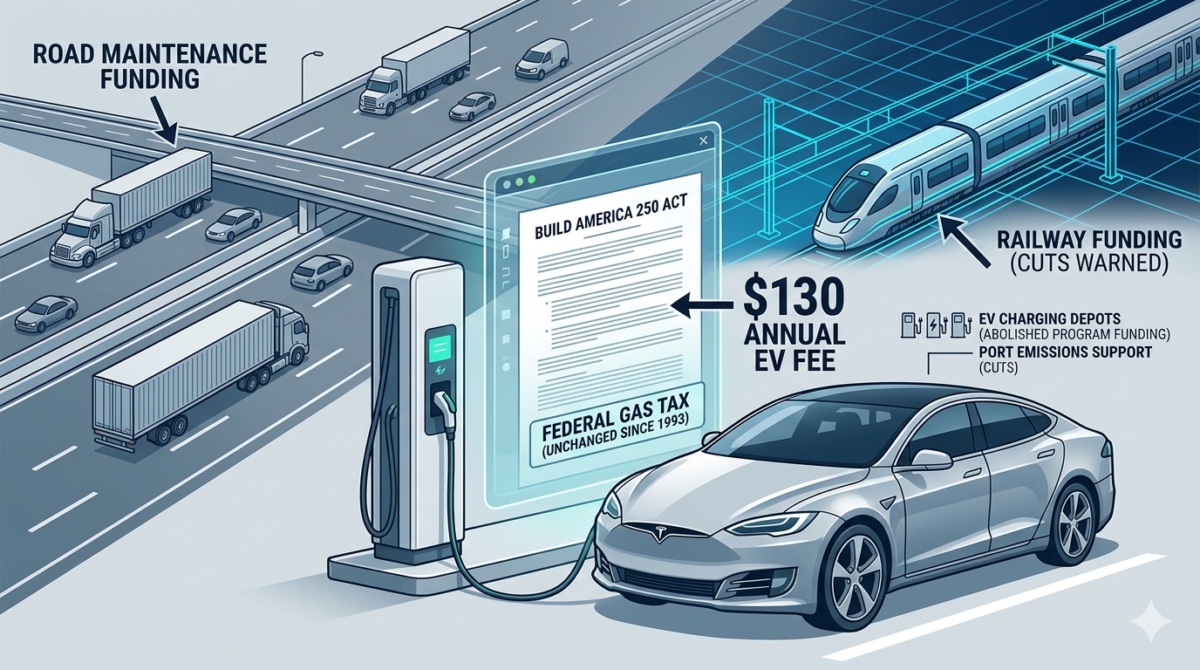
The House Transportation and Infrastructure Committee proposed a five-year transportation funding bill in May that would cut federal funding for certain modes of transportation, potentially driving up costs for U.S. consumers and slowing electric vehicle (EV) adoption.
Bipartisan Transportation Bill and EV Uptake
EV sales in the United States have been increasing more slowly than previously expected for a range of reasons. Consumers have grown increasingly cautious about spending in recent months due to rising inflation and consumer bills. In addition, in 2025, Congress cut subsidies worth up to $7,500 for EV purchases and leases, making them less affordable.
A bipartisan bill known as the BUILD America 250 Act, introduced in May, could make EV ownership even more expensive by imposing a $130 annual fee on EVs and a $35 fee on plug-in hybrids to contribute to road repairs. The bills’ advocates said the federal fee would help finance road maintenance, which is currently partially funded by federal gasoline and diesel taxes.
Chairman of the House Transportation and Infrastructure Committee and Republican Party Congressman Sam Graves said that it “ensures that electric vehicle owners begin paying their fair share for the use of our roads.”
Meanwhile, Democratic Party Congressman Rick Larsen said that he had “worked to make sure that this new fee on EVs is fair and not punitive.” Larsen added, “A commitment to bipartisan lawmaking means finding compromise.”
However, industry and environmental groups have criticized the proposed fee, arguing that it is higher than the average fuel taxes paid by owners of internal combustion engine (ICE) vehicles, with those who drive more miles paying more at present.
The 18.4-cent federal gasoline tax per gallon has not increased since 1993, and President Trump recently proposed halting the tax to reduce the burden of rising fuel prices on consumers.
The Bill and U.S. Car Sales
The average cost of a new vehicle has increased by around 30% over the last six years. Meanwhile, consumers have been facing other rising costs, including fuel and insurance. The share of new-car buyers with incomes under $100,000 fell from 50% in 2020 to just 37% in 2025. At the same time, the share of buyers with incomes over $200,000 rose from 18% to 29% during the same period, according to Cox Automotive.
In 2025, the average manufacturer’s suggested retail price for vehicles hit $51,000. Mark Barrott, a partner at consulting firm Plante Moran, explained, “We’re now relying on the extremely wealthy to generate the sales… That’s a structural problem from an affordability perspective.”
With car prices rising across both ICE vehicles and EVs, consumers are increasingly holding off on purchasing a new vehicle or are turning to the used car market, meaning that any federal policies that drive car prices up could further exacerbate this trend.
Other Initiatives Under the Bill
If the transportation bill passes, it would also abolish the federal Carbon Reduction Program, which funds projects to reduce greenhouse gas emissions, such as cycle paths, traffic management systems, and EV charging stations.
The bill would also cut support for programs that reduce the cost of moving goods by improving port and intermodal freight efficiency, including the Reduction of Truck Emissions at Port Facilities Program.
The National Rail Passengers Association has also warned that the bill could reduce funding for railways by up to 80%, even though the first draft appears to promise Amtrak and other rail operators more money on paper. The organization has therefore refused to endorse the bill.
The association’s vice president of government affairs and policy, Sean Jeans-Gail, wrote, “The message of this bill is loud and clear: highways and roads are a core federal priority, and intercity rail is a state-level vanity project that Congress is willing to play along with – but only up to a point.”
Criticism and Recommendations
The transportation director at the American Council for an Energy-Efficient Economy (ACEEE), Rachel Aland, believes, “This bill would make U.S. transportation less efficient, more expensive, and dirtier.” Aland added, “Instead of locking Americans into an outdated freight system with volatile fuel costs, we should invest in clean and efficient trucking.”
ACEEE has called on Congress to ensure an efficient, less expensive, and cleaner transportation system by including measures in the transportation bill that would:
- Reauthorize the National EV Infrastructure and Charging and Fueling Infrastructure programs at current or greater funding levels and modify the programs to encourage shared charging depots that serve multiple heavy-duty fleets at semi-public locations, which would minimize upfront costs for zero-emissions heavy-duty fleets.
- Reauthorize funding at current or greater levels for programs that improve port and intermodal freight operations—such as the Port Infrastructure Development Program and Reduction of Truck Emissions at Port Facilities programs—to lower costs by improving truck movement efficiency, cut truck maintenance costs, and reduce port operating costs while increasing the capacity of ports.
- Include technical assistance and capacity-building support for state and local governments to ensure transportation projects better serve communities and reduce transportation costs.
Keep In Touch with Shale Magazine
As the new era of energy unfolds, you can bet we’ll be the boots on the ground to keep you informed. Subscribe to Shale Magazine for sharp insight into the arenas that matter most to your life. And don’t forget to listen to our riveting podcast, The Energy Mixx Radio Show, where our very own Kym Bolado interviews the most extraordinary thought leaders, business innovators, and industry experts of our time.