ENMG Analysis
The first answer to where data center development could go if Texas slows down is not necessarily another state. It may be closer to the projects themselves: developers are increasingly looking at dedicated, behind-the-meter power to reduce dependence on grid connections. At the same time, Virginia’s established data center cluster and candidate markets in the Midwest and other regions are likely to compete for projects, if they can provide power, land, water and reliable fiber access.
Texas remains a major market. Texas accounts for about a quarter of planned U.S. data center capacity, according to Goldman Sachs estimates reported by Reuters, while the Pew Research Center study found Texas had 296 operational data centers as of February 2026, second only to Virginia. Texas regulators resumed issuing environmental permits for data centers on November 17 after TCEQ said ERCOT had completed its assessment. However, the incoming administration has pledged to pursue a broader moratorium, leaving the pace and terms of future development uncertain. A pause does not, by itself, determine where projects will move, or whether they will move at all.
Self-Supply Offers A Way Around Some Grid Constraints
A recent deal points to one possible response. The Financial Times reported that Anthropic agreed to a $3.4 billion arrangement involving 1.7 gigawatts of natural-gas-fired engines for data center power, working with San Antonio-based equipment supplier OnePWR Solutions. The reported agreement includes engineering and construction support to install the generators. The sites and detailed delivery schedule have not been publicly identified.
This is an equipment order, not a single power plant. At 1.7 gigawatts of nameplate capacity, the engines are on the scale of more than one large nuclear unit, typically about 1 gigawatt, or several large gas plants, often in the 500- to 750-megawatt range. But the comparison is about capacity, not design: multiple engines distributed at or near data centers operate differently from a central-station plant, and nameplate capacity does not establish how much power will be available at every hour.
Behind-the-meter supply means electricity is generated on the customer’s side of the utility meter and used directly by the facility. Depending on its design, a data center could run on that generation wholly or partly independent of grid supply. It may still connect to the grid for backup, balancing or additional power; self-supply does not automatically mean off-grid operation.
For developers, the appeal is time and control. Onsite generation can reduce dependence on lengthy interconnection studies, transmission upgrades and uncertain delivery schedules. It can also make the project’s power arrangements less dependent on when a utility or regional grid operator can accommodate a large new load.
ENMG previously examined how AI data center power demand is reshaping the grid, including the challenge of matching fast-growing loads with infrastructure that takes years to plan and build. DOE has also pushed large-load interconnection reform at FERC, while ENMG previously examined flexible interconnection pilots that could let some facilities connect sooner by agreeing to operate within defined limits.
Power Is Only One Part of The Siting Equation
Self-supply does not eliminate permitting or infrastructure needs. Gas engines require fuel delivery, emissions approvals, maintenance and controls for local air quality. Multiple engines can offer modularity, but they also create operational complexity: more equipment to maintain, potential noise impacts and a larger set of permitting decisions than a single central plant. If grid access later improves, owners may also face the financial risk of generation assets that are no longer used as heavily as planned.
Cooling and water needs vary by facility design, but water availability can still shape site selection: alongside land and zoning, electricity supply, transmission headroom and fiber connectivity. A site with cheap land but no practical route to power, water or high-capacity communications may not be viable. Likewise, proximity to generation is useful only if fuel, local approvals and electrical equipment can support the project.
Virginia’s leading position reflects the value of an established cluster, with existing data centers, fiber networks and power infrastructure. Pew’s February data counted 398 operational facilities in Virginia, compared with 296 in Texas. But a mature cluster can also face constraints: concentrated demand requires enough transmission and distribution capacity to serve new campuses. Existing development is an advantage, not a guarantee of available grid capacity.
The geography of planned projects is broadening. Pew found that 67% of planned U.S. data centers were in rural areas, compared with 13% of operating facilities. Its analysis also found that 39% of planned projects were in counties without an existing data center. That pattern suggests developers are looking beyond established metro clusters, although a project listed as planned or land-banked is not the same as a funded project under construction.
Heatmap reported that Ohio, New Mexico and Pennsylvania are among the states to watch as data center development and energy infrastructure become more closely linked. These are potential destinations, not confirmed sites for the Anthropic–OnePWR generators. The fit will depend on local grid capacity, gas supply, water, land-use decisions and the time required to secure permits.

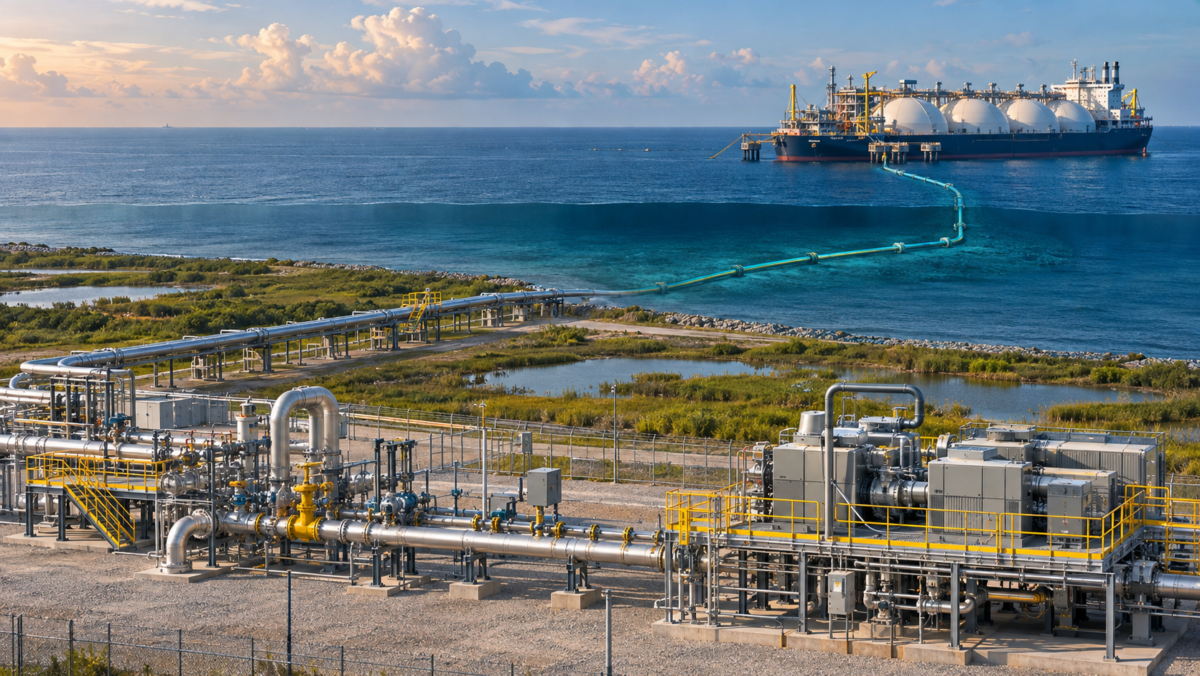
Illustrative image, not a photograph of any named facility. Modular generators can supply a data center directly, but fuel, emissions, maintenance and local permitting remain part of the project.
Grid Access and Cost Allocation Remain Central
Connecting a large facility to the grid can involve engineering studies, equipment procurement and transmission construction. Those steps can take years in some regions, especially where multiple proposed projects compete for limited capacity. Self-supply may bypass some of that interconnection process, but it does not resolve every grid issue: a facility that expects backup or supplemental service still needs a workable connection and clear terms for using it.
That distinction matters for customers as well as developers. If a large load relies less on utility power, it may reduce the need for some grid upgrades. But when a facility retains grid service, utilities may still need to plan for its peak demand or maintain infrastructure for backup. If a project departs after investments are made, the remaining customers’ exposure depends on tariffs, contracts and cost-allocation rules.
A Senate permitting bill moving toward a final vote would require large computing facilities to bear more of the transmission and grid costs associated with serving them. The latest substitute amendment reportedly removed an earlier 20-megawatt threshold. The proposal is not in effect unless enacted and implemented. At the state level, the incoming Texas administration has pledged a broader moratorium and has called for protections against household cost increases. The practical question is how any final rules distinguish costs caused by a new large load from costs that would be incurred for the wider grid.
Who May Benefit and Who Faces Risk
Developers that can secure equipment, fuel and permits may gain more control over project schedules through self-supply. Regions with spare generation, transmission headroom, water and suitable sites could attract projects that might otherwise wait for grid upgrades. Utilities and power producers could benefit from new demand where projects connect and purchase power under terms that support investment.
There are tradeoffs. Local communities may face air emissions, noise, water demands and land-use changes. Grid customers may be affected if infrastructure is built for a project and its costs are not fully assigned to that customer. Developers and cloud companies, meanwhile, face the risk that permitting delays or power constraints change the timing and economics of capacity plans.
Reuters reported that Morgan Stanley identified MARA Holdings, Cipher Digital, SEI and Galaxy Digital among companies potentially exposed to Texas data center policy changes. Its analysis also identified potential exposure for power companies including Vistra, NRG Energy, Constellation Energy and Talen Energy through assumptions about future load growth. Separately, Baird Equity Research identified Oracle and CoreWeave as cloud companies whose business could be affected by a moratorium, as Newsweek reported. These are assessments of potential exposure, not predictions of specific financial outcomes.

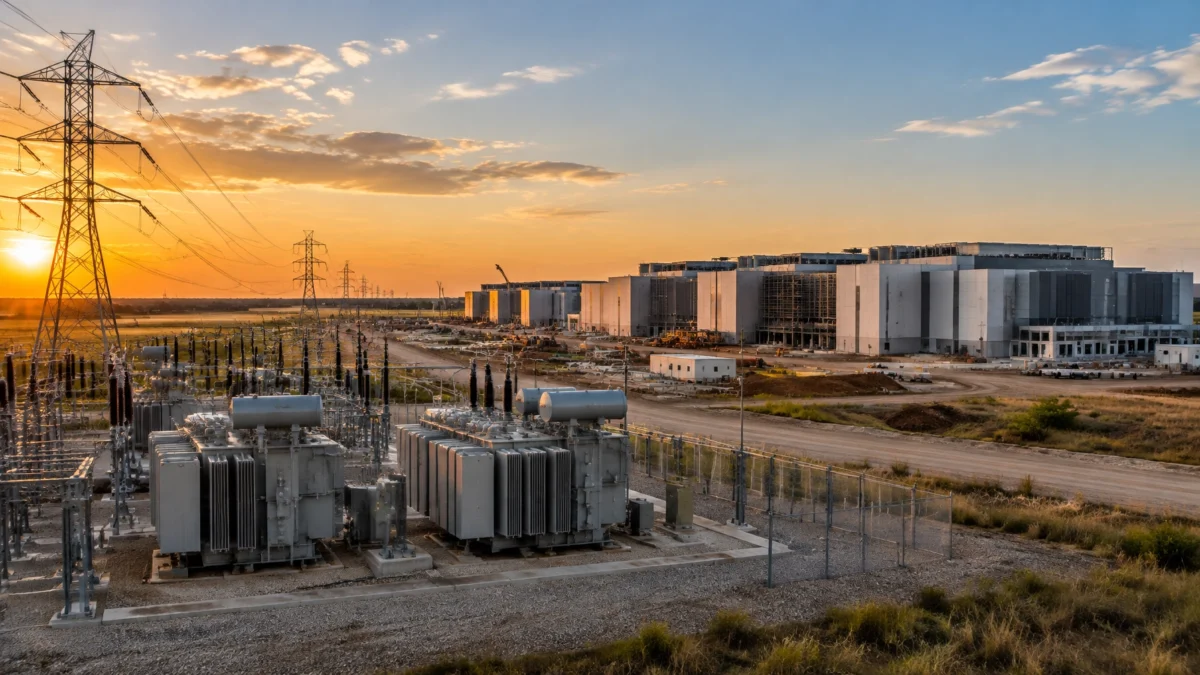
Illustrative image, not a photograph of any named facility. Established clusters can offer fiber and infrastructure advantages, while new development still depends on available transmission capacity.
What to Watch Next
The near-term picture will be shaped by three things: whether Texas continues issuing environmental permits and how the incoming administration pursues its proposed moratorium and related legislation; whether federal permitting and FERC interconnection proposals become final rules; and whether developers can secure power supply, fuel and transmission equipment on schedules that match construction plans.
The Anthropic–OnePWR arrangement highlights self-supply as one response to grid constraints, but it does not show that data center growth is leaving Texas or establish where those generators will be installed. If other states can combine reliable power, available land and water, fiber access and predictable permitting, they may capture projects seeking alternatives. If not, developers may wait, redesign, build their own supply or stage projects across more than one region. In each case, the decisive measure will be deliverable power, not simply a site announcement or a place in an interconnection queue.
Keep In Touch with Shale Magazine
As the new era of energy unfolds, you can bet we’ll be the boots on the ground to keep you informed. Subscribe to Shale Magazine for sharp insight into the arenas that matter most to your life. And don’t forget to listen to our riveting podcast, The Energy Mixx Radio Show, where our very own Kym Bolado interviews the most extraordinary thought leaders, business innovators, and industry experts of our time.