
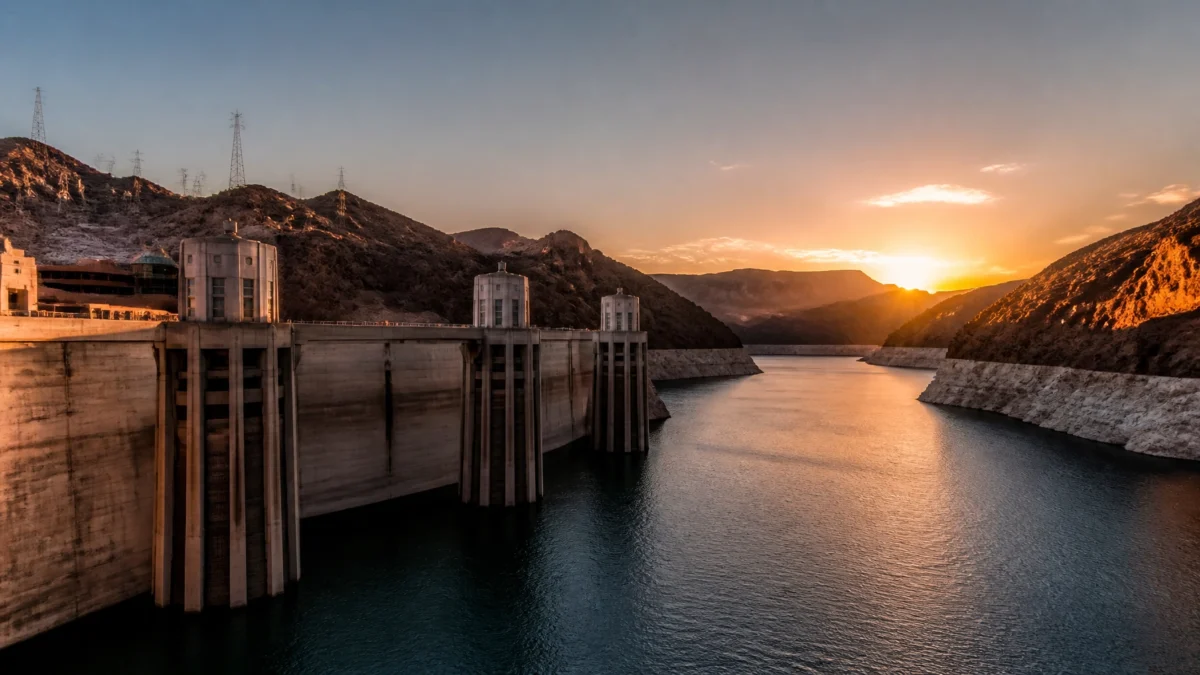
Colorado River framework cuts are officially set to reshape the economic and operational landscape of the American Southwest. On August 1, 2026, the Bureau of Reclamation within the Department of the Interior released its long-awaited Final Environmental Impact Statement (FEIS) for post-2026 Colorado River operations. Establishing a flexible 10-year adaptive decision framework running through 2036, the new federal guidelines replace the aging 2007 operational rules and introduce aggressive sideboards to protect critical water and energy infrastructure at Lake Powell and Lake Mead. Secretary of the Interior Doug Burgum championed the release, emphasizing that the federal government must balance strict hydrologic protections with operational flexibility for municipal utilities, agricultural districts, and energy producers across Arizona, California, and Nevada.
As water scarcity collides with surging power demand from industrial development and artificial intelligence data centers, understanding the mechanics of these federal reforms is vital for industry professionals. Energy Network Media Group continues to monitor how basin-wide supply constraints ripple through regional economies, affecting everything from hydroelectric generation to utility planning.
Navigating the 10-Year Colorado River Framework
The release of the FEIS marks a pivotal turning point for the seven basin states, federal regulators, and downstream agricultural stakeholders. Rather than locking in rigid, permanent reductions that fail to account for unpredictable precipitation cycles, the Department of the Interior has instituted an adaptive decision framework. Under this structure, federal regulators will issue binding operating guidelines in anticipated two-year intervals through 2036, allowing managers to calibrate rules against real-time hydrologic data.
According to Department of the Interior documentation, the Preferred Alternative establishes strict sideboards designed to prevent dead pool conditions at Hoover Dam and Glen Canyon Dam. The framework mandates that Lower Basin states: Arizona, California, and Nevada: absorb shortages of up to 3.0 million acre-feet (maf) annually during severely dry hydrologic regimes. For the 2027–2028 transition period, federal officials have provisionally incorporated a short-term proposal submitted by the Lower Basin states totaling approximately 3.2 maf in voluntary and mandatory reductions.

Secretary Doug Burgum noted in the policy rollout that the administration’s primary objective is system resilience. “The Department has a responsibility to ensure the Colorado River system remains reliable and resilient for the millions of Americans, communities, and industries that depend on it,” Burgum stated. “This framework provides the flexibility to respond to changing hydrologic conditions while preserving the opportunity for the Basin States to continue working toward durable, consensus-based solutions.”
Core Operational Mechanics and Hydrologic Sideboards
To comprehend the sheer scale of the new federal directive, analysts must examine the quantitative parameters governing water storage and river releases. The FEIS establishes clear boundaries for both upper and lower basin operations, balancing storage incentives against mandatory curtailments.
- Lake Powell Annual Releases: Annual releases from Lake Powell are bounded between 5.0 million acre-feet and 12.0 million acre-feet, depending on reservoir elevation tiers and incoming snowpack metrics.
- Lower Basin Shortage Caps: Mandatory shortages can escalate up to 3.0 maf per year in extremely dry years, with initial 2027–2028 rules following state-proposed cuts up to 1.5 maf before reverting to traditional priority-based administration if consensus fails.
- Water Conservation Storage: The framework allows agencies to store up to 8.0 maf of conserved water in Lake Powell and 3.0 maf in Lake Mead for future recovery without facing regulatory penalties.
- Upper Basin Contributions: The Upper Basin (Colorado, New Mexico, Utah, and Wyoming) faces no mandatory delivery curtailments under the primary alternative but is authorized to pursue voluntary conservation yielding roughly 200,000 acre-feet annually, subject to hydrological conditions.

These parameters provide financial and operational clarity for municipal water providers and energy planners who require predictable resource availability to manage thermal plant cooling cycles and hydroelectric capacity.
Stakeholder Reactions and Economic Repercussions
Reaction from regional stakeholders has been marked by a mixture of cautious acceptance and fierce defense of regional water rights. California’s Colorado River Board and the powerful Imperial Irrigation District (IID) have scrutinized how the federal sideboards interact with existing priority decrees and senior water rights established over a century of western expansion. Agricultural districts, which consume the vast majority of Colorado River water, face the daunting task of re-engineering irrigation efficiencies to absorb the 16% to 20% aggregate supply reductions anticipated through 2028.
Simultaneously, financial analysts and energy economists are evaluating the secondary impacts on regional power generation. Reductions in lake elevations directly constrain the generation capacity of hydropower facilities at Glen Canyon and Hoover Dams, forcing grid operators in the Western Interconnection to procure replacement energy from natural gas peaker plants and expanding renewable portfolios. This dynamic underscores the complex nexus between water management and grid reliability, a core focus of ongoing discourse within energy publishing and policy analysis.

The implementation of the Record of Decision, slated to take effect by October 1, 2026, will serve as the definitive legal blueprint as the basin enters its most regulated era in modern history. Industry leaders and institutional investors must closely track these developments to navigate upcoming regulatory shifts and resource constraints across the western energy economy.
Keep In Touch with Shale Magazine
As the new era of energy unfolds, you can bet we’ll be the boots on the ground to keep you informed. Subscribe to Shale Magazine for sharp insight into the arenas that matter most to your life. And don’t forget to listen to our riveting podcast, The Energy Mixx Radio Show, where our very own Kym Bolado interviews the most extraordinary thought leaders, business innovators, and industry experts of our time.
Subscribe to get more posts from Amanda Jenkins