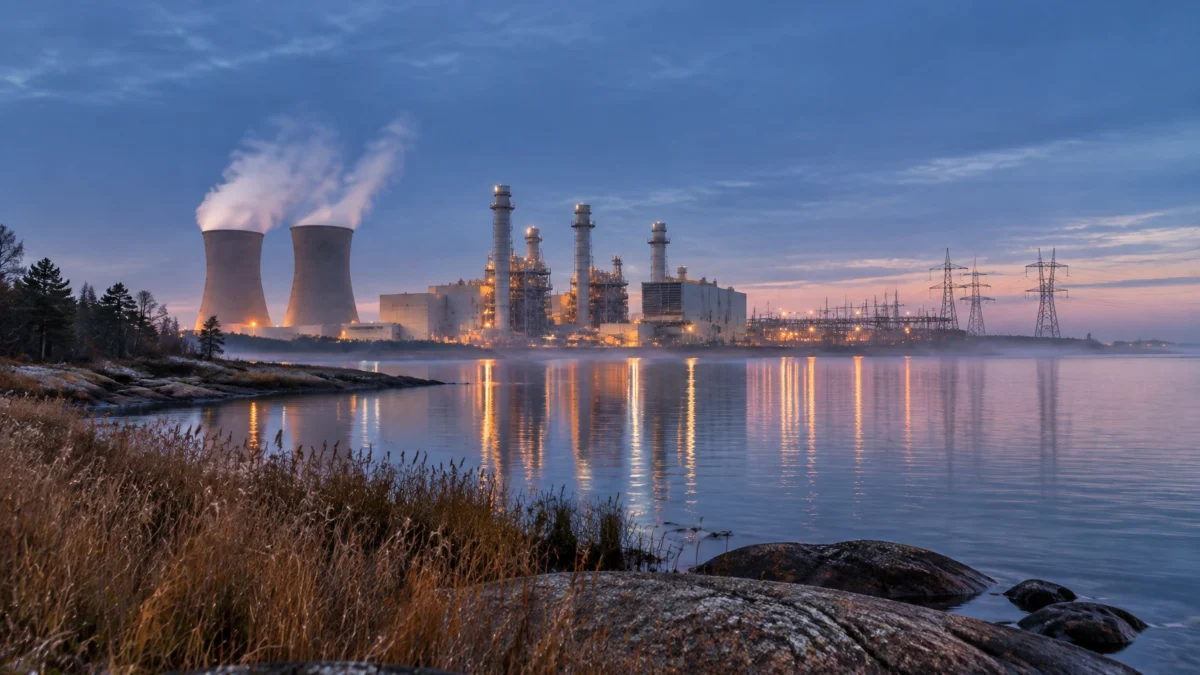
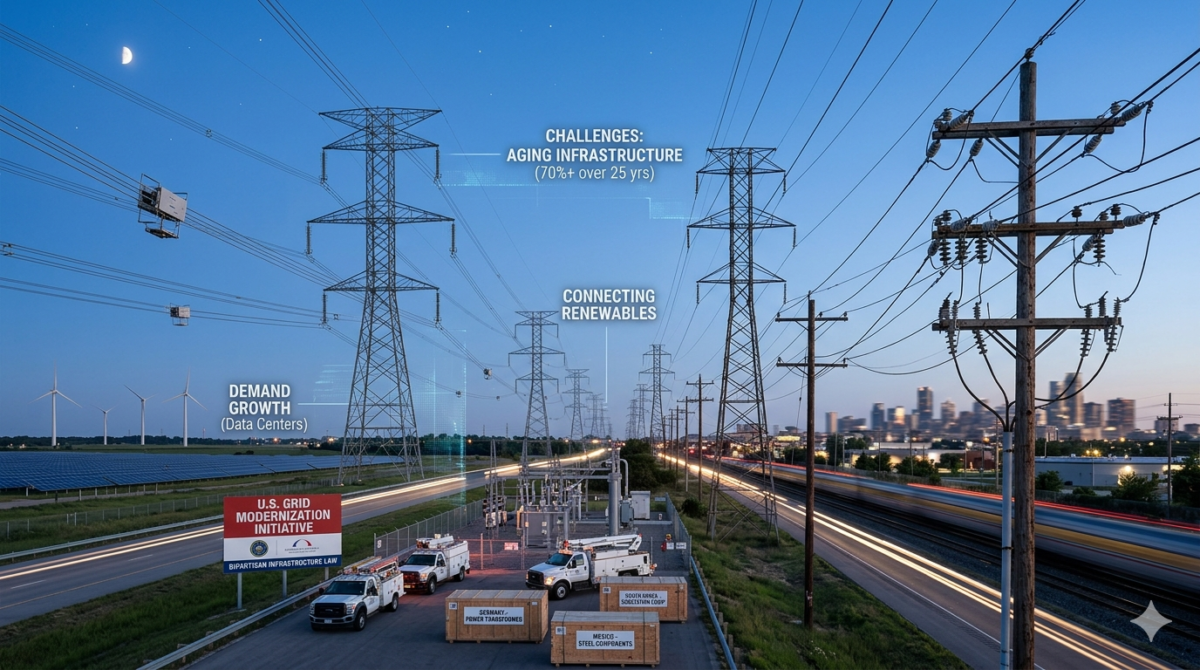
The United States needs to modernize and expand its electricity grid as power demand rises, aging equipment requires replacement and new generation projects wait years to connect.
Data centers, artificial intelligence, advanced manufacturing and broader electrification are creating large new electricity loads after nearly two decades of relatively flat national demand. At the same time, utilities must connect new natural gas, solar, wind, nuclear and energy-storage resources—often in areas without sufficient transmission capacity.
The challenge is not simply generating more electricity. The United States must also be able to move that electricity reliably from where it is produced to where it is needed.
Key Takeaways
- Much of the U.S. transmission and distribution system was constructed decades ago.
- More than 2,060 gigawatts of proposed generation and storage were actively seeking grid connections at the end of 2025.
- Data centers could consume between 6.7% and 12% of U.S. electricity by 2028, according to Lawrence Berkeley National Laboratory.
- Transmission projects face lengthy planning, permitting and cost-allocation processes.
- Equipment shortages and dependence on foreign components can delay construction.
- Advanced conductors and other grid-enhancing technologies can increase capacity on existing infrastructure.
- Grid modernization will require coordinated public and private investment—not merely additional generation.
Why Does the U.S. Electricity Grid Need Modernization?
The U.S. electricity system includes high-voltage transmission lines that move power over long distances and local distribution systems that deliver electricity to homes and businesses.
Much of this infrastructure was constructed during the major expansion of the American power system in the 1960s and 1970s. Transmission infrastructure can remain operational for decades, but age increases the need for inspection, maintenance and replacement.
A widely cited Department of Energy assessment published in 2015 found that:
- 70% of large power transformers were at least 25 years old.
- 70% of transmission lines were at least 25 years old.
- 60% of circuit breakers were at least 30 years old.
These figures should be understood as historical infrastructure benchmarks rather than a new 2026 inventory. Still, they illustrate how long much of the system has been operating.
According to the U.S. Energy Information Administration, utility spending on transmission infrastructure reached approximately $27.7 billion in 2023—nearly three times the amount spent in 2003. That investment includes replacement, expansion, reliability improvements and the connection of new power resources.
Despite higher spending, major transmission constraints remain.
Electricity Demand Is Growing Again
U.S. electricity consumption remained relatively flat between the mid-2000s and early 2020s. That trend is now changing.
The Energy Information Administration reported that electricity demand reached a record in 2024 and was expected to continue rising in 2025 and 2026. Growth is being driven by several factors:
- Artificial intelligence and data centers
- Semiconductor and battery manufacturing
- Electrification of buildings and transportation
- Population growth in high-demand regions
- Expansion of industrial facilities
- Oil and gas production, processing and export infrastructure
Data centers represent one of the largest sources of projected load growth. A 2024 Lawrence Berkeley National Laboratory report estimated that U.S. data centers could consume between 325 and 580 terawatt-hours of electricity annually by 2028. That would represent approximately 6.7% to 12% of total U.S. electricity consumption.
ENMG has examined this trend in The AI Energy Demand Surge Behind the Boom and its analysis of how AI data centers are increasing natural gas demand.
The speed and concentration of data-center development create an additional problem. A hyperscale facility can request hundreds of megawatts of power in a single location, leaving utilities with limited time to develop generation, substations and transmission capacity.
The Grid Connection Backlog Remains Enormous
New power projects generally must complete an interconnection study before connecting to the transmission system. These studies determine what equipment and network upgrades are necessary to add the project without compromising reliability.
At the end of 2025, more than 2,060 gigawatts of proposed generation and storage capacity were actively seeking interconnection, according to Lawrence Berkeley National Laboratory.
That total was lower than the nearly 2,600 gigawatts reported at the end of 2023, but it was still greater than the generating capacity of the existing U.S. power-plant fleet.
The queue includes solar, battery-storage, wind and natural-gas projects. Not every proposed project will be built; historically, many developers withdraw before completing the process. Nevertheless, the size of the queue demonstrates the demand for new grid connections.
Interconnection delays can be caused by:
- Repeated engineering studies
- Uncertainty over the cost of network upgrades
- Withdrawal of projects ahead of others in the queue
- Limited utility and regional-planning resources
- Transformer and equipment shortages
- Permitting and siting disputes
- Disagreement over who should pay for transmission improvements
Renewable projects face a particular geographic challenge because many of the country’s strongest wind and solar resources are located far from major population centers. Delivering that power requires long-distance transmission.
The problem is not exclusive to renewables. New natural-gas plants, nuclear projects, storage facilities and large industrial customers also require timely grid access.
A Fragmented System Complicates Planning
The United States does not operate one centrally managed national grid.
Instead, the system is divided among utilities, state regulators, federal agencies, regional transmission organizations, independent system operators, public power authorities and electric cooperatives. Texas also operates much of its power system separately through the Electric Reliability Council of Texas.
This structure allows states and regions to respond to local priorities, but it makes large interstate projects difficult to plan and finance.
A transmission line may benefit customers across multiple states while passing through communities that receive few direct benefits. Disagreements can therefore emerge over:
- Where a line should be constructed
- Which projects should receive priority
- How costs should be divided
- Which customers receive the benefits
- Whether state or federal authorities should approve the project
ENMG previously explored these structural limitations in U.S. Grid Modernization: Improvements Needed Imminently.
Federal Grid Policy and Investment
The Infrastructure Investment and Jobs Act—commonly called the Bipartisan Infrastructure Law—was signed in November 2021.
The law authorized major investments in transmission, resilience, smart-grid technologies and critical energy infrastructure. The Department of Energy says the law’s Building a Better Grid Initiative supported more than $20 billion in grid-modernization and expansion programs.
One of its largest programs is the $10.5 billion Grid Resilience and Innovation Partnerships program, which supports projects intended to improve grid flexibility and resilience.
The federal government has also pursued changes in long-term transmission planning. In 2024, the Federal Energy Regulatory Commission issued Order No. 1920, requiring transmission providers to conduct regional planning over a horizon of at least 20 years.
The rule directs planners to consider future electricity needs and develop methods for allocating the costs of regional transmission facilities. FERC subsequently issued Orders 1920-A and 1920-B to clarify parts of the framework and the role of state regulators.
In March 2026, the Department of Energy announced approximately $1.9 billion for its Speed to Power through Accelerated Reconductoring and Other Key Advanced Transmission Technology Upgrades, or SPARK, initiative.
ENMG covered the program in 🌳 DOE’s $1.9 Billion SPARK grid-modernization plan.
Grid-Enhancing Technologies Could Increase Existing Capacity
Not every transmission constraint requires an entirely new power-line corridor.
Advanced grid technologies can help utilities move more electricity through existing rights of way. These technologies include:
- Advanced conductors: High-performance wires capable of carrying more electricity than conventional lines
- Dynamic line ratings: Sensors and software that determine how much electricity a line can safely carry under current weather conditions
- Advanced power-flow controls: Equipment that redirects electricity away from congested lines
- Topology optimization: Software that identifies more efficient configurations for the transmission network
- Energy storage: Systems that absorb power when supply is abundant and discharge it when the grid is constrained
The Department of Energy’s Innovative Grid Deployment Liftoff report estimated that commercially available advanced grid solutions could support approximately 20 to 100 gigawatts of additional peak demand on the existing system.
These technologies can often be deployed faster than entirely new transmission corridors. However, they do not eliminate the need for new substations and power lines in rapidly growing regions.
Equipment and Supply-Chain Constraints
Modernizing the grid requires a large supply of transformers, conductors, circuit breakers, electrical steel and substation equipment.
The United States imports portions of this equipment or the materials used to manufacture it. Large power transformers may require long production lead times because they are highly specialized and must be designed for particular applications.
Supply-chain constraints may involve:
- Limited domestic transformer manufacturing
- Shortages of grain-oriented electrical steel
- Competition for copper and aluminum
- Tariffs and trade restrictions
- Transportation challenges for oversized equipment
- A shortage of skilled engineers and electrical workers
Building more domestic manufacturing capacity could reduce some exposure to international disruptions. However, expanding factories and training workers takes time, making supply-chain planning an essential part of grid policy.
Reliability and Extreme Weather
Utilities must also strengthen the grid against extreme weather and physical threats.
Hurricanes, wildfires, floods, winter storms and heat waves can damage electrical equipment or produce unusually high demand. Wildfire risks may force utilities to shut off power lines, while high temperatures can reduce transmission capacity as conductors heat and sag.
Grid-resilience investments may include:
- Undergrounding selected distribution lines
- Elevating substations in flood-prone areas
- Replacing vulnerable wooden poles
- Installing fire-resistant equipment
- Creating microgrids for critical facilities
- Improving vegetation management
- Deploying sensors for faster outage detection
- Strengthening cybersecurity and physical security
A resilient grid does not mean preventing every outage. It means reducing the likelihood, geographic reach and duration of disruptions.
Could Data Centers Generate Their Own Power?
Grid delays are prompting some data-center developers to consider on-site generation.
Natural gas turbines, fuel cells, batteries and microgrids can allow facilities to begin operating before a full utility connection becomes available. These systems may also provide backup power or participate in demand-response programs.
However, self-generation brings its own complications, including fuel availability, emissions permits, equipment lead times and the management of rapidly changing computing loads.
ENMG examines these challenges in On-Site Gas Generation for AI Data Centers and its report on flexible interconnection for AI facilities.
On-site power can relieve certain local constraints, but it is not a substitute for a reliable regional transmission system.
What Must Happen Next?
Accelerating U.S. grid modernization will require action across several areas:
- Long-term regional planning: Utilities and regulators must anticipate future load rather than wait for individual connection requests.
- Faster permitting: Agencies should establish predictable review timelines without eliminating necessary safety, environmental or landowner protections.
- Clear cost allocation: States, utilities and customers need workable methods for sharing the cost of regional projects.
- Technology deployment: Utilities should evaluate advanced conductors, dynamic line ratings and power-flow controls before assuming new corridors are the only option.
- Domestic manufacturing: The United States needs greater capacity to produce transformers, electrical steel and other critical equipment.
- Interconnection reform: Grid operators must process requests more efficiently and remove speculative projects from queues.
- Public-private investment: Federal funding alone cannot cover the scale of required development.
- Resource-neutral planning: Transmission policy must account for natural gas, nuclear, renewables, storage and emerging technologies instead of assuming one resource will meet every need.
The Bottom Line
The United States does not lack potential energy resources. It lacks sufficient infrastructure to connect, transport and manage all of them at the speed now required.
Aging equipment, growing electricity demand, large interconnection queues and supply-chain constraints are converging. Data centers and advanced manufacturing have made grid modernization an economic and national-competitiveness issue—not simply a renewable-energy issue.
Federal programs and private investment are increasing, but financing alone will not resolve the problem. Transmission planning, permitting, cost allocation, equipment production and utility coordination must move together.
The United States can build more power plants. Whether it can connect them quickly enough is the far more expensive question.
Frequently Asked Questions
Why does the U.S. grid need modernization?
Much of the grid is decades old, while electricity demand and requests for new connections are rising. Modernization can improve capacity, reliability, resilience and the integration of new power sources.
How much power capacity is waiting to connect?
At the end of 2025, more than 2,060 gigawatts of proposed generation and storage were actively seeking interconnection. Many of those projects will not ultimately be built.
Are renewable projects the only resources waiting for grid connections?
No. The interconnection queue includes solar, wind, battery storage and natural-gas projects, among other resources.
How much electricity could U.S. data centers consume?
Lawrence Berkeley National Laboratory estimated that data centers could consume between 325 and 580 terawatt-hours annually by 2028—approximately 6.7% to 12% of U.S. electricity consumption.
What are grid-enhancing technologies?
They are technologies such as advanced conductors, dynamic line ratings and power-flow controls that can increase the capacity or efficiency of existing transmission infrastructure.
Who operates the U.S. electricity grid?
The grid is operated by a combination of investor-owned utilities, public utilities, cooperatives, regional transmission organizations and independent system operators under state and federal oversight.
Keep In Touch with Shale Magazine
As the new era of energy unfolds, you can bet we’ll be the boots on the ground to keep you informed. Subscribe to Shale Magazine for sharp insight into the arenas that matter most to your life. And don’t forget to listen to our riveting podcast, The Energy Mixx Radio Show, where our very own Kym Bolado interviews the most extraordinary thought leaders, business innovators, and industry experts of our time.
Subscribe to get more posts from Felicity Bradstock