

How war, AI, and a renewed focus on energy security are reshaping the global energy system
For most of my career, the closure of the Strait of Hormuz was one of those scenarios that people in the energy business discussed but nobody had ever experienced. I have sometimes called it Iran’s “nuclear option,” not because nuclear weapons were involved, but because closing the Strait represented such a consequential escalation and global disruption that Iran would risk triggering a much larger war.
Analysts modeled a closure. Governments planned for it. Energy companies incorporated it into risk assessments. Iran periodically threatened it, and oil prices sometimes reacted. But through decades of conflict and tension in the region, commercial traffic continued to move through the Strait.
That changed this year. After the United States and Israel launched strikes against Iran on February 28, tanker traffic through Hormuz collapsed. The result was what the International Energy Agency has called the largest supply disruption in the history of the global oil market. In 2025, nearly 20 million barrels per day of crude oil and petroleum products had moved through the Strait, including almost 15 million barrels per day of crude oil. That represented about a quarter of global seaborne oil trade and roughly a third of seaborne crude trade. The disruption was so severe that the International Energy Agency coordinated a 400-million-barrel emergency stock release, the largest in its history.
Nearly six months later, one aspect of this crisis has surprised me. I would have expected a disruption of this magnitude and duration to leave benchmark oil prices much closer to $150 a barrel. Some physical crude grades did briefly approach that level in April as refiners scrambled for replacement barrels, but those prices didn’t persist. As I write this on August 14, Brent remains below $90 even as tanker traffic remains severely restricted and negotiations between Washington and Tehran are again stalled.
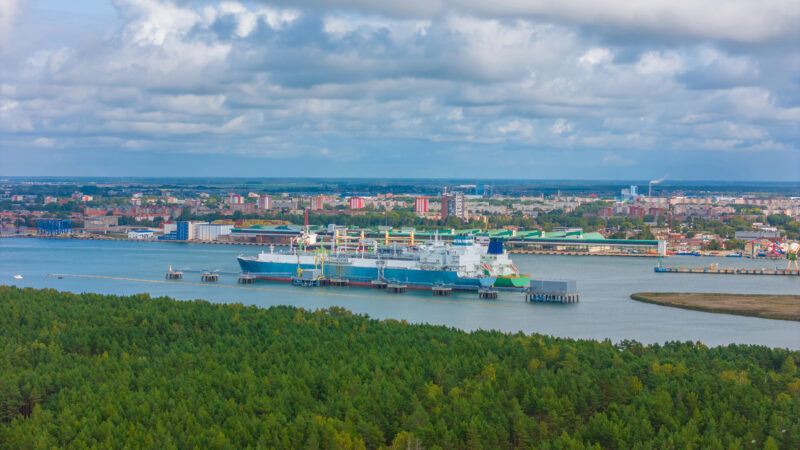
That doesn’t mean the disruption has been less serious than expected. It means the global energy system has adjusted better than I would have anticipated. IEA countries released emergency stocks. Saudi Arabia and the United Arab Emirates pushed more oil through alternate routes. Producers in the Americas increased their contribution. Refiners changed crude slates and reduced runs when they couldn’t get feedstock. High prices also suppressed demand. Inventories absorbed a substantial part of the shock. The IEA now estimates that observed global oil inventories have fallen by 410 million barrels since the war began.
China has been especially important. It entered the crisis after building substantial inventories during 2025, when oil was cheaper. In the second quarter of this year, Chinese crude imports fell to 8.1 million barrels per day, down 32% from the first quarter. EIA specifically noted that the reduction in Chinese imports softened the upward price pressure caused by the loss of Gulf supply. China’s refineries reduced throughput by less than imports declined, which indicates that inventories were being drawn to make up part of the difference. The IEA estimated that Chinese crude stocks fell by 41 million barrels in June and reported continued draws in July.
There is a reasonable argument that China’s response has done as much as that of any major importing country to keep benchmark oil prices from remaining near $150. But there is an important caveat. Drawing inventories doesn’t create new oil. It uses a buffer accumulated earlier. The same is true of the emergency stocks released by the United States, Europe, and other IEA members. The system has managed the crisis remarkably well, but part of the way it has managed is by consuming its insurance policy.

That observation gets to what I think is the larger story. The conflict in the Persian Gulf isn’t an isolated energy event, any more than Russia’s invasion of Ukraine was. The redirection of Russian oil toward Asia, Europe’s rapid shift toward LNG, China’s effort to build energy options, India’s growing importance in world oil markets, the shale-driven change in America’s energy position, and the huge new electricity requirements associated with artificial intelligence all point in the same general direction.
This is not an energy transition in the conventional sense of one fuel replacing another. It is a realignment in how countries think about energy. Cost and efficiency remain key factors, but resilience, security, infrastructure, and the ability to maintain supply when normal conditions disappear have moved much higher on the list of priorities.
Geography Still Matters
One of the clearest lessons from Hormuz is an old one. Technology has not repealed geography.
Oil still has to move through pipelines and on tankers. Natural gas has to travel through pipelines or be liquefied, shipped, and regasified. Electricity has to move across transmission systems. We may live in an age of satellites and artificial intelligence, but the global economy continues to depend on physical infrastructure that can be disrupted by geography, politics, weather, and war.
The Strait of Hormuz illustrates the problem. Commercial traffic is funneled into shipping lanes only two miles wide in each direction, separated by a two-mile buffer. Saudi Arabia and the UAE have pipelines that can bypass the Strait, but the IEA estimates that only about 3.5 million to 5.5 million barrels per day of alternative pipeline capacity is available. Against normal Hormuz flows of nearly 20 million barrels per day, that is nowhere close to a complete substitute.
Oil is only part of the exposure. More than 110 billion cubic meters of LNG passed through Hormuz in 2025, representing almost one-fifth of global LNG trade. About 93% of Qatar’s and 96% of the UAE’s LNG exports moved through the Strait, and unlike crude oil, there are no alternative pipeline routes to bring those volumes to market. Nearly 90% of the LNG shipped through Hormuz was destined for Asia, where it accounted for more than a quarter of the region’s LNG imports.
The chokepoint also reaches beyond energy. More than 30% of global urea trade, about 20% of ammonia and phosphate trade, and roughly half of global seaborne sulfur trade move through Hormuz. Those materials feed fertilizer production, agriculture, chemicals, refining, and metal processing, which is why a prolonged disruption can propagate into food and industrial markets far from the Persian Gulf.
The direct U.S. exposure is much smaller than it once would have been. Only 8% of U.S. crude imports came from Middle East Gulf countries in 2025. But California is a notable exception and appears to be the U.S. state with the greatest direct exposure to a Hormuz disruption. California refineries obtained 61% of their crude from foreign sources last year. Iraq supplied 17.5% of California’s foreign crude, Saudi Arabia another 7.9%, and the UAE 3.4%. Federal data show that the West Coast accounted for 47% of all U.S. crude imports from the Middle East Gulf, with almost all that volume coming from those same three countries.
That geographic exposure also illustrates why redundancy can look wasteful right up until it becomes valuable. Spare pipeline capacity costs money. Maintaining inventories costs money. A second supplier may cost more than the cheapest supplier. Excess generating capacity can depress returns during normal conditions. Yet all those things become valuable when the cheapest route, supplier, or piece of infrastructure suddenly isn’t available.
I spent a significant part of my career doing risk assessments, and this tradeoff is familiar. The most efficient system under normal conditions isn’t necessarily the most resilient system under abnormal ones. Optimizing entirely for the first can leave you dangerously exposed to the second.
Europe learned that lesson after Russia invaded Ukraine.
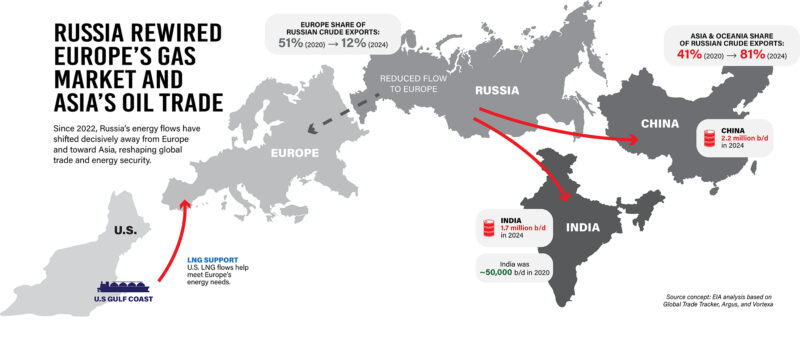
Russia Rewired Europe’s Gas Market and Asia’s Oil Trade
Before February 2022, Russia and Europe had spent decades building one of the largest energy relationships in the world. Europe received enormous quantities of relatively inexpensive Russian natural gas through pipelines, while Russia gained a large, reliable market close to home.
The invasion of Ukraine upended that arrangement. Russia supplied about 45% of EU gas imports in 2021. By 2025, that share had fallen to around 12%, and the European Union has now adopted a timetable intended to phase out the remaining Russian gas imports by the end of 2027.
American LNG was central to making that possible, and I think that point is sometimes understated. Europe also reduced gas consumption, expanded renewable generation, increased pipeline imports from Norway and other suppliers, filled storage aggressively, and constructed new LNG import capacity. There was no single replacement for Russian gas. But U.S. LNG became one of the pillars of the new European supply system.
In 2025, Europe imported a record 10.3 billion cubic feet per day of U.S. LNG, up from 6.3 Bcf/d the previous year. Europe took 68% of all U.S. LNG exports. By the first quarter of 2026, the United States supplied 57.4% of the European Union’s LNG imports, up from just 24% at the beginning of 2021. That is a remarkable shift in only five years, and one that would have been impossible without the enormous buildout of U.S. shale gas production and LNG export capacity.
Russian oil followed a different path. Sanctions and European restrictions changed where the barrels went, but they did not remove most of those barrels from the global market. China remained a major Russian customer, while India went from importing about 50,000 barrels per day of Russian crude and condensate in 2020 to roughly 1.7 million barrels per day in 2024.
That is an important distinction when thinking about sanctions and energy security. Sanctions can change prices, buyers, shipping routes, financing, insurance, and the profitability of production. They can impose significant costs. But when the world still needs more than 100 million barrels of oil every day, large volumes tend to find another route to market if one exists.
Europe’s gas system and Russia’s oil trade therefore tell different versions of the same story. Political decisions can radically reshape energy flows, but physical supply and demand continue to exert enormous pressure on where those flows ultimately go.
China and India Are Building Options
China is another country whose energy strategy can look contradictory if viewed through the usual political categories.
It is the world’s largest importer of crude oil and the largest consumer of coal. At the same time, no country builds more solar or wind power. China is expanding nuclear power rapidly, has invested heavily in batteries and electric vehicles, and imports natural gas through both pipelines and LNG terminals.
That combination makes more sense if you view it through the lens of energy security rather than asking whether China is choosing fossil fuels or clean energy. China is trying to reduce its exposure to any single fuel, supplier, or transportation route.
Domestic coal offers a large supply that can’t be cut off by a foreign navy. Solar, wind, and nuclear power reduce the amount of imported fuel needed to generate electricity. Pipelines from Russia and Central Asia provide alternatives to maritime gas imports. Electrification of transportation can reduce future oil-import requirements. Strategic petroleum inventories provide another layer of protection.
China spent much of 2025 adding to those crude inventories while prices were relatively low. EIA estimated that Chinese crude stocks increased by about 900,000 barrels per day during the first eight months of 2025, and the IEA later estimated that China added 111 million barrels over the full year. When Hormuz became severely constrained, China had a substantial buffer to draw upon.
India faces a different set of circumstances. It imports close to 90% of the crude oil it consumes, so it cannot reproduce China’s domestic energy base. Instead, it has diversified suppliers and built one of the world’s largest refining industries. Indian refiners buy crude from Russia, the Middle East, the United States, and numerous other producers, then export substantial quantities of refined products.
I view that as deliberate strategic diversification. A country whose energy demand is likely to grow enormously over the coming decades has a powerful incentive not to become dependent on a single supplier or political bloc. India has increasingly used its size as a buyer and refiner to give itself more choices.
That concept of choice, or optionality, is becoming one of the defining characteristics of energy security.
America’s Energy Position Has Changed
The United States is in a dramatically different position than it was the last time the world experienced this kind of prolonged Middle East energy shock.
The 1973 Arab oil embargo arrived when domestic oil production was declining and imports were rising. The consequences included gasoline lines, price controls, rationing schemes, and a national fixation on “energy independence” that lasted for decades. By 2005, U.S. net petroleum imports were equal to about 60% of domestic liquid-fuel consumption.
Then the shale revolution changed the balance.
U.S. crude oil production reached a record 13.6 million barrels per day in 2025, and the EIA currently forecasts another record of 13.8 million barrels per day this year. Natural gas production also reached a record last year, and the United States is now the world’s largest LNG exporter. U.S. LNG exports averaged 15.1 Bcf/d in 2025 and are forecast to reach 17.4 Bcf/d this year.
I have often been cautious about the phrase “energy independence,” because it is frequently used to imply something that isn’t true: that the United States no longer depends on international energy trade or global energy markets. We absolutely do. We remain a net importer of crude oil, and a disruption in the Persian Gulf can still raise gasoline and diesel prices in Phoenix, Houston, or New York because oil prices are set in a global market.
But there is another definition of energy independence under which the United States now clearly qualifies. In 2025, the country produced about 107 quadrillion Btu of energy and consumed about 96 quadrillion Btu. U.S. energy production has exceeded consumption since 2019. In aggregate energy terms, we now produce more than enough energy to cover what we consume. That change from net energy importer to net energy exporter was largely driven by the growing volume of oil and gas produced by the shale boom that began about 20 years ago.
That doesn’t mean we could sever international energy trade tomorrow without significant disruption or cost. Different forms of energy are not easily interchangeable, and neither are different grades of crude oil. Much of U.S. shale production is relatively light and sweet, while many American refineries were designed to process heavier, more sour crude. It can therefore make economic sense to export light U.S. crude while importing heavier barrels from Canada, Mexico, Venezuela, and the Middle East. EIA notes that light sweet grades dominate domestic production while the United States continues to rely on imports for heavier and more sour grades.
The sharp return of Venezuelan crude to U.S. refineries this year reinforces that point. Venezuelan shipments to the United States reached roughly 786,000 barrels per day in July, the highest level since early 2019. That isn’t evidence that America suddenly lacks oil. It reflects the fact that Venezuelan heavy crude is well suited to a portion of the U.S. refining system.
So, I would describe the United States today as energy independent in an aggregate production-versus-consumption sense, but certainly not isolated from global energy trade. In fact, trade is one of our strengths. We can export crude oil, LNG, refined products, and other forms of energy while importing the specific grades and products that make the most economic sense for our infrastructure.
The difference from the 1970s is profound. A Middle East supply shock still hurts American consumers, but the United States now responds from the position of the world’s largest oil and natural gas producer and largest LNG exporter rather than as an increasingly import-dependent producer in decline.
AI Is Making Electricity Strategic
While geopolitics is reminding the world of the importance of oil and natural gas, artificial intelligence is creating a very different energy challenge.
U.S. electricity demand barely grew for many years. Improvements in efficiency offset much of the growth in population and economic activity, and an entire generation of utility planning evolved around relatively modest load growth. That period is ending. U.S. electricity generation set another record in 2025, rising 2.8% from the previous year, and data centers are becoming an increasingly important source of new demand.
The International Energy Agency estimates that global data-center electricity consumption will rise from about 485 terawatt-hours in 2025 to roughly 950 TWh in 2030. In the United States, data centers are expected to account for nearly half of the growth in electricity demand through the end of the decade.
This is bringing the technology and energy industries together in ways we haven’t seen before. Technology companies are signing long-term power contracts, supporting nuclear restarts and new reactor projects, contracting for renewable electricity and storage, and exploring dedicated natural gas generation because electricity availability increasingly determines where and how quickly they can expand.
That doesn’t point toward a single winning fuel. The IEA expects renewables to supply nearly half of the additional electricity needed for data centers over the next several years, with natural gas and coal also contributing and nuclear becoming more important later in the decade.
That mix makes sense when you consider what a large data center actually needs. Solar can be added relatively quickly and at large scale, but its output varies by time of day and weather. Natural gas can provide flexible, dependable generation, but turbines and pipeline capacity have become constraints. Nuclear can provide large quantities of reliable, carbon-free power but takes much longer to license and build. Batteries can shift electricity and help balance variable sources, but they must first be charged by some other source.
The challenge isn’t choosing one of these technologies. It is putting enough of them together, along with the transmission, transformers, substations, pipelines, and other infrastructure required to deliver reliable power.
We are already seeing regulatory and political pushback when the pace of data-center development runs ahead of the infrastructure needed to support it. On August 3, Texas paused new data-center development while the state gathers more information on projects already under review. EIA responded by reducing its forecast for Texas electricity-load growth in 2027 from 14% to 6%.
That doesn’t mean the underlying AI demand has disappeared. It means projected electricity demand and demand that can actually be connected to the grid on schedule are two different things.
What American Energy Taught Me About the Present
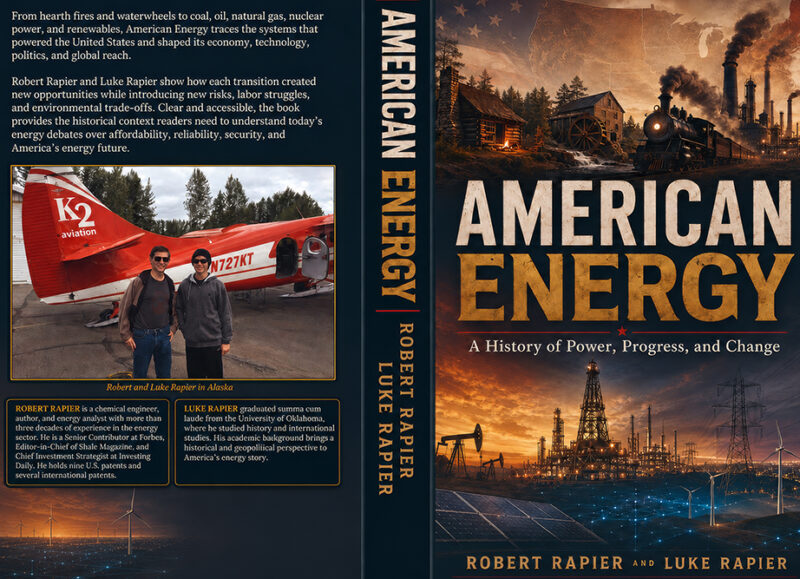
This historical context is particularly relevant to me because this year my son Luke and I published American Energy: A History of Power, Progress, and Change. I had wanted for years to write a book tracing the development of energy in America, from wood and water power through coal, oil, natural gas, nuclear energy, and today’s renewable technologies. I approached the subject through engineering, markets, resources, and infrastructure; Luke, who studied history and international studies, brought a historian’s focus on timing, institutions, politics, communities, and national power.
Looking across more than two centuries of American energy history through both lenses reinforced something I have believed for a long time: energy transitions appear much cleaner when viewed backward than they do while you are living through them. The shorthand version of history makes it sound as though wood gave way to coal, coal to oil, and then new technologies successively displaced what came before. The actual history is much messier.
New energy sources usually grew alongside existing ones for long periods. Coal did not disappear when oil became dominant in transportation. Oil did not disappear when natural gas expanded. Nuclear power did not eliminate coal or natural gas, and the explosive growth of wind and solar has not caused global fossil-fuel consumption to collapse. Total energy demand often grew fast enough for old and new sources to expand simultaneously.
We are seeing that pattern again. Solar and wind continue to expand, nuclear energy is receiving renewed investment, natural gas demand is benefiting from LNG growth and rising electricity needs, and global oil consumption remains enormous. AI is now layering another electricity-intensive industry on top of all of them. From that historical perspective, the present looks less contradictory. Energy systems tend to accumulate new sources long before older ones disappear.
That lesson from American Energy shapes how I view the current realignment. I don’t expect the next phase of the global energy system to be defined by a single dominant new resource. I expect successful countries to combine multiple resources, technologies, suppliers, and delivery systems while reducing their exposure to any one point of failure.
The Constraint Is Increasingly Our Ability to Build
The United States enters this period with considerable advantages. We have enormous oil and natural gas resources, some of the world’s best renewable-energy resources, an existing nuclear fleet, extensive energy infrastructure, deep capital markets, strong technology companies, and a large base of technical expertise.
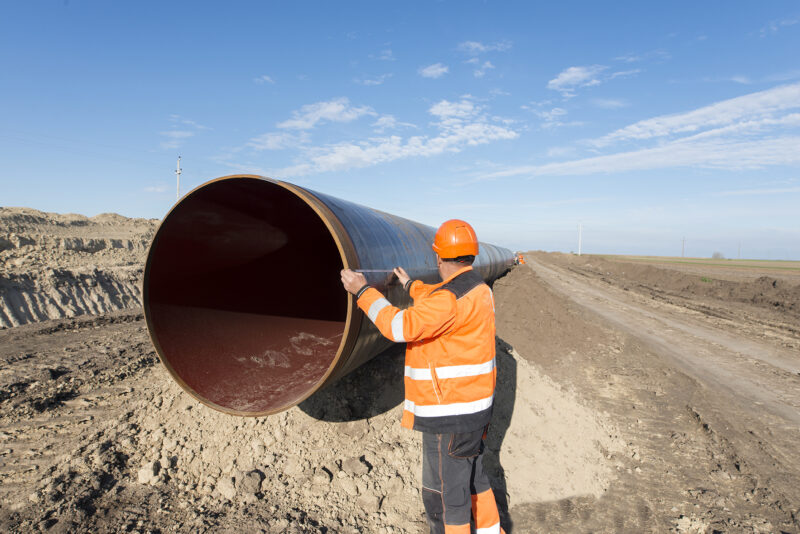
Increasingly, however, the question isn’t whether the underlying energy resource exists. It is whether we can turn that resource into useful energy and deliver it where it is needed quickly enough.
A natural gas field doesn’t power a data center without pipelines, turbines, transmission lines, substations, and an interconnection. A solar project that spends years in an interconnection queue cannot meet a customer’s near-term electricity needs. A promising new nuclear design contributes nothing until it is licensed, financed, manufactured, and constructed. Oil reserves in Venezuela don’t help a refinery if production equipment, pipelines, ports, skilled workers, and a stable investment framework aren’t in place.
The same principle applies internationally. The Persian Gulf has not run out of oil. The problem is getting that oil through a contested shipping route. Russia has not run out of petroleum. The challenge is moving it through a trading system constrained by sanctions, financing, insurance, and changing political relationships. Europe did not replace Russian gas by discovering a giant new gas field under Germany. It built LNG import capacity, attracted cargoes from the United States and elsewhere, expanded alternative supplies, reduced demand, and paid for a more diverse system.
The Iran crisis has also demonstrated that resilience works, but not without cost. The global oil market entered the war with unusually large inventories and significant excess supply. Since then, hundreds of millions of barrels have been drawn from storage, emergency reserves have been tapped, shipping patterns have been rearranged, refiners have cut output, and consumers have responded to higher prices. That flexibility is a major reason benchmark crude is still below $100. But inventories aren’t infinite, and infrastructure can’t always be improvised during a crisis.
For the United States, I think the defining energy question of the next decade may be less about what resources we possess than how quickly we can build. The shale revolution demonstrated what American technology and capital could accomplish when they were applied to an enormous resource base. The next challenge involves power plants, pipelines, transmission, transformers, LNG facilities, nuclear projects, storage, manufacturing capacity, and the skilled workforce needed to construct and operate all of it.
That shift changes where strategic value sits. When resources are available but deliverability is scarce, existing transmission corridors, firm pipeline capacity, grid interconnections, transformers, turbines, operating nuclear assets, storage, and other infrastructure become more valuable. So do the less visible capabilities such as permitting, engineering, construction, manufacturing, and skilled labor that determine whether a project can move from announcement to operation. This is not an argument for one winning fuel. It is an argument for the infrastructure that can turn a diverse resource base into dependable supply.
The risk shifts with it. If utilities and developers build for projected AI loads that arrive late or never materialize, someone can be left paying for underused infrastructure. That is why large customers are increasingly being asked to make long-term commitments, post collateral, accept minimum-demand provisions, or contribute directly to infrastructure costs. The next phase of the buildout will be shaped not only by how much electricity data centers say they want, but by how much of that demand is firm enough to finance.
What the Realignment Means
When I connect these developments, I don’t see a world in which oil is about to disappear or one in which fossil fuels are destined to crowd out every alternative. Neither interpretation fits what is happening.
Russia’s invasion of Ukraine changed the direction of major oil and gas flows. Europe traded heavy dependence on Russian pipelines for a more diversified and more expensive supply system in which American LNG is central. China has built across nearly every major energy source while accumulating inventories and alternative supply routes. India has diversified suppliers and used its refining scale to expand its choices. The United States now produces more total energy than it consumes while remaining deeply integrated into world energy trade. Hormuz has reminded everyone that geography can still disrupt all of it.
At the same time, AI is turning electricity supply into a constraint on technological growth. Utilities, regulators, technology companies, and governments now must think about electricity not simply as a mature utility service, but as infrastructure supporting national competitiveness.
Those developments share a common theme. Energy security increasingly depends on having options: multiple sources, multiple suppliers, multiple transportation routes, sufficient inventories, adequate infrastructure, and enough flexibility to continue functioning when one part of the system fails.
None of that makes efficiency irrelevant. Redundancy is expensive, and somebody ultimately has to pay for it. Depending on the project, that may be consumers, taxpayers, investors, or the large customer driving the need. Building too much infrastructure can be just as costly as building too little. The challenge is determining how much resilience is worth paying for before the next disruption occurs.
The past six months have made me more optimistic about the resilience of the global energy system than I was when this crisis began. If someone had told me in February that flows through Hormuz would remain severely impaired into August, I would have expected sustained oil prices considerably higher than what we are seeing today. The market adapted through inventories, alternative routes, changing trade flows, increased supply from elsewhere, and lower demand.
But the fact that the system has managed doesn’t mean the underlying vulnerabilities have disappeared. Much of the cushion that allowed the world to absorb the shock is being depleted. The infrastructure bottlenecks exposed by AI are becoming more obvious. And the geopolitical relationships that once allowed energy to flow primarily according to economics are increasingly being shaped by national security.
That is what I mean by the Great Energy Realignment. It isn’t a prediction that one fuel or technology will dominate the next era. It is a shift toward a world in which resilience, optionality, infrastructure, and the ability to deliver energy under stress carry more strategic value than they did a decade ago.
The United States is unusually well positioned for that world. Whether we capitalize on that position will depend not only on the resources beneath our feet, but on whether we can build the systems needed to put them, and all of our other energy options, to work.
Related Great Energy Realignment Coverage
Oil Chokepoint Problem Worsens in the Middle East
Oil Chokepoints: Hormuz, Saudi Arabia and the Red Sea
Keep In Touch with Shale Magazine
As the new era of energy unfolds, you can bet we’ll be the boots on the ground to keep you informed. Subscribe to Shale Magazine for sharp insight into the arenas that matter most to your life. And don’t forget to listen to our riveting podcast, The Energy Mixx Radio Show, where our very own Kym Bolado interviews the most extraordinary thought leaders, business innovators, and industry experts of our time.
Subscribe to get more posts from Robert Rapier