
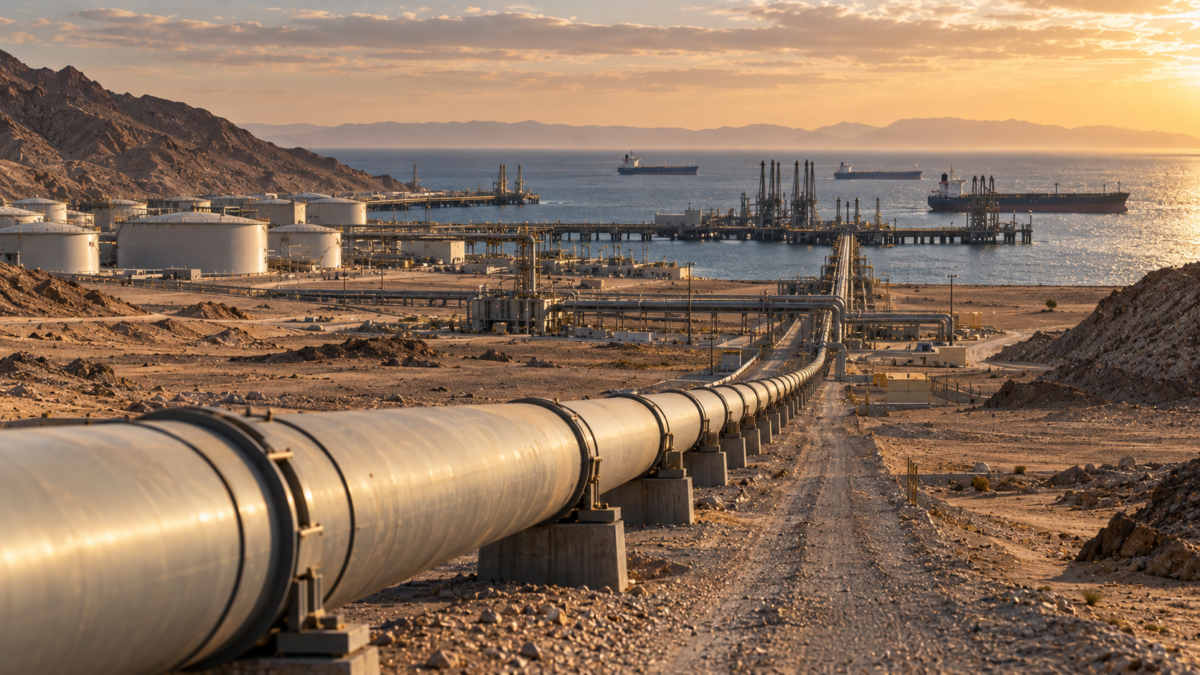
The World’s Oil Escape Routes Are Running Out
An update to The Great Energy Realignment: New pressure on the Strait of Hormuz, Saudi Arabia’s East-West Pipeline and Bab el-Mandeb is revealing how vulnerable the infrastructure moving the world’s energy has become.
When we examined The Great Energy Realignment, one of the central questions was how rapidly changing geopolitics, energy demand and infrastructure are reshaping the way the world produces, transports and consumes energy.
The latest developments in the Middle East add another dimension to that realignment.
It is no longer enough to ask who has the oil. We also have to ask whether that oil can reach the market.
For decades, the Strait of Hormuz has represented one of the most obvious vulnerabilities in the global energy system. The narrow waterway separating Iran from Oman has historically carried roughly one-fifth of the world’s petroleum liquids.
But today’s disruption is exposing something larger.
The alternatives have vulnerabilities of their own.
Saudi Arabia’s East-West Pipeline provides the kingdom with an essential alternative to Hormuz. The system carries crude from Saudi Arabia’s eastern producing region across the Arabian Peninsula to Yanbu on the Red Sea.
That redundancy becomes particularly important when the Persian Gulf route is constrained.
But when the alternative itself comes under pressure, the calculation changes.
Recent attacks affecting the East-West Pipeline have demonstrated why energy security cannot be measured simply by reserves or production capacity. A producer can have enormous quantities of oil underground and still face difficulty supplying customers if the infrastructure required to transport that oil is impaired.
And reaching the Red Sea does not eliminate the geographic risk.
At the southern entrance to the Red Sea lies another critical corridor: Bab el-Mandeb.
The result is an increasingly uncomfortable reality for global oil markets.
The world isn’t dealing with a single oil chokepoint. It is dealing with a chain of them.
Hormuz Was Supposed to Be the Problem
Under normal conditions, the Strait of Hormuz carries an extraordinary concentration of global energy trade.
EIA data show that oil flows through Hormuz averaged approximately 20.9 million barrels per day during the first half of 2025—about 20% of global petroleum liquids consumption.
Saudi Arabia and the United Arab Emirates have pipeline systems capable of bypassing the strait, but the combined bypass capacity represents only a fraction of the oil normally moving through Hormuz.
That makes Saudi Arabia’s East-West Pipeline particularly important.
The pipeline moves crude westward across Saudi Arabia to Yanbu, allowing those barrels to reach the Red Sea without traveling through Hormuz.
During normal conditions, that infrastructure provides valuable redundancy.
During a major disruption, it becomes something more: an essential escape route.
And that is precisely why pressure on the East-West Pipeline matters so much now.
Backup infrastructure becomes most valuable when the primary system fails. If the backup becomes constrained at the same time, the world’s margin for error begins shrinking quickly.
Geography Is Becoming an Energy Asset
This is one of the larger lessons emerging from The Great Energy Realignment.
Energy security has traditionally been discussed in terms of reserves and production.
Which countries have the oil?
Which countries have natural gas?
How much can they produce?
Those questions remain critical, but the current situation demonstrates why another set of questions deserves equal attention.
Where are the pipelines?
Where are the export terminals?
Which waterways must tankers cross?
And how many alternatives remain when one of those routes becomes unavailable?
Saudi Arabia illustrates the issue particularly well.
The kingdom possesses tremendous petroleum resources. But oil underground cannot satisfy global demand until it is produced, transported, loaded onto a vessel and ultimately delivered to a refinery or customer.
Having the resource is one form of energy security. Having multiple reliable ways to move it is another.
The Second Chokepoint
Moving crude to Yanbu solves the Hormuz problem, but it doesn’t necessarily solve the transportation problem.
Tankers leaving the Red Sea for many Asian destinations generally must travel through Bab el-Mandeb, the narrow passage between Yemen and the Horn of Africa.
That means oil diverted away from one strategically vulnerable waterway can eventually encounter another.
And a complete closure isn’t required to create economic consequences.
Security threats can increase marine insurance costs. Ships can be diverted. Voyages around Africa can become longer. Additional travel time consumes tanker capacity and raises transportation costs.
All of those effects can eventually become part of the price consumers pay for energy.
The global oil system is therefore testing its redundancy in real time.
What It Means for Oil Prices
This is where an international geopolitical story becomes an economic story.
Oil prices don’t reflect only the number of barrels available underground. Markets also price the risk associated with producing, transporting and delivering those barrels.
When one major transportation corridor becomes impaired, the market looks for alternatives.
When those alternatives become vulnerable as well, the number of available options begins to narrow.
That doesn’t guarantee continuously rising oil prices.
Higher prices can weaken demand. Production outside the Persian Gulf provides an important buffer. Inventories can temporarily compensate for disrupted flows. Alternative transportation routes can absorb some displaced supply.
But each additional disruption removes another layer of flexibility.
And in a system moving enormous quantities of energy every day, flexibility matters.
From Energy Production to Energy Delivery
This may ultimately be one of the defining themes of The Great Energy Realignment.
The realignment isn’t occurring only in oil fields, LNG facilities, power plants, data centers, renewable projects or electrical grids.
It is also occurring throughout the infrastructure connecting those assets to the world.
Pipelines matter.
Ports matter.
Shipping lanes matter.
Storage matters.
Geography matters.
The countries and companies best positioned for the next era of energy may therefore be those that possess not simply abundant resources, but resilient infrastructure and multiple ways of getting those resources to market.
For decades, governments and energy companies prepared for the possibility that the Strait of Hormuz could be seriously disrupted. Pipelines, storage facilities and alternative export routes were developed in part to reduce that vulnerability.
Those investments are proving their value.
But they are also exposing another reality.
Bypassing one chokepoint can simply lead to another.
That is why the current situation matters far beyond Saudi Arabia, Iran or the Red Sea.
The Great Energy Realignment is becoming a realignment not only of where the world gets its energy, but of how—and whether—that energy can reliably reach the people who need it.
Keep In Touch with Shale Magazine
As the new era of energy unfolds, you can bet we’ll be the boots on the ground to keep you informed. Subscribe to Shale Magazine for sharp insight into the arenas that matter most to your life. And don’t forget to listen to our riveting podcast, The Energy Mixx Radio Show, where our very own Kym Bolado interviews the most extraordinary thought leaders, business innovators, and industry experts of our time.
Subscribe to get more posts from Robert Rapier


