
MARVEL Microreactor Clears Final Safety Review
ENMG Analysis
The U.S. Department of Energy has approved the final documented safety analysis for the MARVEL microreactor at Idaho National Laboratory, authorizing the project’s dry, near-zero-power criticality configuration. INL now anticipates conducting the experiment in December 2026, earlier than schedules previously published on DOE and INL project pages.
The approval is an important project milestone, but it does not represent commercial reactor licensing, full-power operation or the start of electricity production for the grid. MARVEL is a DOE test reactor operating under the department’s authorization process at a national laboratory. Its purpose is to generate engineering and reactor-physics data that can inform future microreactor development.
Idaho National Laboratory announced that the final safety documentation follows an earlier Preliminary Documented Safety Analysis approved in March 2026. The preliminary analysis established the safety basis for the initial dry-criticality configuration. The final DSA is the last comprehensive safety-analysis step for that test configuration before the planned experiment.
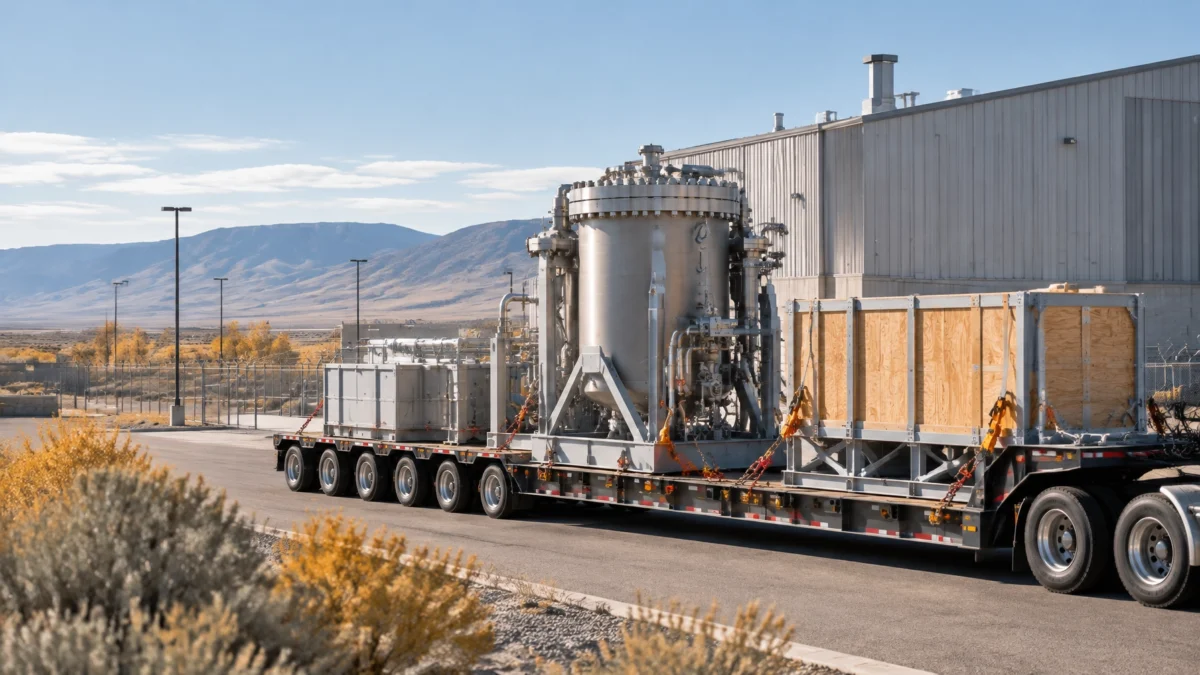
INL has also reported that MARVEL’s primary coolant system arrived in Idaho in mid-September.. That announcement should not be read as confirmation that the reactor has been fully installed, commissioned or operated. The arrival of the primary coolant system is a hardware milestone; the December test remains a future activity subject to assembly, readiness checks and the applicable authorization controls.
What the MARVEL Microreactor Is Designed to Test
A documented safety analysis is the formal safety case for a nuclear facility or experiment. It identifies potential hazards, analyzes how those hazards could affect workers, the public and the facility, and establishes the controls required to operate within acceptable limits.
The document also identifies safety-class structures, systems and components, as well as operating limits and surveillance requirements. For MARVEL, the final analysis addresses the specific configuration planned for initial criticality rather than serving as a blanket authorization for every future phase of the project.
That distinction matters because MARVEL will progress through separate technical and safety milestones. A test authorization for dry criticality does not automatically authorize coolant operation or full-power demonstrations.
The Duck Curve reported that the final approval is associated with the planned dry-criticality campaign at INL’s Transient Reactor Test Facility. Nuclear Engineering International reported that the project’s phased safety approach is intended to address issues progressively as the reactor moves from initial physics testing toward later operations.
Three milestones that should not be confused
The December experiment is a dry criticality test. In this configuration, the reactor core reaches a self-sustaining nuclear chain reaction at near-zero power with no coolant present. The objective is to validate the core’s nuclear physics, neutron behavior, control worth and instrumentation.
Dry criticality does not mean that the reactor is producing useful electricity. It is a controlled physics experiment in which the chain reaction is sustained at a power level too low to produce meaningful commercial energy output.
A wet criticality test is a separate milestone. It would establish criticality with the reactor’s coolant present. Coolant can affect neutron behavior, heat transfer and other reactor characteristics, so operating with the coolant system introduces physical conditions that are not present during the dry test.
Full-power operation is a third and later stage. It involves sustained operation at the reactor’s design power level, removal and management of heat, operation of the power-conversion system and, in MARVEL’s case, electricity generation and potential process-heat demonstrations. A successful dry-criticality experiment would validate important physics, but it would not by itself demonstrate full-power performance or prove that a commercial product is ready for deployment.

A very small reactor with a specific research purpose
INL describes MARVEL as a sodium-potassium, or NaK, cooled microreactor with a nominal thermal output of approximately 85 kilowatts. Current INL materials describe its electrical output as approximately 10 kilowatts, although other project materials cite output of up to 20 kilowatts.
Those figures need to be kept in perspective. MARVEL’s 85 kilowatts thermal output is 0.085 megawatts thermal. A large commercial reactor is commonly measured at roughly 3,000 megawatts thermal. On that comparison, MARVEL’s thermal power is about 35,000 times smaller.
MARVEL is therefore a research and demonstration reactor, not a grid power plant. Its value lies in testing systems, controls, instrumentation, operating procedures and potential applications at a small scale.
The difference between thermal and electric output is also important. Thermal power is the heat generated by the reactor. Electric power is the portion converted into electricity through a power-conversion system. That conversion is not perfectly efficient, and MARVEL’s primary purpose is testing rather than maximizing power export. As a result, approximately 85 kWt can correspond to about 10 kWe of electricity, although some INL project materials cite electrical output of up to 20 kWe.
Why the NaK coolant matters
MARVEL uses a sodium-potassium alloy coolant. Liquid-metal coolants can transfer heat efficiently and support low-pressure operation because they remain liquid at high temperatures without requiring the high pressures associated with some water-cooled reactor systems.
The chemistry creates additional engineering requirements. NaK reacts vigorously with water and can ignite when exposed to air, creating additional requirements for leak prevention, inert environments, containment, monitoring and emergency response. The coolant system must be treated as a central safety and operations consideration, not simply as a heat-transfer component.
That is one reason the test sequence matters. Dry criticality allows operators and researchers to characterize core physics and instrumentation before introducing the NaK coolant. After the dry test, the project is expected to transition toward operations in which the alloy circulates through the primary system to carry heat away from the core.
The dry test cannot answer every question associated with coolant operation. It can, however, provide data on the nuclear behavior of the core under a simpler initial configuration before the project introduces the chemical and thermal conditions associated with the full cooling system.

DOE authorization is not NRC licensing
MARVEL’s regulatory pathway also requires careful language. Because it is a DOE test reactor at Idaho National Laboratory, the project is being authorized through DOE’s safety-analysis and authorization process. DOE approval of the MARVEL documented safety analysis is not an NRC license.
A commercial microreactor deployed outside the DOE laboratory system would generally face a different regulatory process under the Nuclear Regulatory Commission. That process could include design review or certification, site-specific licensing, environmental review, construction authorization and an operating license, depending on the project and regulatory pathway.
Data from MARVEL could help future developers prepare for commercial licensing, but DOE authorization does not transfer automatically to a private commercial project. The usefulness of the information will depend on how well the data apply to other reactor designs, fuels, sites, operating conditions and licensing cases.
This distinction is central to interpreting the milestone. The project is advancing through an authorized federal test program; it is not bypassing the need for commercial developers to satisfy NRC requirements.
Who benefits and what remains unresolved
The immediate beneficiaries are the MARVEL team, DOE researchers, national laboratories and companies seeking data on microreactor systems. The project may also provide information relevant to remote power, industrial heat, resilient energy systems and behind-the-meter applications.
The broader nuclear sector could benefit if MARVEL produces credible operating data that reduce uncertainty around instrumentation, remote operation, coolant management and reactor-physics modeling. Developers may also learn from the structure of the safety-analysis process itself.
The limitations are equally important. MARVEL’s output is too small to materially support a commercial data center, industrial facility or electric grid. The reactor will not establish the cost, supply chain, construction schedule or licensing performance of a commercial microreactor. It also cannot resolve every issue associated with fuel availability, component manufacturing, safeguards, waste management or long-term operation.
For grid planners, MARVEL should be viewed as an R&D asset rather than new generating capacity. Its potential significance is indirect: it may help build the technical knowledge needed for larger or commercially oriented systems that could eventually complement natural gas, renewables, storage, transmission and conventional nuclear power.

What to watch next
The December 2026 criticality date is a plan and could shift as assembly, readiness reviews and authorization activities continue. The immediate indicators will be completion of the relevant hardware integration, verification of instrumentation, fuel and configuration readiness, and confirmation that the test can proceed within the approved safety basis.
The next major question will be what happens after dry criticality. MARVEL will need additional authorization steps before transitioning to coolant operation and later full-power activities. Those steps will determine whether the project can move from physics validation to demonstrations involving heat removal, electricity production and process heat.
The most important long-term measure will be the quality and transferability of the data. A successful December experiment would show that MARVEL’s core can achieve the intended dry critical condition and provide useful reactor-physics information. It would not, by itself, establish that microreactors are commercially competitive or ready for widespread deployment.
For context, the milestone belongs to a broader sequence of advanced nuclear demonstrations, including the ZiaCore microreactor criticality milestone and the July 4 microreactor criticality deadline. It also fits within wider federal efforts described in the DOE’s nuclear capacity expansion strategy, although a laboratory test reactor should not be counted as commercial generating capacity.
MARVEL’s final safety-analysis approval clears an important gate. The December test, if completed as planned, will be another step in establishing what the reactor can demonstrate. The harder questions (coolant operation, full-power performance, economics, commercial licensing and deployment) will come later.
Keep In Touch with Shale Magazine
As the new era of energy unfolds, you can bet we’ll be the boots on the ground to keep you informed. Subscribe to Shale Magazine for sharp insight into the arenas that matter most to your life. And don’t forget to listen to our riveting podcast, The Energy Mixx Radio Show, where our very own Kym Bolado interviews the most extraordinary thought leaders, business innovators, and industry experts of our time.