Critical materials manufacturing acceleration is now at the forefront of United States economic and energy strategy following a major August 3, 2026 announcement by Argonne National Laboratory and the Department of Energy. Supported directly by the Department of Energy Office of Critical Materials and Energy Innovation, the newly established National Science-at-Scale Collaborative represents a decisive structural pivot in how domestic industries translate laboratory breakthroughs into full commercial production. By bridging the traditional chasm between early-stage scientific discovery and industrial-scale deployment, this multi-sector initiative aims to fortify domestic supply chains for critical minerals, advanced chemicals, and next-generation energy infrastructure.
As global energy markets face persistent geopolitical friction and surging technology demand, the imperative to secure resilient, domestic material supply chains has never been more urgent. According to recent Energy Information Administration and International Energy Agency assessments, the rapid expansion of electrification, grid modernization, and advanced energy technologies places unprecedented pressure on global markets for lithium, rare earths, specialized polymers, and precursor chemicals. The Argonne-led collaborative directly confronts this vulnerability by uniting national laboratory expertise with major industrial manufacturers to streamline commercial scaling.
Critical materials manufacturing acceleration through public-private partnership
The collaborative is built upon an integrated multi-sector framework connecting government research institutions with heavyweights across the chemical and industrial sectors. Inaugural industrial participants include Dow, ExxonMobil, BASF, Albemarle, Chemours, Orbia, and Standard Lithium. This coalition brings together diverse industrial stakeholders spanning upstream resource extraction, midstream refining, and downstream chemical synthesis, ensuring that pilot-scale innovations are tailored to real-world commercial realities from inception.

During the official launch announcement, Argonne National Laboratory Director Paul Kearns emphasized the transformative potential of the collaborative. Kearns noted that uniting national laboratory infrastructure with American industrial leadership creates an unprecedented pathway to de-risk capital-intensive manufacturing scaling. Assistant Secretary Audrey Robertson of the Department of Energy echoed this perspective, highlighting that securing domestic leadership in critical materials requires dismantling the traditional silos that separate foundational science from industrial engineering.
Key structural pillars of the National Science-at-Scale Collaborative include:
- Cross-sector integration uniting national laboratories, federal agencies, and major industrial manufacturers
- Accelerated transition pipelines moving discoveries from bench-scale synthesis to pilot-scale commercial validation
- Targeted resolution of technical, regulatory, and supply chain bottlenecks hindering domestic production
- Collaborative co-investment models reducing capital risk for early-stage commercialization projects
Scaling critical materials manufacturing with advanced AI and computer modeling
At the heart of the collaborative’s technical strategy is the heavy deployment of artificial intelligence, high-performance computing, and advanced computer modeling. Traditional materials discovery and process optimization can take decades and immense capital expenditure. By integrating machine learning algorithms with automated synthesis platforms, researchers and industrial partners can simulate chemical behaviors, predict structural integrity, and optimize reaction yields with extreme precision before physical construction begins.

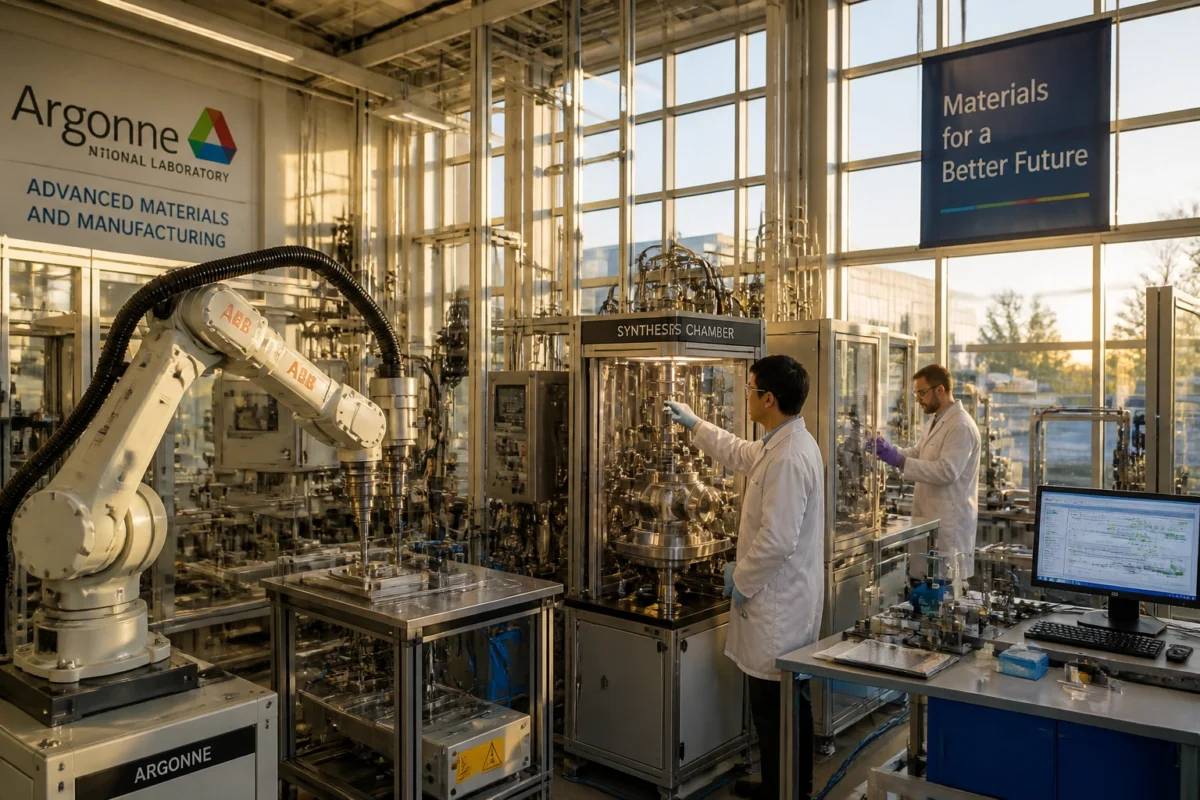
Central to these computational and empirical workflows is Argonne’s renowned Materials Engineering Research Facility. The facility provides specialized infrastructure that allows industrial partners to test, refine, and validate production processes under simulated operational loads. Whether optimizing lithium extraction efficiency or scaling bio-based chemical precursors, the combination of advanced artificial intelligence and pilot-scale testing infrastructure dramatically compresses development timelines.
According to recent market analyses from organizations such as Rystad Energy and Department of Energy advisory committees, reducing commercialization timelines for advanced materials is vital for meeting national clean energy and industrial targets. The integration of artificial intelligence into chemical and mineral processing ensures that American manufacturing remains globally competitive while adhering to stringent environmental and efficiency standards.
Unlocking commercial viability for domestic energy supply chains
The broader implications of the National Science-at-Scale Collaborative extend across the entire energy value chain. From oil and gas petrochemical refinement to advanced nuclear fuel cycles and renewable energy storage, critical materials serve as the foundational building blocks of modern energy infrastructure. When supply chains for specialized chemicals or battery-grade minerals experience disruption, downstream manufacturing halts across multiple industrial sectors.

By systematically addressing manufacturing bottlenecks through targeted collaborative research, the initiative strengthens macroeconomic stability for U.S. producers. Industry participants gain direct access to world-class scientific instruments and computational capabilities that would otherwise be cost-prohibitive for individual corporate research and development budgets. Furthermore, this cooperative model creates clear pathways for academic institutions and universities to contribute specialized talent and engineering research to pressing commercial challenges.
As the collaborative moves into its operational phase following the August 2026 launch, initial project milestones will focus on specific high-priority material classes identified by the Department of Energy. Industry observers and financial analysts will closely monitor how effectively these public-private partnerships translate into commercial facilities breaking ground across the United States. Through sustained institutional commitment and rigorous technical execution, the National Science-at-Scale Collaborative establishes a durable blueprint for American industrial leadership in the twenty-first-century energy economy.
Keep In Touch with Shale Magazine
As the new era of energy unfolds, you can bet we’ll be the boots on the ground to keep you informed. Subscribe to Shale Magazine for sharp insight into the arenas that matter most to your life. And don’t forget to listen to our riveting podcast, The Energy Mixx Radio Show, where our very own Kym Bolado interviews the most extraordinary thought leaders, business innovators, and industry experts of our time.
Subscribe to get more posts from Amanda Jenkins