Some states are welcoming data centers, so long as they guarantee they will produce their own power rather than draw from the grid. This comes following widespread public criticism of data centers, demonstrated by a 2026 Gallup poll, which suggested that seven in 10 Americans opposed constructing data centers for artificial intelligence in their local area.
Data Center Power Concerns
Consumers in the United States are facing rising energy bills due to inflation and other factors. Meanwhile, ongoing geopolitical uncertainty is exacerbating global energy price volatility and shortages. In addition, several utilities across the country are lagging in investment in transmission network infrastructure, as many renewable energy projects await grid connection.
Meanwhile, current forecasts expect data centers to be a main driver of power use in the United States over the next decade. Power consumption in the United States is expected to break records once again in 2026 and 2027, following a second consecutive annual high in 2025, with data centers serving AI and broader electrification driving this demand, according to the U.S. Energy Information Administration.
Total U.S. electricity use is expected to rise from 4,195 billion kilowatt-hours (kWh) in 2025 to 4,268 billion kWh in 2026 and 4,391 billion kWh in 2027. U.S. data center grid power demand is expected to almost triple by 2030 from 2025 levels.
The United States is leading the global surge in data center power demand, consuming nearly 40% of the global total and contributing almost half of the worldwide increase in 2025. This brings an end to decades of stagnant electricity demand and poses a challenge for utilities, which must rapidly upgrade transmission infrastructure to meet it.
States Take the Reins
In August, Pennsylvania’s Governor Josh Shapiro issued an executive order that provides preferential treatment to data center developers who commit to a set of power supply, environmental, and cost-responsibility requirements. Pennsylvania’s Department of Environmental Protection (DEP) will develop the new review process.
Shapiro aims to stop independent power producers from entering into long-term contracts to sell electricity to data center developers from existing generating assets, a common trend in recent years that could prevent the state from meeting its citizens’ power demand in the future if not managed properly now.
The move follows pauses on data center development by some states concerned about meeting the growing power demand, such as Texas. The order states that data center developers who sign a consent order and agreement to abide by Pennsylvania’s infrastructure development standards will be offered preferential treatment.
Katie Blume, the political and legislative director for Conservation Voters of Pennsylvania, stated, “We have so much speculation in Pennsylvania — like, gold rush speculation on these data centers.” Blume added, “A lot of this [order] is going to be weeding out those bad actors because they’re not going to want to spend five years in the permitting process.”
The order also encourages developers to invest in clean energy supplies, such as solar, advanced nuclear, and battery storage, Shapiro announced when signing the executive order. The state’s clean energy requirement for data centers increases from 10% on January 1st to 14.5% three years later, and 32% by the beginning of 2035. The Pennsylvania DEP has been told to expedite permitting for clean energy and storage facilities on brownfield sites to support this goal.
The Bring Your Own Power Model
Existing U.S. grid infrastructure, much of which is already outdated, was built for a different time and is ill-prepared for the heavy power demand of the new data center era. The country’s largest power grid operator, PJM Interconnection, is already struggling to keep up with rising power demand and is at risk of maxing out during extreme weather.
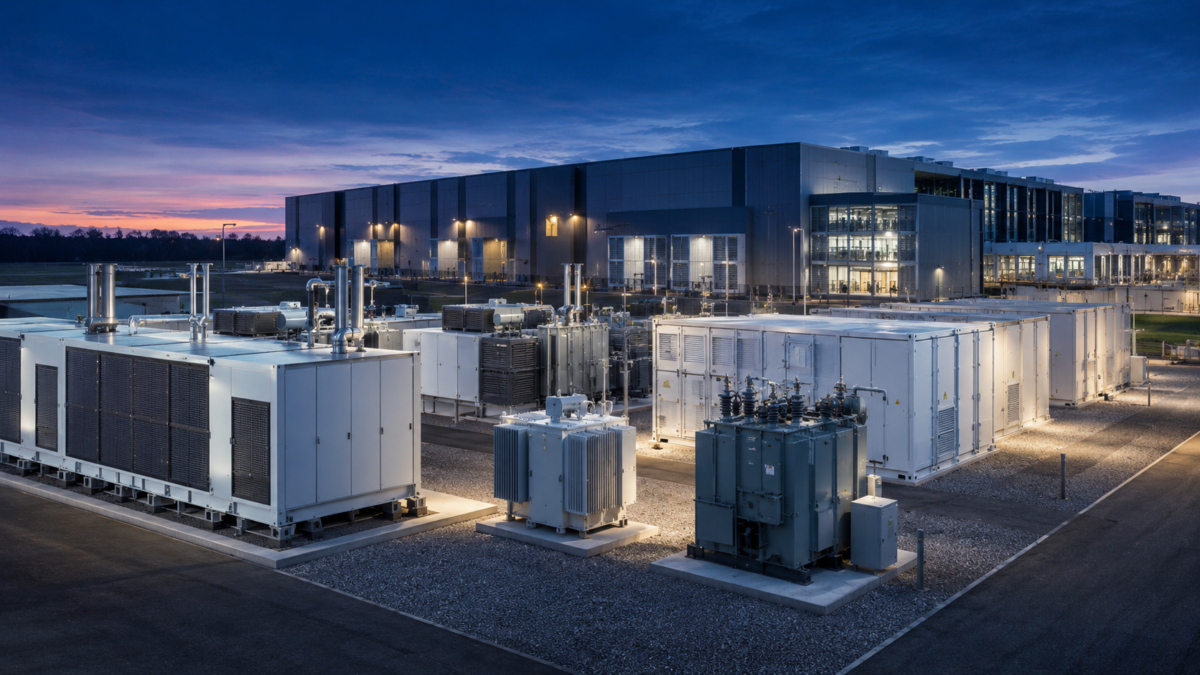
This is driving data center operators to take a different approach to power, by developing their own natural gas, renewable energy and – eventually – nuclear power projects on-site. Future data centers could be more expansive than current facilities, as many will be built to include a self-contained energy ecosystem.
A Data Center Power Report by Bloom Energy suggests that around one-third of U.S. data centers could be fully self-sufficient in terms of their power demand by 2030. Bloom surveyed executives in the data center industry to better understand their plans for electricity supply.
Bloom Energy’s chief marketing officer, Natalie Sunderland, explained, “Data center and AI factory developers can’t afford delays.” She added, “Our analysis and survey results show that they’re moving into power-advantaged regions where capacity can be secured faster – and increasingly designing campuses to operate independently of the grid.”
Over 50% of new data center campuses are expected to exceed 500 MW by 2035, with almost a third predicted to exceed 1 GW. Therefore, several states could require developers to provide their own power to gain approval for development. Establishing on-site energy production could also help companies develop new data centers more quickly and cheaply, allowing companies to bypass multi-year public grid interconnection queues.
Keep In Touch with Shale Magazine
As the new era of energy unfolds, you can bet we’ll be the boots on the ground to keep you informed. Subscribe to Shale Magazine for sharp insight into the arenas that matter most to your life. And don’t forget to listen to our riveting podcast, The Energy Mixx Radio Show, where our very own Kym Bolado interviews the most extraordinary thought leaders, business innovators, and industry experts of our time.
Subscribe to get more posts from Felicity Bradstock