
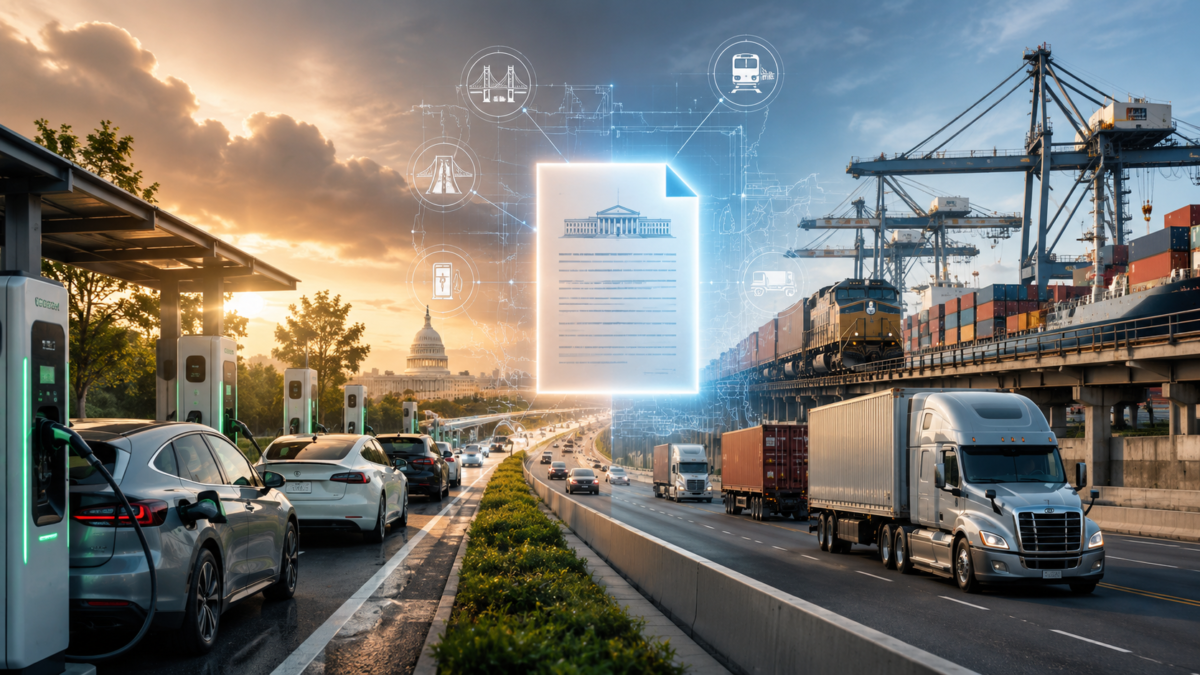
The BUILD America 250 Act would impose new annual federal fees on electric vehicles and plug-in hybrids while redirecting federal transportation funding toward roads, bridges and other infrastructure priorities.
Introduced as H.R. 8870, the bipartisan legislation would authorize approximately $580 billion for surface transportation programs from fiscal years 2027 through 2031. The House Transportation and Infrastructure Committee approved the bill by a 62–2 vote on May 22, 2026, but it has not yet passed the full House or become law.
Supporters argue that the bill would modernize aging infrastructure and require electric vehicle owners to contribute to the Highway Trust Fund. Critics contend that the proposed fees, combined with reductions or changes to charging, emissions-reduction and rail programs, could increase transportation costs and discourage electric vehicle adoption.
Key Takeaways
- The BUILD America 250 Act proposes a $130 annual fee for battery-electric vehicles.
- Plug-in hybrid owners would initially pay $35 annually.
- The fees would increase every two years beginning in 2029, eventually reaching maximums of $150 and $50.
- Revenue would support the Highway Trust Fund, which relies heavily on federal gasoline and diesel taxes.
- The legislation would authorize approximately $580 billion over five years.
- Critics argue that EV owners in states with existing registration surcharges could face overlapping state and federal fees.
- The bill advanced from committee but had not passed the full House as of September 2, 2026.
What Is the BUILD America 250 Act?
The Building Unrivaled Infrastructure and Long-term Development for America’s 250th Act is Congress’ proposed five-year reauthorization of federal surface transportation programs.
The legislation covers highways, bridges, public transit, passenger rail, freight transportation, highway safety and related infrastructure programs. It was introduced by House Transportation and Infrastructure Committee Chairman Sam Graves, a Missouri Republican, and Ranking Member Rick Larsen, a Washington Democrat.
The committee describes the bill as an effort to move people and freight more safely and efficiently while giving states greater certainty over long-term infrastructure funding. Following a 14-hour markup, the committee approved H.R. 8870 by a 62–2 vote.
Committee approval does not make the proposal law. The bill must still move through the House, be reconciled with any Senate transportation legislation and receive presidential approval.
How Much Would EV Owners Pay?
The bill would establish an annual federal fee of:
- $130 for battery-electric vehicles.
- $35 for plug-in hybrid vehicles.
Beginning in 2029, each fee would increase by $5 every two years. The EV fee would eventually be capped at $150, while the plug-in hybrid fee would be capped at $50.
The revenue would be deposited into the Highway Trust Fund.
Federal road funding currently depends heavily on an 18.4-cent-per-gallon gasoline tax and a 24.4-cent-per-gallon diesel tax. Those rates have not increased since 1993.
Because fully electric vehicles do not use gasoline or diesel, their owners generally do not contribute to the fund through federal motor-fuel taxes. Plug-in hybrids consume fuel but typically use less than comparable internal-combustion vehicles.
Graves said the legislation would ensure EV owners begin paying their share of road costs. Larsen characterized the negotiated fee as an attempt to produce a fair rather than punitive contribution from EV drivers.
The Committee for a Responsible Federal Budget estimates that the fees could raise approximately $30 billion over a decade. That would provide a new revenue stream, but it would cover only part of the Highway Trust Fund’s projected shortfall.
Would the Fee Make EV Ownership More Expensive?
Yes. If enacted, the federal charge would add a recurring cost to EV and plug-in hybrid ownership.
Whether the fee is proportionate depends on how the comparison is calculated. A gasoline-powered vehicle’s federal tax contribution varies based on mileage and fuel efficiency. The proposed EV charge would generally be a flat annual amount, meaning an owner who drives relatively few miles could pay the same federal fee as one who drives substantially more.
More than three dozen states already impose special registration fees or taxes on electric vehicles. In Texas, for example, EV owners currently pay an additional $200 annual registration fee. The proposed federal fee could raise that combined annual obligation to $330 unless the legislation or state law provides an offset.
Supporters say an additional funding mechanism is necessary because road maintenance cannot continue relying indefinitely on gasoline consumption. Critics argue that a flat charge may require some EV drivers to contribute more than comparable gasoline-vehicle owners, particularly in states that already impose substantial EV fees.
This debate reflects a larger unresolved question: how should the United States finance roads as vehicles become more efficient and drivers purchase less taxable fuel?
The EV Tax Credit Has Already Expired
The proposed fee would arrive shortly after the expiration of federal clean-vehicle tax incentives and other significant changes to federal EV policy.
The federal New Clean Vehicle Credit previously offered qualifying buyers as much as $7,500. However, the credit is generally unavailable for vehicles acquired after September 30, 2025, according to the Internal Revenue Service.
Credits for eligible previously owned and commercial clean vehicles also ended for vehicles acquired after that date.
Removing the purchase incentive did not directly increase vehicle sticker prices, but it eliminated a benefit that could reduce the effective cost for qualifying buyers. Adding an annual ownership fee would create a second federal policy change affecting EV economics.
ENMG previously examined this broader policy shift in Trump Administration Gasoline Vehicle Shift Impacts EV Adoption.
Vehicle Affordability Extends Beyond EVs
Affordability is a problem across the entire automobile market, not only for electric vehicles.
New-vehicle prices have increased substantially since 2020. Higher interest rates, insurance premiums, repair costs and household expenses have also made vehicle ownership more difficult for many consumers.
Cox Automotive data cited in industry reporting show that households earning less than $100,000 represent a shrinking share of new-car buyers, while households earning more than $200,000 account for a growing share.
This does not mean the proposed federal fee alone would determine whether a consumer purchases an EV. Purchase price, range, charging availability, electricity rates, resale value, insurance and expected fuel savings all influence that decision.
However, the fee would become part of the total cost calculation—especially for buyers who also face state EV surcharges.
How Would the Bill Affect EV Charging?
The BUILD America 250 Act would change the federal government’s approach to charging infrastructure.
Current programs include the National Electric Vehicle Infrastructure Formula Program and the Charging and Fueling Infrastructure Discretionary Grant Program. These programs support public charging stations, alternative-fuel corridors and community charging projects.
Critics of H.R. 8870 argue that it does not continue those programs at levels sufficient to complete a national charging network. Supporters place greater emphasis on highway, bridge, safety and project-delivery investments.
Charging availability remains one of the most significant barriers to EV adoption. ENMG previously examined state deployment efforts and federal funding in its report on the national EV charging network. Consumers with access to home charging generally face a different ownership experience than apartment residents, long-distance drivers or people living in rural areas.
ENMG’s State Progress and the National EV Charging Backbone provides additional background on the charging network and its funding challenges.
What Happens to Carbon-Reduction and Port Programs?
The bill would eliminate or restructure several programs established under the Infrastructure Investment and Jobs Act.
The American Council for an Energy-Efficient Economy argues that the proposal would end the Carbon Reduction Program and reduce federal support for programs intended to improve port operations, freight efficiency and truck emissions.
The Carbon Reduction Program has supported projects including traffic-management systems, bicycle infrastructure, public transportation and certain charging installations.
The Reduction of Truck Emissions at Port Facilities Program supports projects intended to reduce idling, replace older equipment and improve freight movement around ports.
ACEEE contends that eliminating these programs could raise freight and operating costs. However, the bill’s supporters point to other provisions involving freight data, truck parking, bridge investment and infrastructure permitting that they say would improve transportation efficiency.
Those competing claims should be evaluated separately. A program can produce environmental benefits without necessarily being the most efficient use of federal money, while eliminating it does not automatically guarantee lower costs elsewhere.
How Would Passenger Rail Funding Change?
The bill would authorize approximately $64.3 billion for passenger rail over five years, according to an analysis from the American Public Transportation Association.
That compares with approximately $112.9 billion authorized under the Infrastructure Investment and Jobs Act, a difference of about $48.7 billion, or 43%.
The comparison requires an important qualification: the BUILD America 250 Act’s passenger-rail funding would be subject to future appropriations rather than guaranteed in advance. That means the amount ultimately provided could be lower than the headline authorization.
The National Association of Counties notes that the bill would reauthorize Amtrak and consolidate certain intercity passenger-rail programs, but actual funding would depend on annual congressional appropriations.
Rail advocates argue that this structure creates uncertainty for projects requiring multiyear planning. Supporters of the legislation emphasize that it still authorizes significant passenger-rail investment while prioritizing roads and bridges.
The Highway Trust Fund Has a Structural Problem
The dispute over EV fees is part of a larger transportation-funding problem.
The federal gasoline tax has remained unchanged for more than three decades. Inflation has reduced its purchasing power, while improving vehicle fuel economy has lowered the amount collected per mile traveled.
EVs intensify that problem, but they did not create it.
Congress could address the gap through fuel-tax changes, registration fees, mileage-based user charges, general federal revenue or some combination of those approaches. Each option distributes the cost differently among drivers and taxpayers.
A flat EV fee is relatively straightforward to administer. A mileage-based system could more closely reflect road use but would introduce privacy, reporting and administrative concerns.
The BUILD America 250 Act chooses the simpler approach while directing states to collect the federal fee. Whether that system survives the broader legislative process remains uncertain.
What Happens Next?
As of September 2, 2026, the BUILD America 250 Act has advanced through the House Transportation and Infrastructure Committee but has not received final approval from Congress.
The committee’s chairman said on September 1 that he intended to continue moving the legislation through the House and negotiate with the Senate. Current surface transportation authority was temporarily extended while lawmakers continued working on a longer-term agreement.
The eventual legislation may therefore differ from the committee-approved version. EV fees, rail funding, charging programs and emissions-related provisions could all change through amendments or negotiations.
For consumers, the most immediate conclusion is straightforward: no new federal EV registration fee is currently being collected under H.R. 8870. It remains a proposal.
The Bigger Picture
The BUILD America 250 Act attempts to solve a real problem: the United States needs a more durable way to finance roads and transportation infrastructure as gasoline-tax revenue becomes less reliable.
Its proposed solution would require EV and plug-in hybrid owners to contribute directly to the Highway Trust Fund. That could strengthen transportation revenue, but it would also increase ownership costs at a time when federal purchase incentives have expired and many states already impose their own EV charges.
The bill also reveals a broader change in federal priorities. Roads and bridges would receive substantial investment, while several charging, emissions-reduction and passenger-rail programs would receive less support or less certain funding than under the previous transportation law.
Whether that represents a practical reset or a retreat from transportation modernization will remain at the center of the congressional debate.
Frequently Asked Questions
Has the BUILD America 250 Act passed?
No. The House Transportation and Infrastructure Committee approved H.R. 8870 on May 22, 2026, but the legislation has not passed the full House or become law.
Would the bill impose a federal EV fee?
Yes. The committee-approved proposal includes a $130 annual fee for battery-electric vehicles and a $35 fee for plug-in hybrids.
Would the EV fee increase?
Yes. The fees would rise by $5 every two years beginning in 2029, with caps of $150 for EVs and $50 for plug-in hybrids.
Would the federal fee replace state EV registration fees?
The committee-approved proposal does not broadly eliminate existing state EV fees. Owners in states with separate charges could therefore face both obligations unless federal or state provisions provide an offset.
Why does Congress want EV owners to pay a fee?
EVs use public roads but do not consume gasoline, meaning their owners do not contribute through the federal gasoline tax. The proposed fee would direct revenue from those vehicles into the Highway Trust Fund.
Keep In Touch with Shale Magazine
As the new era of energy unfolds, you can bet we’ll be the boots on the ground to keep you informed. Subscribe to Shale Magazine for sharp insight into the arenas that matter most to your life. And don’t forget to listen to our riveting podcast, The Energy Mixx Radio Show, where our very own Kym Bolado interviews the most extraordinary thought leaders, business innovators, and industry experts of our time.