
ENMG Analysis
The Amarillo Expansion Project would provide natural gas transportation for a new power plant intended to serve a planned data center in the Texas Panhandle. The proposal has entered federal environmental review, but the Federal Energy Regulatory Commission has not authorized construction.
A Federal Register notice published November 5 opened the environmental scoping process for Natural Gas Pipeline Company of America’s proposal in Moore and Deaf Smith counties. Comments addressing the environmental review are due by 5 p.m. Eastern, or 4 p.m. Central, on December 2 under docket CP26-581-000.
The review offers residents, landowners, government agencies, and other interested parties an opportunity to identify issues FERC should evaluate. It is not a construction permit, approval of the power plant, or evidence that the planned data center will begin operating.
How The Project Would Support Data Center Power
Natural Gas Pipeline Company of America, or NGPL, is operated by Kinder Morgan. According to FERC, the company proposes to construct Compressor Station 112 in Moore County and a new delivery point in Deaf Smith County.
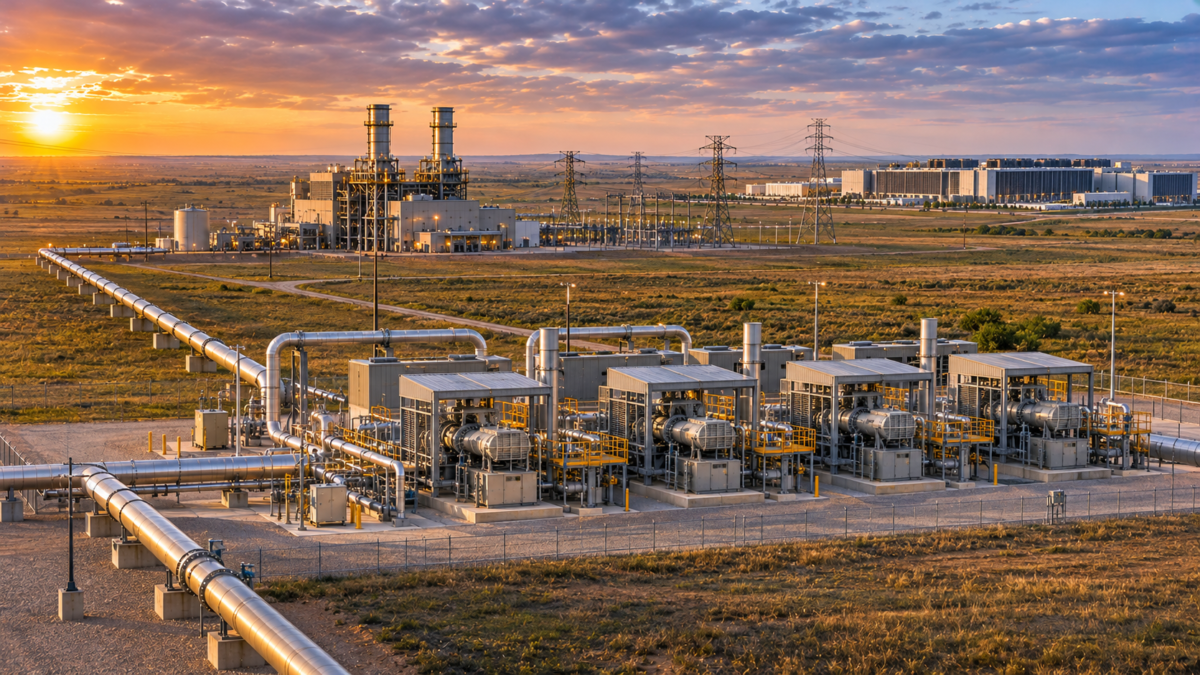
The compressor station would include four gas-fired compressor units rated at 5,500 horsepower each, for a combined 22,000 horsepower. The proposed delivery point would include a 24-inch tap assembly and electric gas-measurement equipment.
Compression is necessary because natural gas loses pressure as it travels through a pipeline. Compressor stations increase the gas pressure needed to maintain transportation capacity and move fuel toward downstream delivery points. In this case, the proposed equipment would increase the amount of firm service NGPL could provide to the planned generating facility.
That relationship illustrates an important part of on-site gas generation for data centers. A gas-fired power plant requires more than generating equipment. It also needs a source of gas, transportation rights, adequate pipeline pressure, metering, air permits, electrical equipment, and a plan for maintaining service during outages or extreme weather.
Only Part Of The Capacity Would Be New
The Amarillo Expansion Project would provide approximately 550,000 dekatherms per day of firm natural gas transportation service. That figure does not mean the physical expansion would create 550,000 Dth per day of entirely new pipeline capacity.
FERC’s notice divides the proposed service into two parts:
- Approximately 228,800 Dth per day would come from existing unsubscribed capacity that NGPL would reserve for the customer.
- Approximately 321,200 Dth per day would be incremental capacity created through the proposed expansion.
Firm transportation generally gives a shipper contractual priority to move an agreed amount of gas under the pipeline’s tariff and service agreement. It does not mean that the customer will use its maximum reservation every day.
The 550,000-Dth figure also should not be converted directly into data-center megawatts. Dekatherms measure the energy content of gas, while megawatts measure the rate of electrical output. Converting one into the other would require documented assumptions about the generating equipment, efficiency, operating schedule, auxiliary loads, and actual fuel consumption.
This is the same distinction ENMG has identified in its coverage of contracted Texas data center gas demand. Reserved transportation, designed pipeline capacity, actual gas flow, and electricity generation are connected, but they are not interchangeable measurements.
The Customer Remains Unidentified
Kinder Morgan said in its second-quarter results that all of the project’s proposed capacity was fully subscribed under a long-term contract. The company has not publicly identified the shipper, the data-center operator, or the owner of the proposed generating facility in the materials reviewed for this article.
The FERC notice attributes the proposed end use to NGPL. It says the gas would be delivered to a new gas-fired generating facility intended to power a planned data center in Deaf Smith County.
That establishes the proposed relationship among the pipeline, power plant, and data center. It does not establish that every component has received its permits, financing, equipment, or authorization to begin construction.
The three projects also may follow different schedules. Progress on the pipeline does not automatically authorize the power plant, and progress on the generating facility does not establish that the data center has completed every approval or infrastructure requirement.
The Project Cost Needs Clarification
The public record currently contains two different project-cost estimates.
FERC’s October application notice says NGPL estimated the project would cost approximately $139 million. Kinder Morgan’s current Amarillo Expansion Project page describes an approximately $200 million project, with Kinder Morgan’s share estimated at approximately $75 million.
The difference could reflect changes in scope, accounting, ownership allocation, timing, or an updated estimate, but the reviewed materials do not explain it. Until Kinder Morgan clarifies the figures, neither should be presented as the single undisputed current cost.
Kinder Morgan targets the project for service during the third quarter of 2028. That remains a company schedule subject to regulatory approval, construction, equipment availability, and commissioning.
What FERC Will Review
FERC says construction would disturb approximately 56 acres. About 8.4 acres would remain in use for permanent project operations, while the remaining acreage would be restored after construction.
The proposed compressor station would occupy land within the boundaries of a former compressor station that has been removed and is owned by NGPL. The delivery facilities would be located beside existing pipeline, utility, or road rights-of-way.
FERC’s environmental review may examine:
- Air quality and compressor emissions
- Operational and construction noise
- Geology and soils
- Water resources and wetlands
- Vegetation and wildlife
- Threatened and endangered species
- Cultural and historic resources
- Land use
- Reliability and safety
- Reasonable project alternatives
- Measures that could avoid or reduce environmental effects
These are subjects for review, not findings that the project has caused or will cause a particular impact.
Landowners may also raise questions about easements, restoration obligations, construction access, drainage, noise, and the location of permanent facilities. FERC explains that if it ultimately approves the project, the Natural Gas Act may allow the pipeline company to pursue eminent-domain proceedings when it cannot reach an easement agreement. Compensation disputes would be handled by the courts rather than FERC.
Residents can use FERC’s eComment system for brief text-only comments or its eFiling system for comments containing documents or attachments. Submissions should identify docket CP26-581-000.
What The Proposal Could Mean For Texas
For natural gas producers and pipeline companies, the project represents a potential new demand center outside the Gulf Coast. Data-center development could increase demand for gas transportation, compression, generating equipment, construction, maintenance, and related services across the Panhandle.
For the planned data center, dedicated or nearby gas-fired generation could provide electricity without relying exclusively on an immediate large-load connection to the wider grid. That does not necessarily mean the facility would remain permanently disconnected from ERCOT, and the FERC notice does not establish its eventual grid arrangement.
That distinction matters because a pipeline connection solves only the fuel-delivery portion of the energy system. Reliable electricity also depends on generating-unit availability, backup capacity, fuel contracts, equipment maintenance, cooling, electrical interconnections, and the design of the data center’s internal power system.
ENMG’s analysis of the Texas transmission bottleneck explains why adding generation does not automatically resolve every power-delivery constraint. A facility’s effect on the broader grid depends on whether it operates independently, imports power, exports power, or uses some combination of those arrangements.
The proposal also does not establish that households will pay more or less for electricity or natural gas. Any consumer effect would depend on project financing, contract terms, fuel prices, grid participation, utility cost allocation, and actual operations.
What Comes Next
The immediate milestone is the December 2 environmental-scoping deadline. FERC staff will use the comments and project record to determine the scope of its environmental analysis and whether to prepare an environmental assessment or environmental impact statement.
The most important unanswered questions include:
- Who is the contracted shipper?
- Who will own and operate the generating facility?
- Which company is developing the data center?
- What permits remain outstanding for the power plant and data center?
- Will the generating facility connect to ERCOT?
- How will the plant secure fuel during periods of high gas demand?
- Why do FERC and Kinder Morgan publish different project-cost estimates?
- What noise, emissions, safety, and land-restoration measures will apply?
- Can the pipeline, power plant, and data center maintain their targeted schedules?
The Amarillo Expansion Project has advanced into federal environmental review, and its proposed transportation capacity is supported by a long-term contract. That makes it more developed than a general forecast of future data-center energy demand.
It remains a proposal. The December comment period is an opportunity to shape the federal review—not a notice that construction has been approved or that the power plant and data center are certain to open.
Keep In Touch with Shale Magazine
As the new era of energy unfolds, you can bet we’ll be the boots on the ground to keep you informed. Subscribe to Shale Magazine for sharp insight into the arenas that matter most to your life. And don’t forget to listen to our riveting podcast, The Energy Mixx Radio Show, where our very own Kym Bolado interviews the most extraordinary thought leaders, business innovators, and industry experts of our time.