ENMG Analysis
The Delfin LNG extension request would give the Houston-based developer three additional years to complete the Louisiana facilities needed to connect its planned floating LNG vessel with the onshore natural gas system. The request reflects an important reality of LNG development: ordering the vessel is only one part of building a functioning export project.
Delfin LNG filed its request with the Federal Energy Regulatory Commission on October 30. A Federal Register notice published November 16 opened the request for public comment. FERC has not approved the extension.
Delfin’s current deadline to construct and place the facilities in service is September 28, 2027. The company wants FERC to move that deadline to September 28, 2030, bringing the onshore schedule closer to the expected arrival of its first floating liquefaction vessel.
Comments and motions to intervene are due by 5 p.m. Eastern on November 25 under docket CP15-490-005.
What Delfin Is Asking FERC to Extend
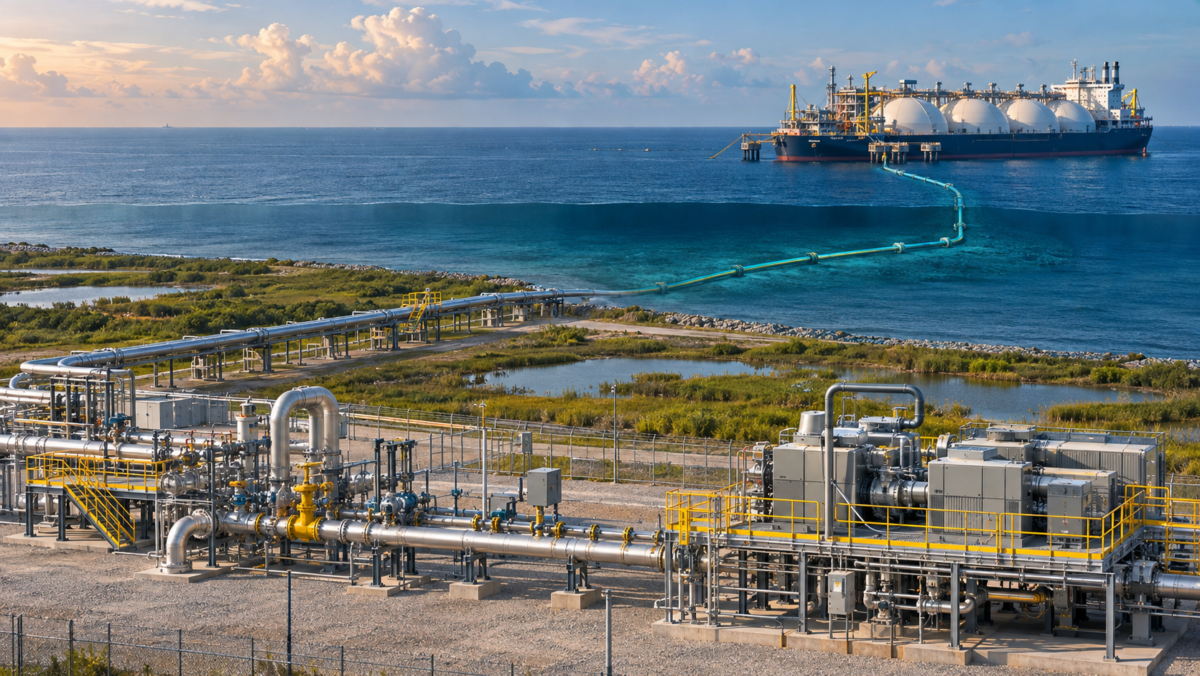
The request applies to metering, compression, and piping facilities in Cameron Parish, Louisiana. Those facilities would transport natural gas from the existing pipeline network to Delfin’s planned deepwater port offshore Louisiana.
Each component performs a different function:
- Metering equipment measures the quantity and operating conditions of the gas entering the project.
- Compressors increase gas pressure so that the supply can move through the system at the required rate.
- Connecting piping directs the gas from the onshore network toward the offshore pipeline and floating liquefaction facilities.
These are not secondary accessories. The floating vessel cannot liquefy and export natural gas unless a functioning system delivers feedgas from shore.
FERC originally authorized the onshore facilities in 2017 and required them to be available for service by September 28, 2019. The commission subsequently granted five extensions, moving the current deadline to September 28, 2027. Delfin’s pending request would be the sixth extension.
That history does not mean FERC will automatically approve another one. The commission says it will evaluate whether Delfin has demonstrated good cause. If the request is contested, FERC generally aims to act within 45 days, although that target is not a guaranteed decision date. govinfo.gov
The Floating Vessel Drives the New Schedule
Delfin announced on June 3 that it had reached a $5 billion final investment decision for its first floating LNG vessel. The company also entered construction arrangements involving Samsung Heavy Industries and Black & Veatch.
The first vessel is designed to produce approximately 4.4 million metric tons of LNG annually. Delfin’s broader project plan calls for as many as three vessels with combined capacity of up to 13.2 million metric tons per year. Those are planned production capabilities, not current exports. Delfin has not started commercial LNG production from the project. globenewswire.com
The Federal Register notice says the first vessel will not be positioned at the deepwater port until 2030. Delfin argues that completing the shore-side facilities by September 2027 would put them into service years before the equipment they are intended to supply.
Aligning the schedules could reduce the period during which completed onshore assets sit unused. It could also delay the point at which regulators and the public receive operating evidence showing that the full system works as designed.
A final investment decision is important because it signals that project sponsors have committed to advancing a defined investment. It is not the same as completed construction, successful commissioning, or the departure of a first LNG cargo.
FERC and DOE Deadlines Cover Different Things
The project operates under more than one federal regulatory clock.
FERC’s deadline applies to the onshore natural gas facilities in Louisiana. The Maritime Administration regulates the offshore deepwater port. The Department of Energy governs Delfin’s authority to export natural gas to foreign markets.
DOE has given Delfin until June 1, 2031, to begin exports under its non-free-trade-agreement authorization. The controlling DOE order confirms that deadline. It does not require the project to begin operating in 2030, nor does it guarantee that exports will start by 2031. It establishes the date Delfin must meet to retain the relevant export authorization unless DOE grants another change. energy.gov
The distinction is similar to the one examined in ENMG’s coverage of the ST LNG federal approval: a project may need separate authorizations for its offshore facilities, onshore infrastructure, environmental requirements, and exports. Progress under one proceeding does not complete the others.
What the Request Means for Gulf Coast Gas
For producers, pipeline operators, and gas marketers, an operating Delfin project could eventually create another source of demand along the Gulf Coast. The project’s effect would depend on its actual feedgas requirements, utilization, pipeline connections, transportation contracts, and commercial operations.
The extension request does not establish where the gas will originate. It does not prove that a Texas producer has contracted to supply the first vessel, and it does not show that additional gas is already moving toward the project.
That distinction matters because Delfin is headquartered in Houston, while the facilities covered by this proceeding are in Louisiana. The corporate address creates a Texas business connection, but it does not convert the Louisiana construction project into operating Texas export capacity.
The larger supply relationship remains relevant. ENMG’s analysis of U.S. LNG export growth explains how Gulf Coast terminals draw on production from regions including the Haynesville and Permian basins. Pipeline access determines whether gas produced in those regions can physically reach a terminal when it is needed.
No near-term conclusion about Texas natural gas prices, household bills, or domestic supply can be drawn from this request alone. Price effects would depend on broader production, weather, storage, pipeline capacity, domestic consumption, and the utilization of multiple export facilities.
What to Watch Next
The first milestone is the November 25 deadline for comments and interventions. A comment allows a person or organization to submit a position for the record. A motion to intervene is a separate filing used to seek legal party status in the proceeding.
After that, the key developments are:
- Whether FERC grants, denies, or conditions the extension.
- Whether Delfin maintains its 2030 vessel schedule.
- When onshore construction begins.
- Which pipeline connections and firm transportation agreements will supply the project.
- When Delfin begins taking feedgas for commissioning.
- Whether the project meets DOE’s June 1, 2031 export deadline.
The Delfin LNG extension request does not reopen the original approval of the project or authorize a new export facility. It asks FERC to change the deadline for completing infrastructure the commission previously approved.
Delfin has taken a major commercial step by reaching a final investment decision on its first vessel. It still must build, connect, test, and commission the larger system required to turn that vessel into an operating LNG export facility. Offshore ambition is impressive; the gas still needs plumbing.
Keep In Touch with Shale Magazine
As the new era of energy unfolds, you can bet we’ll be the boots on the ground to keep you informed. Subscribe to Shale Magazine for sharp insight into the arenas that matter most to your life. And don’t forget to listen to our riveting podcast, The Energy Mixx Radio Show, where our very own Kym Bolado interviews the most extraordinary thought leaders, business innovators, and industry experts of our time.