ENMG Analysis
The ST LNG federal approval clears a major regulatory hurdle for a proposed $8.2 billion liquefied natural gas export facility off the Texas coast. It does not establish that the project has secured financing, reached a final investment decision, or received authorization to begin construction.
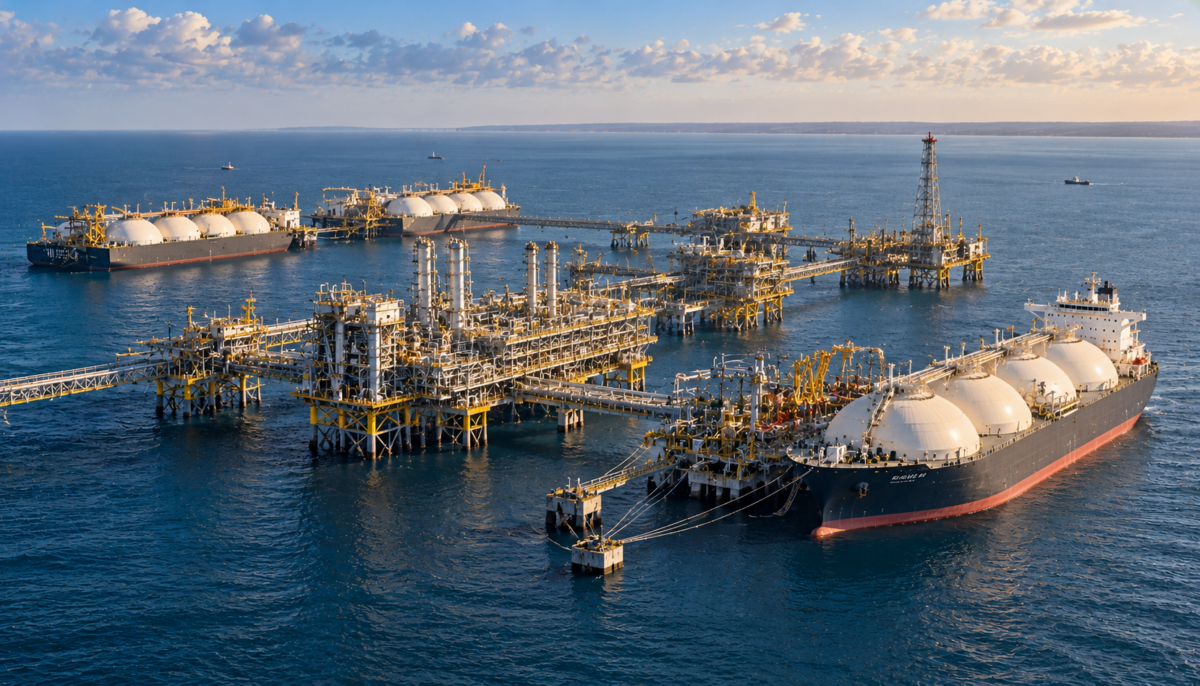
On October 28, the U.S. Maritime Administration announced that it had approved ST LNG’s deepwater-port license application. The proposed facility would be located approximately 10.4 miles offshore Matagorda County and would ultimately include four liquefaction systems, each designed to produce 2.1 million metric tons of LNG annually.
Together, the four systems would provide 8.4 million metric tons per annum, or MTPA, of planned LNG production capacity. The Department of Transportation announcement describes construction as expected to begin in 2027, with operations targeted for 2029. Those dates remain project expectations, not guaranteed delivery milestones.
What Did MARAD Approve for ST LNG?
MARAD’s decision approves ST LNG’s deepwater-port license application following a federal environmental, safety, security, and interagency review. The complete Record of Decision and related documents are listed under docket MARAD-2025-0096.
At full build-out, the offshore project would include:
- Four liquefaction systems with 2.1 MTPA of capacity each
- 20 offshore platforms
- Four floating LNG storage units
- Four vessel-mooring systems
- Approximately 7.7 miles of pipeline infrastructure
The project would receive natural gas from the Tres Palacios Natural Gas Storage and Trading Hub and Williams’ Markham Gas Processing Plant. DOT says the gas would move through existing Transco infrastructure located approximately 5.6 miles northeast of the proposed port.
This configuration distinguishes ST LNG from a conventional onshore export terminal. Instead of moving LNG carriers through an inland ship channel to reach a land-based liquefaction facility, ST LNG proposes to liquefy, store, and transfer the LNG offshore.
That structure could reduce some vessel congestion near onshore terminals, but offshore construction introduces its own technical demands. Platforms, pipelines, floating storage units, mooring systems, loading equipment, power generation, communications, and safety systems must withstand Gulf conditions and operate as an integrated export facility.
How the Offshore LNG System Would Work
Liquefaction removes impurities from pipeline-quality natural gas and cools the gas to approximately minus 260 degrees Fahrenheit. This converts it into a liquid with roughly 1/600th of its gaseous volume, allowing large quantities to be transported by ship. The U.S. Energy Information Administration’s LNG explanation provides additional background on the process.
For ST LNG, feed gas would first need to move from the connected storage, processing, and pipeline system to the offshore facility. The liquefaction systems would then cool the gas before transferring the LNG into floating storage units.
Export vessels would moor offshore and receive LNG from those storage units. The system’s commercial output would depend on the reliability of the feed-gas supply, pipeline capacity, liquefaction equipment, floating storage, marine loading systems, and tanker availability.
Nameplate capacity also should not be confused with actual annual exports. The 8.4-MTPA figure represents the project’s planned production capability at full build-out. Actual output would depend on commissioning, maintenance, utilization, feed-gas availability, weather, mechanical performance, and customer demand.
Approval Does Not Equal Construction
The federal decision reduces an important category of regulatory risk. It does not automatically provide the capital, customers, contractors, equipment, or construction notice required to build an $8.2 billion project.
In the primary announcements reviewed for this report, ST LNG did not disclose:
- A completed final investment decision
- A fully committed construction-financing package
- A complete portfolio of binding long-term sales and purchase agreements
- A final engineering, procurement, and construction contract
- A formal notice to proceed with construction
The absence of those disclosures from the reviewed announcements does not prove that negotiations or preliminary commitments do not exist. It does mean those commercial milestones should be confirmed directly before the project is described as fully financed or under construction.
LNG projects are capital-intensive because they require more than liquefaction equipment. Developers must fund pipelines, marine facilities, storage, power systems, specialized materials, cryogenic equipment, environmental compliance, construction labor, and years of development work before export revenue begins.
Long-term customer agreements frequently support project financing by giving lenders greater confidence in future revenue. However, the value of those agreements depends on whether they are binding, their duration, contracted volume, pricing structure, creditworthy counterparties, and conditions that allow either party to withdraw.
ENMG’s previous analysis of U.S. LNG export growth explains how American export capacity expanded rapidly. That growth also means new projects are entering a more competitive global LNG market, where developers must compete for customers, financing, equipment, and construction capacity.
Export Authority Is a Separate Question
The MARAD approval addresses the proposed offshore port. It is separate from Department of Energy authorization governing LNG exports.
DOE records reviewed for the source material indicate that ST LNG received long-term authority on April 22 to export LNG to countries with which the United States has a free-trade agreement requiring national treatment for natural gas.
The project has also requested authorization to export to non-free-trade-agreement countries. A subsequent non-FTA order was not identified in the DOE index reviewed for this report and should be confirmed directly with DOE and ST LNG before publication.
That distinction matters because many major LNG buyers are located in non-FTA countries. A project may hold permission to construct an export facility while still requiring separate authorization for portions of its intended customer market.
The final MARAD license conditions also matter. The Record of Decision and license should be reviewed for preconstruction requirements, environmental mitigation, financial-responsibility provisions, safety conditions, reporting obligations, and deadlines that could affect the development schedule.
Why the Project Matters for Texas
If ST LNG reaches construction and operation, it could create another demand center for Texas natural gas. That could support producers, pipeline operators, storage facilities, processing plants, engineering firms, offshore contractors, marine-service providers, and equipment manufacturers.
DOT estimates that the project would support approximately 2,000 construction jobs and as many as 855 permanent positions. Those are project-stage estimates, not documented employment outcomes.
The department also says ST LNG could expand U.S. LNG export capacity by between 7% and 9%. That estimate describes the potential effect of the completed project. Approval alone adds no operating capacity.
The proposed connection to Tres Palacios could provide access to stored gas when production and customer demand do not align perfectly. Storage can help balance short-term supply, but it cannot replace adequate pipeline capacity or guarantee fuel availability under every operating condition.
Additional LNG demand could create a new market for Texas producers. It could also increase competition for pipeline capacity and natural gas during periods of high domestic demand. The eventual effect on regional prices would depend on production growth, storage inventories, pipeline investment, weather, and the project’s utilization.
MARAD’s Faster Review
MARAD says it completed the project’s final environmental impact statement in 410 days. According to DOT, that was nearly 3.7 years faster than the historical average, represented a 70% reduction in review time, and was the agency’s fastest deepwater-port license review in more than two decades.
Those comparisons are agency calculations and should be attributed accordingly. A faster review does not eliminate the need to comply with license conditions or secure commercial commitments.
The shorter review could still be important for future projects. Long and uncertain regulatory timelines increase development costs and can make it harder to coordinate permits, contracts, equipment orders, and financing. A predictable review process can reduce that uncertainty even when approval is not guaranteed.
What Comes Next for ST LNG?
The next meaningful milestones will be commercial and operational:
- Confirmation of the final license and its conditions
- Clarification of DOE’s non-FTA export-authorization status
- Disclosure of binding LNG sales agreements
- Completion of project financing
- A formal final investment decision
- Execution of engineering and construction contracts
- A notice to proceed and documented start of site work
- Updated construction and commissioning schedules
The ST LNG federal approval is real and consequential. It moves the proposed Texas project closer to construction by resolving a major federal review. It does not prove that an $8.2 billion offshore LNG facility will be financed, built, or operating by 2029.
The next decisive announcement will not be another target date. It will be verifiable financing, final investment approval, and firm construction commitments.
Keep In Touch with Shale Magazine
As the new era of energy unfolds, you can bet we’ll be the boots on the ground to keep you informed. Subscribe to Shale Magazine for sharp insight into the arenas that matter most to your life. And don’t forget to listen to our riveting podcast, The Energy Mixx Radio Show, where our very own Kym Bolado interviews the most extraordinary thought leaders, business innovators, and industry experts of our time.