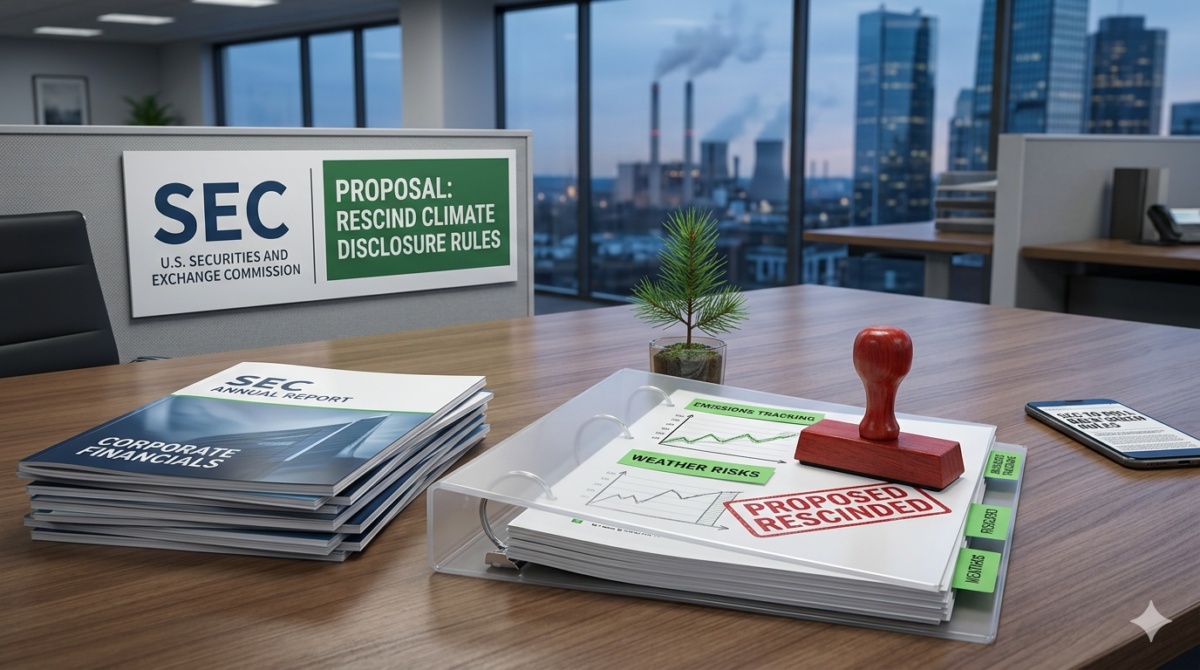
The Securities and Exchange Commission has proposed rescinding federal climate-disclosure rules that would require public companies to report certain climate-related risks and financial effects.
The proposal does not immediately eliminate the rules. The SEC adopted them in March 2024, but they were stayed before taking effect because of legal challenges. As of September 3, 2026, the SEC’s rescission remains a proposal rather than a finalized rule.
If the agency completes the rescission, public companies could face fewer standardized federal climate-reporting requirements. However, companies may still have disclosure obligations under existing securities laws, state regulations and international reporting regimes.
Key Takeaways
- The SEC adopted federal climate-disclosure rules in March 2024.
- The rules were stayed in April 2024 while legal challenges proceeded.
- The SEC stopped defending the rules in court in March 2025.
- On May 29, 2026, the agency proposed rescinding them.
- The public-comment period closed on August 3, 2026.
- Rescission would not eliminate every corporate climate-disclosure obligation.
- Energy companies operating across multiple jurisdictions may still face state and international reporting requirements.
What Are the SEC Climate Disclosure Rules?
The SEC adopted its climate-disclosure rules in March 2024 under the Securities Act of 1933 and the Securities Exchange Act of 1934.
The rules were designed to give investors more consistent information about climate-related financial risks. Depending on a company’s circumstances, required disclosures could have included:
- Material climate-related risks affecting business strategy or financial performance
- Corporate governance and management of those risks
- Certain expenses and financial effects associated with severe weather
- Material expenditures related to climate-risk mitigation or adaptation
- Scope 1 and Scope 2 greenhouse gas emissions from certain larger companies when considered material
“Material” generally means that a reasonable investor would consider the information important when making an investment or voting decision.
The rules did not require companies to report Scope 3 emissions generated throughout their broader value chains.
For additional background, see ENMG’s previous coverage of the SEC’s original climate-disclosure rules.
Why the Rules Never Took Effect
The SEC formally adopted the rules, but they did not reach their scheduled compliance stages.
Business organizations and Republican-led states challenged them in multiple courts. The cases were consolidated before the U.S. Court of Appeals for the Eighth Circuit. On April 4, 2024, the SEC stayed the rules while the litigation continued.
The U.S. Chamber of Commerce and attorneys general from several Republican-led states argued that the requirements exceeded the SEC’s authority and would impose substantial costs on companies.
In March 2025, the SEC voted to end its defense of the rules in court. The Eighth Circuit subsequently placed the litigation on hold while the Commission considered what to do with them.
This distinction is important: the rules were officially adopted, but they were stayed before companies were required to comply.
What Is the SEC Proposing?
On May 29, 2026, the SEC proposed rescinding the climate-disclosure rules in their entirety.
The Commission said the requirements were unnecessarily burdensome, inconsistent with its traditional materiality-based approach and potentially beyond its statutory authority.
SEC Chairman Paul Atkins said disclosure requirements should remain guided by materiality, avoid directing corporate behavior and provide benefits that justify their costs.
According to the SEC’s proposal, the Commission believes the 2024 rules:
- Are unnecessary under the existing company-specific materiality standard
- Extend beyond the central purposes of federal securities law
- Create costs that may outweigh their informational value
- Could discourage companies from entering or remaining in public markets
- Risk using securities regulation to influence corporate climate policy
The proposal is consistent with the administration’s broader emphasis on deregulation and expanded domestic energy production. ENMG has examined that direction in its coverage of Trump’s energy-policy actions and regulatory rollbacks and the proposed White House energy budget’s shift away from climate programs.
Why Supporters Favor Rescission
Supporters of the proposal argue that the SEC’s primary responsibility is to protect investors and oversee capital markets—not to establish national climate policy.
The U.S. Chamber of Commerce has supported rescission, warning that the reporting requirements could impose significant compliance costs and discourage privately held companies from going public.
Some companies in emissions-intensive industries have also expressed concern about the cost and complexity of collecting, verifying and reporting climate data.
Energy, aviation, transportation and agricultural companies may face particular challenges because their emissions can be distributed across complex facilities, operations and supply chains.
Supporters also argue that existing securities laws already require public companies to disclose material risks, including climate-related risks when they could meaningfully affect business performance.
Why Investors and Climate Groups Oppose the Proposal
Opponents argue that inconsistent voluntary reporting makes it difficult for investors to compare companies’ exposure to climate risks.
Climate-related events can produce material business consequences, including:
- Damage to facilities and infrastructure
- Supply-chain interruptions
- Higher insurance costs
- Commodity-price volatility
- Regulatory and litigation risks
- Changes in energy demand
- Expenses associated with adapting operations
Some investors therefore view standardized climate information as financial data rather than environmental advocacy.
Andrew Behar, CEO of the shareholder advocacy organization As You Sow, argued that rescission would reduce investors’ access to information about material climate-related financial risks.
The debate reflects a fundamental disagreement over whether standardized climate reporting protects investors or improperly expands the SEC’s regulatory role.
It also forms part of the wider national debate examined in ENMG’s coverage of the proposed EPA greenhouse-gas regulatory reversal.
What Rescission Could Mean for Energy Companies
If the SEC finalizes its proposal, energy companies could avoid the specific federal reporting framework created by the 2024 rules.
That could reduce some compliance expenses, particularly for companies that would otherwise need to develop new reporting procedures, internal controls and emissions-assurance systems.
However, rescission would not necessarily end climate reporting.
Public energy companies would still have to disclose risks that are material under existing securities laws. A company could therefore need to discuss climate-related litigation, severe-weather damage, changing demand, regulatory costs or transition risks when those issues materially affect its business.
Companies may also continue publishing voluntary sustainability reports in response to investor, lender, insurer or customer expectations.
Multinational energy companies face another complication: climate-disclosure requirements are developing outside the SEC’s jurisdiction.
California and International Requirements Remain Relevant
California has established separate corporate climate-reporting requirements.
The state’s Climate Corporate Data Accountability Act, or SB 253, applies to certain U.S.-based companies doing business in California with more than $1 billion in annual revenue. It requires covered entities to report Scope 1, Scope 2 and, subsequently, Scope 3 greenhouse gas emissions.
A related law, SB 261, requires certain companies with more than $500 million in annual revenue to publish biennial reports addressing climate-related financial risks and measures adopted to manage them. California adopted implementing regulations in 2026, according to the California Air Resources Board.
International disclosure standards are also expanding. As of March 2026, approximately 40 jurisdictions representing more than 60% of global GDP had adopted or announced plans to use standards developed by the International Sustainability Standards Board, according to the IFRS Foundation.
Consequently, a company may avoid the SEC’s climate-specific framework while remaining subject to state, foreign or market-driven reporting requirements.
What Happens Next?
The SEC published the proposal in the Federal Register on June 3, 2026. The public-comment period closed on August 3, 2026.
The Commission must now evaluate submitted comments before deciding whether to adopt a final rescission rule, modify the proposal or take another course of action.
Until the SEC completes that process:
- The 2024 rules remain adopted.
- Their implementation remains stayed.
- Companies are not presently required to comply with those climate-specific rules.
- Existing federal securities disclosure requirements continue to apply.
- State and international reporting obligations must be evaluated separately.
The SEC’s official rulemaking docket should be treated as the authoritative source for future status changes.
The Larger Climate-Disclosure Debate
The SEC’s proposal represents another major change in federal climate policy. Supporters see it as a return to investor-focused securities regulation and a reduction in unnecessary corporate costs. Opponents see it as the removal of comparable information investors need to evaluate financial risk.
For energy companies, the practical situation is more complicated than either position suggests. Federal requirements may decrease while state, international and voluntary reporting expectations continue developing.
That creates a fragmented system in which a company’s obligations depend on its size, public-market status, geographic operations and exposure to different regulatory jurisdictions.
Regardless of whether the SEC completes the rescission, climate-related financial risk—and the debate over how companies should report it—will remain an important issue for energy producers, investors and policymakers.
Frequently Asked Questions
Has the SEC already rescinded its climate-disclosure rules?
No. As of September 3, 2026, the SEC has proposed rescission, but it has not published a final rescission rule.
Are the 2024 SEC climate rules currently being enforced?
No. The Commission stayed the rules in April 2024 while legal challenges proceeded.
Did the SEC climate rules require Scope 3 reporting?
No. The final 2024 rules did not require companies to disclose Scope 3 value-chain emissions.
Would rescission eliminate all climate-disclosure requirements?
No. Public companies must still disclose material risks under existing securities laws. State, foreign and voluntary reporting frameworks may also apply.
What does “material” mean in SEC reporting?
Information is generally material when a reasonable investor would consider it important when making an investment or voting decision.
How could rescission affect energy companies?
It could reduce federal climate-specific compliance requirements, but energy companies may still need to disclose material financial risks and comply with California or international reporting regimes.
Keep In Touch with Shale Magazine
As the new era of energy unfolds, you can bet we’ll be the boots on the ground to keep you informed. Subscribe to Shale Magazine for sharp insight into the arenas that matter most to your life. And don’t forget to listen to our riveting podcast, The Energy Mixx Radio Show, where our very own Kym Bolado interviews the most extraordinary thought leaders, business innovators, and industry experts of our time.
Subscribe to get more posts from Felicity Bradstock