ENMG Analysis
A new domestic LNG deal from Houston-based Stabilis Solutions shows that Gulf Coast liquefied natural gas has uses far beyond overseas exports. The company has secured a three-year supply agreement with an unnamed commercial aerospace customer operating at NASA’s Stennis Space Center in Mississippi.
The agreement is smaller than the multibillion-dollar export projects that dominate LNG coverage, but it illustrates a separate part of the market: producing LNG at regional plants and transporting it directly to customers that require fuel at a specific site.
Stabilis announced the agreement on November 10 in a release furnished to the Securities and Exchange Commission. The contract runs from January 1, 2027, through December 31, 2029, and includes a minimum commitment of 230,000 gallons per month. Monthly purchases could reach 260,000 gallons.
Stabilis has supplied the customer at Stennis since 2024. The new development is therefore the three-year contract and its stated minimum volume—not the first delivery of LNG to the site.
What The Take-Or-Pay Agreement Means
Stabilis describes the contract as a take-or-pay agreement. Under this type of arrangement, a customer generally commits to purchase a minimum quantity or make a corresponding payment, subject to the contract’s specific provisions.
That structure can give a supplier greater visibility into minimum demand and support decisions involving production, transportation equipment, staffing, and inventory. It does not mean the customer will necessarily consume the maximum monthly quantity.
Multiplying the announced minimum of 230,000 gallons by the contract’s 36 months produces an implied minimum commitment of 8.28 million gallons. That total is arithmetic based on the company’s announcement, not a delivery forecast. The complete contract has not been disclosed, so any exceptions, adjustment provisions, or other commercial conditions remain unknown.
Stabilis also did not disclose the contract price, expected revenue, or the customer’s identity. Those omissions make it impossible to calculate the agreement’s financial contribution from the published volume figures alone.
Why This Is Not An LNG Export Deal
LNG is natural gas cooled to approximately minus 260 degrees Fahrenheit, reducing its volume to about one-six-hundredth of its gaseous volume. That makes it practical to store and transport natural gas where pipeline service is unavailable, insufficient, or unsuitable for a customer’s needs, according to the U.S. Energy Information Administration.
Large export terminals use that physical process to load LNG onto ocean-going carriers. Stabilis operates on a different scale. Its business includes regional liquefaction, storage, cryogenic transportation, equipment rental, engineering, and field services.
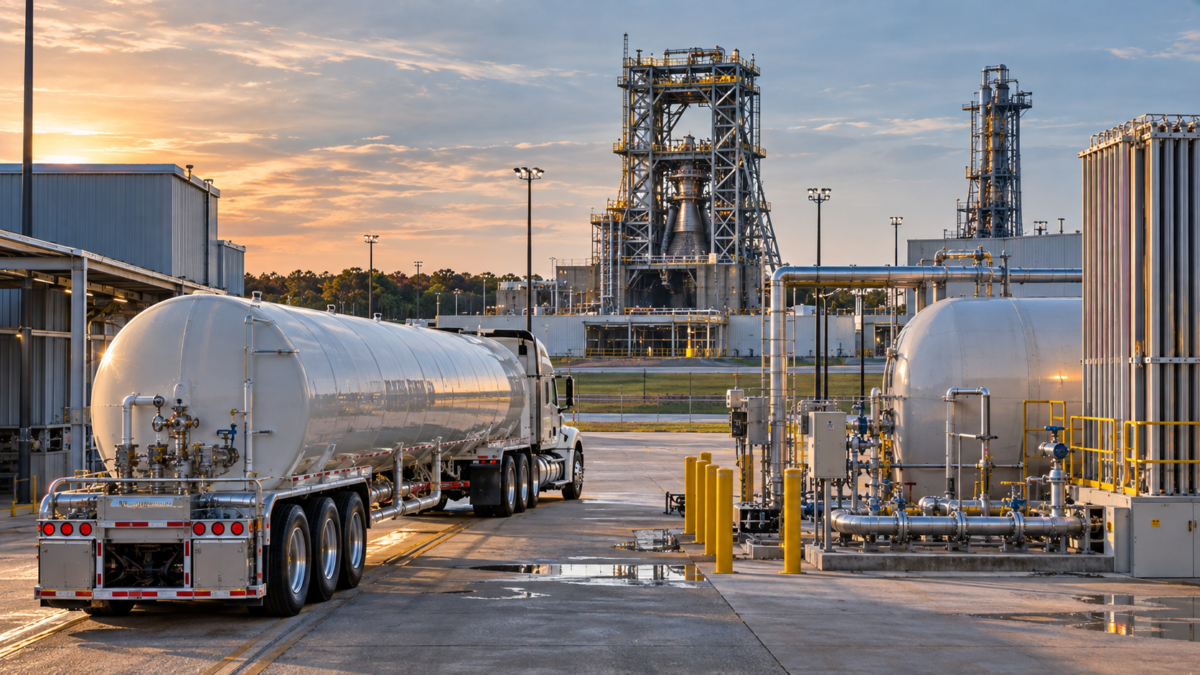
The company’s latest quarterly SEC filing says it distributes LNG using cryogenic trailers and can source fuel from company-owned plants or third-party suppliers. The Department of Energy describes similar truck-based movements as a form of small-scale LNG delivery, sometimes called a “virtual pipeline,” because the fuel reaches customers without a conventional natural gas pipeline extending directly to the site.
This agreement should not be confused with a Gulf Coast export project, such as the proposed facility examined in ENMG’s analysis of the ST LNG federal approval. No export terminal, ocean-going cargo, or international buyer is involved in the Stabilis announcement.
The Customer Is Commercial—Not NASA
The agreement supports an existing commercial aerospace customer’s operations at the John C. Stennis Space Center in Hancock County, Mississippi. Stabilis did not identify that customer or describe the specific way it will use the LNG.
NASA operates Stennis as a major rocket propulsion testing center and supports both government and commercial projects. Its propulsion-testing overview says the facility can conduct large-engine, component, thruster, and subscale testing for government and commercial customers.
That background explains why an aerospace company may operate at Stennis. It does not establish that NASA signed the LNG agreement, will pay for the fuel, or selected Stabilis.
The announcement also does not identify a rocket, engine, test stand, or propulsion system connected to the contract. LNG can be used as a fuel or industrial energy source, but the customer’s precise application should not be inferred without confirmation.
Louisiana Will Supply Most Of The LNG
The Texas connection is primarily corporate. Stabilis is headquartered in Houston and operates a liquefaction plant in George West, Texas, with stated production capacity of up to 100,000 gallons per day.
However, the company expects to supply this aerospace customer primarily from its Port Allen, Louisiana, facility. That plant can produce up to 30,000 gallons per day, according to the company’s quarterly filing.
At the announced minimum, the contract would average approximately 7,560 gallons per day over a typical 30.4-day month. The maximum monthly volume would average approximately 8,550 gallons per day. Those calculations provide scale, but they should not be interpreted as a steady daily production schedule. Actual deliveries could occur in batches and vary throughout each month.
The Port Allen plant’s stated capacity appears sufficient to cover those average volumes on paper. Operational availability, other customer commitments, storage, trailer scheduling, maintenance, and contract requirements would determine how supply works in practice.
Stabilis has not assigned any volume under this agreement to its George West plant. The contract therefore does not establish additional production or demand in South Texas.
The distinction resembles a broader point ENMG has examined in its coverage of Texas gas pipeline access and well economics: where a company is headquartered, where fuel is produced, where it is priced, and where it is ultimately consumed can be different places.
Why Regional LNG Delivery Matters
Small-scale LNG can provide fuel to industrial, marine, power-generation, mining, and transportation customers that are not adequately served by pipelines. Its compact liquid form allows the gas to be moved using insulated cryogenic equipment and stored at the customer’s location.
That flexibility comes with tradeoffs. Liquefaction consumes energy, cryogenic storage and transportation require specialized equipment, and over-the-road delivery introduces logistics and scheduling costs. LNG also must remain at extremely low temperatures, and facilities require systems for safe transfer, storage, pressure control, and vapor management.
A long-term supply agreement can help coordinate those requirements, but it does not eliminate operational risk. Production interruptions, transportation delays, equipment availability, severe weather, and changes in customer demand can affect delivery.
Those constraints distinguish distributed LNG from both pipeline gas and large-scale exports. Pipeline systems can move much greater volumes continuously when the necessary infrastructure exists. Truck-delivered LNG offers more flexibility for individual customers but usually at a smaller scale and with added handling.
ENMG’s analysis of Texas gas storage and Gulf Coast deliverability explains the larger principle: having natural gas available somewhere in the region is different from having it at the correct location, in the correct form, when a customer needs it.
What To Watch Next
The immediate milestone is the contract’s scheduled start on January 1, 2027. The more useful operating evidence will come later: actual delivery volumes, continued production at Port Allen, and confirmation that the supply arrangement performs as intended.
Several questions remain unanswered:
- How will the commercial customer use the LNG?
- What storage, vaporization, and other equipment is included?
- Will Stabilis provide transportation and onsite services?
- What backup supply is available if Port Allen is offline?
- Could the George West facility support the contract if needed?
- How much revenue will the agreement generate?
For Stabilis, the deal provides a contracted minimum with an existing customer in a specialized market. For Houston and South Texas, it demonstrates that regional LNG businesses can serve aerospace and other domestic customers without relying entirely on exports.
The agreement does not add Texas liquefaction capacity, establish new demand at George West, or prove that similar contracts are becoming widespread. It does show how a Houston-based supplier can connect regional LNG production with a customer that needs natural gas delivered in liquid form to a particular site.
That is the development worth watching: not another export cargo, but a smaller and more targeted LNG supply chain linking Gulf Coast infrastructure with commercial aerospace operations.
Keep In Touch with Shale Magazine
As the new era of energy unfolds, you can bet we’ll be the boots on the ground to keep you informed. Subscribe to Shale Magazine for sharp insight into the arenas that matter most to your life. And don’t forget to listen to our riveting podcast, The Energy Mixx Radio Show, where our very own Kym Bolado interviews the most extraordinary thought leaders, business innovators, and industry experts of our time.