
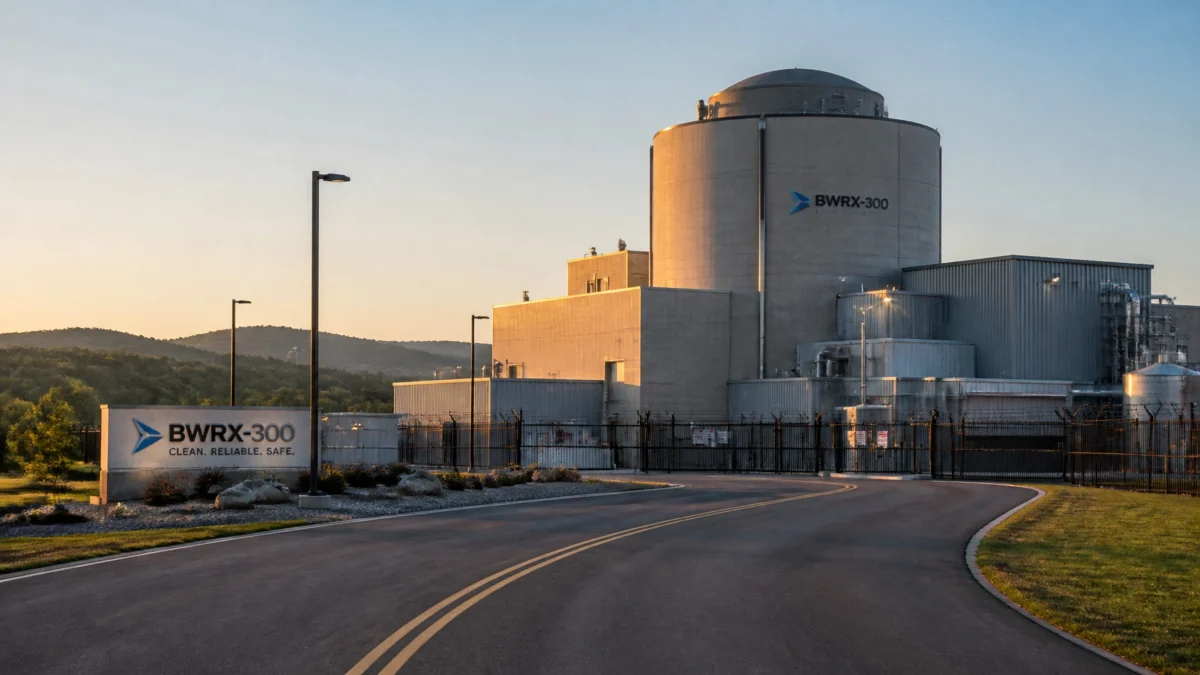
The recent BWRX-300 reactor licensing milestone marks a significant shift in the trajectory of the American nuclear industry as federal regulators move closer to authorizing the first commercial small modular reactor construction permit. On July 15, 2026, the staff of the Nuclear Regulatory Commission (NRC) formally recommended that the Commission issue a construction permit to the Tennessee Valley Authority (TVA) for its proposed site at Clinch River in Oak Ridge, Tennessee. This recommendation follows an exhaustive multi-year review process that signals a new era for advanced nuclear deployment, potentially providing a scalable and reliable carbon-free energy solution to meet the surging electricity demands of the next decade.
The recommendation is the culmination of technical safety evaluations and environmental impact studies that have been underway since TVA first submitted its application in 2025. By moving the project into the final stages of the licensing process, the NRC staff has validated the design of the BWRX-300, a 300-MWe boiling water reactor developed by GE Hitachi. For industry observers, this development is not merely a procedural win for TVA but a litmus test for the efficiency of the modern regulatory framework in handling non-traditional, modular reactor designs that promise lower capital costs and faster construction timelines than the gigawatt-scale plants of the past.
Technical Validation of the BWRX-300 Reactor Licensing Milestone
The NRC staff's recommendation is anchored by the issuance of the Final Safety Evaluation Report (FSER) in June 2026, a document that serves as the technical backbone for the project's viability. The FSER concludes that the BWRX-300 design, as proposed for the Clinch River Unit 1, meets the rigorous standards of the Atomic Energy Act of 1954 and conforms to all relevant NRC regulations for commercial light-water reactors. This finding is critical because it confirms that the preliminary design provides an adequate margin of safety, ensuring that the facility can be constructed in a manner that protects public health and the environment.
Key technical findings in the FSER highlight the "reasonable assurance" that the final design will align with safety design bases. The NRC staff also assessed TVA’s financial and technical qualifications, determining that the utility possesses the necessary resources and expertise to manage a project of this complexity. This level of scrutiny is essential for small modular reactors (SMRs), which utilize simplified passive safety systems that differ from the active cooling systems found in older generation reactors. The BWRX-300 specifically leverages natural circulation and passive cooling, which reduces the number of required pumps, valves, and pipes, thereby decreasing both the potential for mechanical failure and the overall cost of the build.

The Advisory Committee on Reactor Safeguards (ACRS), an independent body of experts, also voiced its support for the permit following its review in June 2026. In their Final Letter Report to the Commission Chairman, the ACRS stated that their findings support the issuance of the construction permit for the Clinch River site. With both the NRC staff and the ACRS in agreement, the project enters the mandatory hearing phase with a high degree of technical momentum. This consensus is vital for maintaining investor confidence and demonstrates that the regulatory pathway for SMRs, though still intensive, is becoming increasingly predictable.
Environmental Stewardship and the BWRX-300 Reactor Licensing Milestone
Beyond the technical safety metrics, the success of the BWRX-300 reactor licensing milestone is deeply rooted in the environmental review process. In April 2026, the NRC finalized the Supplemental Environmental Impact Statement (SEIS), which evaluated the potential ecological and socio-economic effects of constructing and operating an SMR at the Clinch River site. The SEIS concluded that after weighing the benefits of clean energy production against the environmental and technical costs, the recommendation remains firmly in favor of issuing the permit.
According to the federal findings, no "environmentally preferable alternative" was identified that could meet the project's purpose and need for carbon-free, baseload power. This is a significant endorsement for nuclear energy in the context of the broader energy transition. While renewables like wind and solar are expanding rapidly, the need for steady, reliable power that does not depend on weather conditions is a primary driver for TVA’s nuclear investment. The Clinch River project is positioned to provide 300 megawatts of constant power, which is particularly relevant as the Tennessee Valley continues to attract energy-intensive industries, including data centers and advanced manufacturing.

The environmental review also examined the impact on local water resources and biodiversity. By utilizing an existing industrial site at Oak Ridge, TVA is able to minimize the footprint of the new facility and leverage existing infrastructure. The NRC staff’s recommendation explicitly states that the construction should proceed unless unforeseen safety issues mandate otherwise, reflecting a balanced approach that prioritizes both energy security and environmental preservation. For professionals in the energy sector, this highlights the role of SMRs as a "good neighbor" technology: compact enough to be sited near existing grid connections without the massive land-use requirements of larger industrial projects.
Next Steps for the BWRX-300 Reactor Licensing Milestone and TVA
While the staff recommendation is a major hurdle cleared, the final authority to grant the construction permit rests with the NRC Commissioners. A mandatory uncontested hearing is scheduled for August 13, 2026, where the Commission will review the record of the safety and environmental evaluations. Given that no petitions to intervene were filed during the official 60-day window, the hearing is expected to proceed without significant legal challenges. This lack of opposition is a testament to TVA’s extensive community engagement and the technical robustness of the GE Hitachi design.
The current schedule targets a final permit decision by the fall of 2026. If approved, TVA will be authorized to begin major construction activities at the Clinch River site. This timeline is being watched closely by other utilities, such as those discussed in recent SHALE Magazine analysis of grid reliability and the energy abundance roadmap. The success of the Clinch River project could catalyze a wave of similar applications across the United States, as the DOE and industry leaders look for ways to revitalize the domestic nuclear supply chain.

Furthermore, the economic implications are substantial. The NRC staff reported that the review process alone involved over 16,500 staff hours and approximately $1.4$ million in contractor costs: a figure that, while significant, represents an improvement in efficiency compared to previous licensing efforts. As the industry moves toward "nth-of-a-kind" deployments, these regulatory costs are expected to decrease, making nuclear energy more competitive with other baseload sources. For now, the focus remains on the upcoming August hearing, which will likely solidify the BWRX-300’s place as the first of many SMRs to join the American power fleet.
Yoast SEO Elements
- Focus Keyphrase: BWRX-300 reactor licensing milestone
- Meta Description: NRC staff recommends a construction permit for TVA's BWRX-300 SMR at Clinch River, marking a historic BWRX-300 reactor licensing milestone for U.S. nuclear.
- Slug: nrc-recommends-tva-bwrx-300-construction-permi