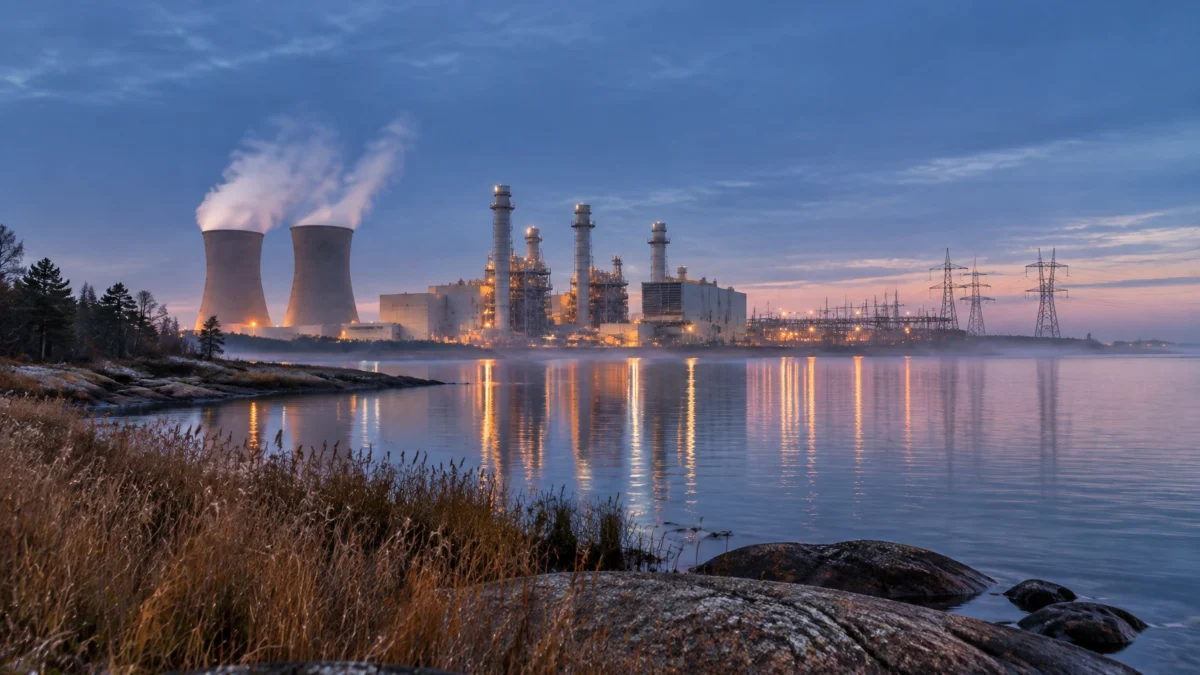

Long Mott Nuclear Project Nears Final NRC Safety Review
ENMG Analysis
The Nuclear Regulatory Commission is approaching the final stage of its technical review of Dow and X-energy’s proposed Long Mott Generating Station in Seadrift, Texas. The NRC’s project schedule targets a final safety evaluation in November 2026, while Dow has said it expects a construction permit decision by the end of the year.
The distinction is important. The NRC’s official milestone table lists the construction permit decision as “TBD,” meaning the agency has not committed to a formal issuance date. The November target applies to the final safety evaluation, not automatically to the permit itself.
If approved, Long Mott would be a significant test of whether an advanced reactor can be licensed and deployed directly alongside a large industrial operation. The four-unit project is designed to provide Dow’s Seadrift manufacturing site with electricity and high-temperature steam, rather than serving only as a conventional grid power plant.
Reuters reported that an additional award of up to $1 billion in Department of Energy support brought the project’s total potential federal funding since 2021 to approximately $2.15 billion. The funding is connected to DOE’s Advanced Reactor Demonstration Program, or ARDP.
That figure represents potential federal cost-share support and should not be treated as the plant’s final construction cost. Dow has not publicly disclosed a total construction-cost estimate, and the federal contribution does not represent the project’s complete private and public investment requirement.
NRC Environmental Review for the Long Mott Nuclear Project Is Complete
Long Mott Energy LLC, a Dow subsidiary, submitted the construction permit application on March 31, 2025. The NRC accepted the application for detailed review in May of that year and established an 18-month review schedule.
The agency completed the project’s environmental assessment on May 18, 2026, issuing a Finding of No Significant Impact, or FONSI. The determination means NRC staff concluded that the proposed construction would not result in significant environmental impacts requiring preparation of a more extensive environmental impact statement under the reviewed conditions.
It does not mean the reactor has been approved for construction or operation.
The NRC’s Long Mott project page identifies the application as a construction permit request for four Xe-100 modules in Calhoun County, Texas. The agency’s published schedule shows that the draft safety evaluation was completed in February 2026 and that the advanced safety evaluation reached its scheduled milestone in August.
The next major technical milestone is the final safety evaluation targeted for November. The NRC has also scheduled an uncontested mandatory hearing for September 22, 2026, in Port Lavaca. The hearing record will remain open for written comments through October 6.

A Construction Permit Is Not an Operating License
The Long Mott application is being reviewed under the traditional 10 CFR Part 50 licensing framework. A Part 50 construction permit authorizes the applicant to build a nuclear facility after the NRC completes its required reviews. It does not authorize the company to load fuel or operate the reactors.
After construction, the project would need a separate operating license unless the licensing strategy changes or another authorization is pursued. The operating-license process would address construction conformity, operational programs, testing, staffing, emergency planning and other requirements.
This distinction also separates Long Mott from the NRC’s newer Part 53 framework. The agency finalized an optional, technology-inclusive Part 53 licensing framework in 2026, with a risk-informed, performance-based approach intended for advanced reactor technologies. However, the Seadrift project’s current construction permit application remains a Part 50 proceeding.
ENMG has examined these different regulatory pathways in its coverage of U.S. nuclear permitting reform.
Long Mott would also not be the first advanced reactor construction permit issued by the NRC. The agency issued a construction permit for TerraPower’s Kemmerer Power Station in Wyoming in March 2026. Seadrift would instead represent an important industrial co-location case, involving a commercial advanced reactor designed to supply both process heat and electricity to a chemical manufacturing site.
What the Xe-100 would provide
The Xe-100 is a high-temperature gas-cooled reactor that uses helium as its coolant and TRISO particle fuel embedded in graphite pebbles. Each module is rated at 80 megawatts-electric and approximately 200 megawatts-thermal.
The proposed plant would include four modules with a combined electrical capacity of 320 megawatts-electric and approximately 800 megawatts-thermal of reactor heat. Capacity is the maximum rate of output, not the amount of electricity the facility would generate over a year. Actual generation would depend on maintenance, operating conditions, dispatch and the eventual operating license.
For Dow, the thermal output may be as important as the electrical output. Chemical manufacturing requires continuous heat and steam, and the project is intended to replace aging power and steam assets at the Seadrift site. Nuclear Engineering International reported that the facility is intended to provide electricity and high-temperature industrial steam to Dow’s UCC Seadrift Operations.
Industrial co-location can improve energy utilization because the reactor’s heat is used directly rather than converted entirely into electricity. It may also reduce exposure to natural gas price volatility for steam production. At the same time, the economics depend on construction cost, financing, reliability, fuel availability, regulatory compliance and Dow’s long-term willingness to commit capital to the project.

TRISO Fuel Creates Both an Advantage and a Supply-Chain Test
TRISO fuel is designed with multiple ceramic and carbon-based layers surrounding each uranium fuel kernel. In the Xe-100 design, the particles are incorporated into graphite fuel pebbles. The fuel architecture is intended to retain fission products at high temperatures and support the reactor’s high-temperature operating profile.
The fuel is also part of the project’s commercial risk. Advanced reactors require reliable access to high-assay low-enriched uranium, or HALEU, and developers must establish fuel fabrication, transportation, quality-assurance and regulatory infrastructure at commercial scale.
The Centrus HALEU supply-chain coverage examines the federal effort to expand domestic HALEU production. ENMG has also reported on how the Centrus-Radiant fuel agreement connects planned reactor deployments with future domestic enrichment capacity.
X-energy is developing TRISO fuel-manufacturing capability, but the existence of a demonstration or pilot facility does not by itself guarantee the volume, qualification and delivery schedule required for a four-unit commercial plant.

Texas Policy Adds Support but Does Not Remove Project Risk
Texas has established a state-level policy framework intended to attract new nuclear investment. The Texas Nuclear Development Fund provides context for how state support, federal programs and private capital could combine to advance SMR development.
That support may benefit X-energy, Dow, specialized manufacturers and the Gulf Coast workforce if it leads to engineering, construction and long-term operations activity. It could also create a reference project for refineries, petrochemical facilities, hydrogen producers and other industrial users that need dependable heat and power.
However, public funding does not eliminate first-of-a-kind project risk. The project must still demonstrate that its construction schedule, supply chain, fuel cycle, workforce and operating costs can support a commercial facility. Nuclear-qualified welders, machinists, inspectors and component manufacturers remain potential constraints as multiple advanced-reactor projects move through licensing.
Community participation is another part of the process. The NRC’s Atomic Safety and Licensing Board initially granted San Antonio Bay Estuarine Waterkeeper intervention rights concerning a financial-qualification contention. After Long Mott supplemented its financial information, the board dismissed the admitted contention as moot, and X-energy subsequently reported that the contested proceeding was terminated in June 2026.
The separate mandatory hearing scheduled for September 22 provides the public with an opportunity to speak on the record, but it is not a new contested hearing or an opportunity to file additional intervention requests.
Ratepayers are also affected indirectly rather than automatically. Because the plant is intended to serve an industrial site, the project’s costs and benefits will depend on its ownership structure, power arrangements and relationship with the Texas electricity market. A successful facility could reduce pressure from some industrial power demand, but any broader grid benefit would depend on how the plant is interconnected and operated.
What to Watch Next
The most consequential near-term milestones are:
- The NRC’s mandatory hearing on September 22, 2026.
- The close of the public-comment record on October 6, 2026.
- The NRC’s final safety evaluation, currently targeted for November 2026.
- Any formal NRC decision on the construction permit.
- Dow’s investment decision, which the company has previously indicated would not be expected before 2028.
- Progress on Xe-100 fuel manufacturing, HALEU availability and nuclear-grade graphite.
- Construction planning, procurement and workforce development if authorization is granted.
- The eventual operating-license process after construction.
The Seadrift project has cleared its environmental review and reached the final stage of the NRC’s technical assessment. That is meaningful progress, but it is not yet a construction authorization or a commercial operating milestone. The larger question is whether the project can convert federal support and regulatory progress into a financeable, buildable industrial energy asset.
Keep In Touch with Shale Magazine
As the new era of energy unfolds, you can bet we’ll be the boots on the ground to keep you informed. Subscribe to Shale Magazine for sharp insight into the arenas that matter most to your life. And don’t forget to listen to our riveting podcast, The Energy Mixx Radio Show, where our very own Kym Bolado interviews the most extraordinary thought leaders, business innovators, and industry experts of our time.
Subscribe to get more posts from Amanda Jenkins