ENMG Analysis
The U.S. Department of Energy is making up to $50 million available over three years for research and development of silicon carbide nuclear fuel cladding, with the immediate objective of producing full-length test rods for irradiation in research reactors.
The funding opportunity, announced by the DOE Office of Nuclear Energy on October 5, is intended to advance silicon carbide cladding toward full-length lead test rod development and generate irradiation data that could support eventual U.S. Nuclear Regulatory Commission licensing and commercial deployment. Applications are due December 7, 2026, according to the funding opportunity posted on Grants.gov.
This is a research and development solicitation, not a procurement contract for licensed fuel. No silicon carbide cladding has been licensed for commercial use in the United States through this program, and success in fabricating a 12-foot rod would represent an engineering milestone rather than the completion of the regulatory process.
Why fuel cladding matters
Commercial light-water reactors use uranium processed into small ceramic fuel pellets. Those pellets are stacked inside long tubes, sealed at both ends, and assembled into fuel bundles. The tubes are known as fuel cladding.
Cladding separates the nuclear fuel from the reactor coolant and serves as the first engineered barrier containing fission products generated during reactor operation. It is therefore one of the most safety-critical components in a fuel assembly. The material must maintain its shape and integrity while exposed to neutron irradiation, high temperature, high pressure, corrosive water chemistry and mechanical stresses for years.
The cladding also has to perform during abnormal and accident conditions. A failure can allow radioactive material to enter the coolant system, making the behavior of the cladding central to fuel performance and nuclear safety analysis.
The DOE described the current fuel arrangement and the purpose of the new effort in its announcement of the funding opportunity.
Why zirconium alloys dominate today
Zirconium-based alloys are the established cladding materials for the U.S. light-water reactor fleet. These include Zircaloy formulations and proprietary alloys developed by nuclear fuel manufacturers. Their continued use reflects a balance of nuclear, mechanical and manufacturing properties.
Zirconium has relatively low neutron absorption, which allows more neutrons to interact with the fuel rather than being captured by the cladding. It also provides useful corrosion resistance in the high-temperature water environment found inside a reactor and has sufficient mechanical strength and ductility for fuel fabrication, handling and operation.
Its principal weakness becomes more important under severe accident conditions. At very high temperatures, zirconium can react with steam and generate hydrogen. Hydrogen accumulation was one of the factors involved in the Fukushima Daiichi accident in 2011, when hydrogen explosions damaged reactor buildings after the loss of cooling following the earthquake and tsunami.
That history has shaped the development of so-called accident-tolerant fuel technologies. The phrase covers several approaches, including changes to fuel pellets, cladding materials or both. Silicon carbide cladding is one materials-focused approach, but it should not be treated as a complete replacement for the safety systems, emergency procedures and containment structures that protect a nuclear plant.
What silicon carbide offers
Silicon carbide is a ceramic material with properties that could address some of zirconium’s limitations. It can tolerate very high temperatures and has strong resistance to oxidation and steam at elevated temperatures. Compared with zirconium, silicon carbide has a lower potential for hydrogen generation during severe accident conditions.
Those characteristics are the reason researchers have considered silicon carbide for advanced fuel cladding. In principle, the material could provide additional time and margin during certain accident scenarios while supporting fuel operation under demanding conditions.
The tradeoffs are substantial, however. Silicon carbide is brittle rather than ductile. A metal tube can deform under stress while retaining some structural integrity; a ceramic does not generally absorb mechanical strain in the same way. Silicon carbide can fracture if subjected to certain impacts, stresses or flaws.
Fabrication also presents a challenge. Producing a long, thin-walled ceramic tube with consistent dimensions and reliable strength is more difficult than manufacturing conventional metal cladding. Joining the ceramic material to end fittings, sealing the rod and maintaining those seals during reactor operation are additional engineering problems.
Silicon carbide also behaves differently under neutron irradiation. Its dimensional stability, strength, thermal conductivity and interaction with other fuel-rod materials must be evaluated after exposure to the reactor environment. Its neutron absorption characteristics must likewise be accounted for in fuel and core design.

Why the 12-foot target matters
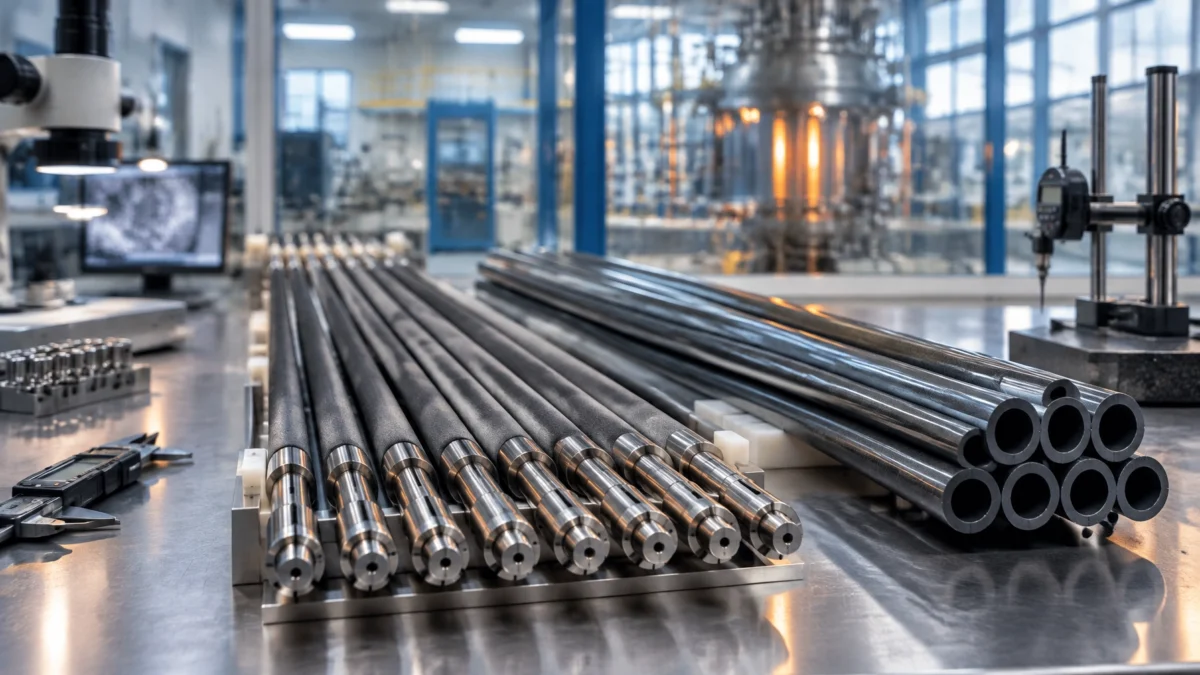
The DOE funding is designed to support the fabrication of 12-foot silicon carbide cladding fuel rods for irradiation testing. The length is significant because commercial light-water reactor fuel rods are roughly 12 feet, or about 3.7 meters, long.
A short laboratory specimen can demonstrate material properties without resolving all the problems associated with a full-length rod. A commercial-scale rod must remain straight, dimensionally stable and structurally sound over its entire length. It must also be compatible with fuel pellets, end fittings, fuel assemblies and reactor handling equipment.
Scaling from short samples to full-length rods is therefore a recognized gap between materials research and reactor deployment. The DOE’s target is not simply a larger test sample. It is an attempt to demonstrate whether the material can be manufactured in a geometry relevant to the existing light-water reactor fleet.
That distinction matters to the broader industry. A cladding material that cannot be produced consistently at commercial dimensions would have limited value, even if its performance in small unirradiated samples is promising.
Why irradiation testing is essential for licensing
Materials exposed to a reactor environment do not always behave as predicted by unirradiated testing. Neutron bombardment can alter a material’s microstructure, strength, swelling, dimensional stability and thermal performance. The effects may also depend on temperature, stress, burnup and the interaction between the cladding and the fuel.
Irradiation testing in a research reactor allows developers to gather evidence under controlled conditions. After exposure, researchers can conduct post-irradiation examinations to determine how the rods changed and whether they retained their required properties.
That evidence is central to the licensing pathway. The DOE says the program is intended to generate irradiation performance data needed for NRC licensing and commercial deployment. In other words, the funding is aimed at producing the technical record regulators would need to evaluate the material; it does not itself authorize the use of silicon carbide fuel in a commercial reactor.
Any future deployment would require NRC review and could require plant-specific analyses involving fuel design, reactor physics, thermal-hydraulics, materials performance, accident analysis and operating procedures. The process would be separate from, and in addition to, the research reactor testing funded under this opportunity.

Who is affected
The opportunity is relevant to nuclear fuel manufacturers, reactor vendors, national laboratories, universities, materials companies and research-reactor operators. It could also create demand for specialized ceramic fabrication, joining technologies, nondestructive examination and post-irradiation analysis.
For utilities, the potential benefit is longer-term. If silicon carbide cladding ultimately demonstrates reliable performance and receives regulatory approval, it could become an option for portions of the existing light-water reactor fleet. The technology could support efforts to improve fuel performance, add safety margin under certain accident conditions and potentially expand operational flexibility.
Those benefits remain conditional. Ceramic fabrication costs, supply-chain requirements, compatibility with current fuel assemblies and the need for new licensing analyses could affect commercial economics. A material that performs well technically may still face difficult questions about manufacturing yield, inspection, repair, transportation and replacement procedures.
The program also should not be confused with a change in fuel type. Silicon carbide cladding is primarily a materials substitution involving the barrier around the fuel pellets and the associated rod structure. By itself, it does not change the uranium fuel into a different enrichment category, does not create high-assay low-enriched uranium and does not constitute a new reactor design.
For context on the fuel-cycle issues affecting advanced nuclear development, readers can review ENMG’s coverage of the domestic HALEU supply chain.
Connection to the larger energy system
The DOE’s investment comes as utilities, policymakers and industrial customers are examining how to preserve and expand reliable nuclear generation. Existing reactors provide steady electricity for the grid, while proposed new reactors are being considered for industrial facilities, data centers and other large loads.
Fuel performance is one part of that broader effort. Improvements to cladding could affect reactor safety analysis, fuel-cycle economics, outage planning and the ability of existing plants to operate efficiently. At the same time, cladding research will not resolve other constraints facing nuclear expansion, including construction costs, workforce availability, component manufacturing, uranium conversion and enrichment capacity, waste management and licensing schedules.
The effort also sits alongside federal initiatives focused on reactor uprates, restarts and new nuclear capacity. ENMG’s analysis of the DOE’s nuclear capacity expansion strategy examines how those efforts fit into the broader reliability and industrial-demand debate.

What to watch next
The first near-term milestone is the December 7 application deadline. The Grants.gov notice identifies the effort as a cooperative agreement for silicon carbide cladding lead test rod development, with work covering research, fabrication, research-reactor insertion, irradiation and post-irradiation examination.
The more important milestones will come later:
- Selection of the project team and definition of its cost-sharing and technical responsibilities.
- Demonstration that full-length rods can be fabricated with consistent dimensions and reliable seals.
- Successful insertion and irradiation in a research reactor.
- Post-irradiation data on strength, cracking, dimensional stability, corrosion and fuel-cladding interaction.
- Determination of what additional testing and analysis the NRC would require before commercial use.
- Evidence that the material can be manufactured and inspected at a cost compatible with the commercial reactor fleet.
The pathway from funding award to full-length rod, irradiation data, licensing and commercial deployment will take multiple years. The DOE opportunity establishes a focused development step, but it does not guarantee that silicon carbide cladding will meet every technical, regulatory or economic requirement.
Keep In Touch with Shale Magazine
As the new era of energy unfolds, you can bet we’ll be the boots on the ground to keep you informed. Subscribe to Shale Magazine for sharp insight into the arenas that matter most to your life. And don’t forget to listen to our riveting podcast, The Energy Mixx Radio Show, where our very own Kym Bolado interviews the most extraordinary thought leaders, business innovators, and industry experts of our time.