
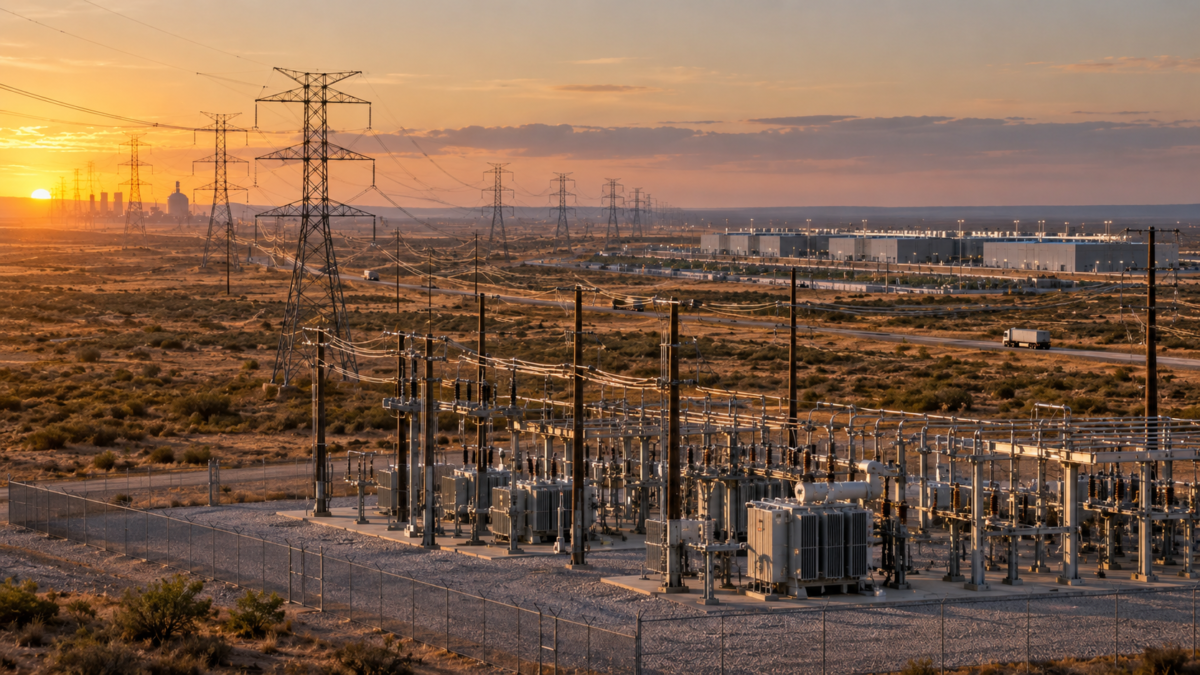
Texas’s energy demand is expected to rise sharply over the next decade as the population grows, industry expands, and more data centers launch operations in the state.
Texas is rapidly becoming a major green energy hub, as well as being a longstanding oil and gas powerhouse, with energy output expected to increase substantially over the next decade. However, a major limitation stands in the way of this expansion – a transmission infrastructure bottleneck. If Texas cannot address constraints on its grid infrastructure, the state may struggle to meet rising power demand.
Texas Power Demand Outlook
The demand on the Texas energy grid is expected to nearly double by 2032, reaching around 175 gigawatts (GW), according to estimates from the grid operator the Electric Reliability Council of Texas (ERCOT). The rapid rise in power demand is driven by a range of factors, including a growing population, industrial expansion, and the influx of data centers, according to ERCOT’s CEO, Pablo Vegas.
Regulators are confident that the increase in electricity generation, through new solar power and battery storage projects, will meet the growing demand; however, there are rising concerns around the bottlenecks in the state’s transmission network.
The high temperatures in Texas in July led ERCOT to report a record-breaking energy demand of 91.3 GW on July 22, far higher than the 85.5 GW record set in August 2023. ERCOT said it had no issue providing this power, reporting an excess of more than 20 GW of generation relative to demand. A recent expansion in the state’s solar capacity has contributed significantly to this generation, at times accounting for up to 45% of electricity demand.
Addressing the Bottleneck
While power generation has expanded significantly in Texas in recent years, utilities have not kept pace with the transmission network upgrades needed to reliably deliver this power to customers. ERCOT reported a large-load queue growth of over 200 GW since 2024, citing data centers, manufacturing, cryptocurrency, and industrial oil and gas development as the main drivers.
“We now are at about 188 GW in the large load interconnection queue, up 70% since March of this year,” explained Casey Bell, the Infocast Texas Clean Energy Summit’s executive briefing chairman, which was held in August.
“Of those 188 GW, 82 GW currently have interconnection studies under review. Another 22 GW have studies approved or have actually been approved to energize. 7 GW of large load are connected, up 30% on the year. 14 GW of large load are in advanced planning, which is up 60%. So, the big question is, how are we going to interconnect all of those large loads safely, reliably, and expeditiously?” Bell said.
Grid Expansion
In April, ERCOT approved $33 billion in grid expansion funding to address unprecedented load growth and transmission constraints, with plans to construct over 2,400 miles of 765 kV high-voltage power lines. This aims to address the lack of transmission capacity that is holding back developers looking to invest in the state.
ERCOT is responsible for around 90% of the electricity load and power demand in Texas. The operator’s transmission plan includes the extension of high-voltage transmission in ERCOT West, Far West and North, and the Permian Basin. It is expected to reduce power curtailment of wind and solar power in West Texas where the accelerated development of clean energy projects has outpaced transmission infrastructure.
However, because it can take several years to complete new transmission lines, the bottleneck is expected to persist in the short term as the state’s power demand continues to rise. According to an ERCOT forecast from December 2025, summer and winter planning reserve margins in Texas’s transmission infrastructure will decrease from 2026 through 2030, reaching negative levels by 2028.
ERCOT’s high-voltage transmission expansion is not expected to be completed until 2030, meaning that “the transmission gap will persist through most of this decade. So, new generation and new load face the same bottlenecks,” Aparajita Datta, an Energy Policy Associate at the University of Houston’s UH Energy division, told Reuters.
Halting Data Center Development
Fears over the transmission gap have led Texas Governor Greg Abbott to make Texas the first major data center hub to pause new grid connections for data centers while the state government assesses operators’ plans for the facilities. Governor Abbott cited concerns about future energy supply and demand as the reason for the pause on development.
The announcement of the pause in early August led the U.S. Energy Information Administration to lower its forecast for electricity demand growth in Texas to 6% in 2027, down from 14%.
While a halt to data center development could provide the buffer needed for ERCOT to catch up on grid expansion and modernization, the operator will need to regularly reassess the state’s power demand outlook to plan for future infrastructure improvements and help mitigate potential transmission gaps.
Keep In Touch with Shale Magazine
As the new era of energy unfolds, you can bet we’ll be the boots on the ground to keep you informed. Subscribe to Shale Magazine for sharp insight into the arenas that matter most to your life. And don’t forget to listen to our riveting podcast, The Energy Mixx Radio Show, where our very own Kym Bolado interviews the most extraordinary thought leaders, business innovators, and industry experts of our time.
Subscribe to get more posts from Felicity Bradstock