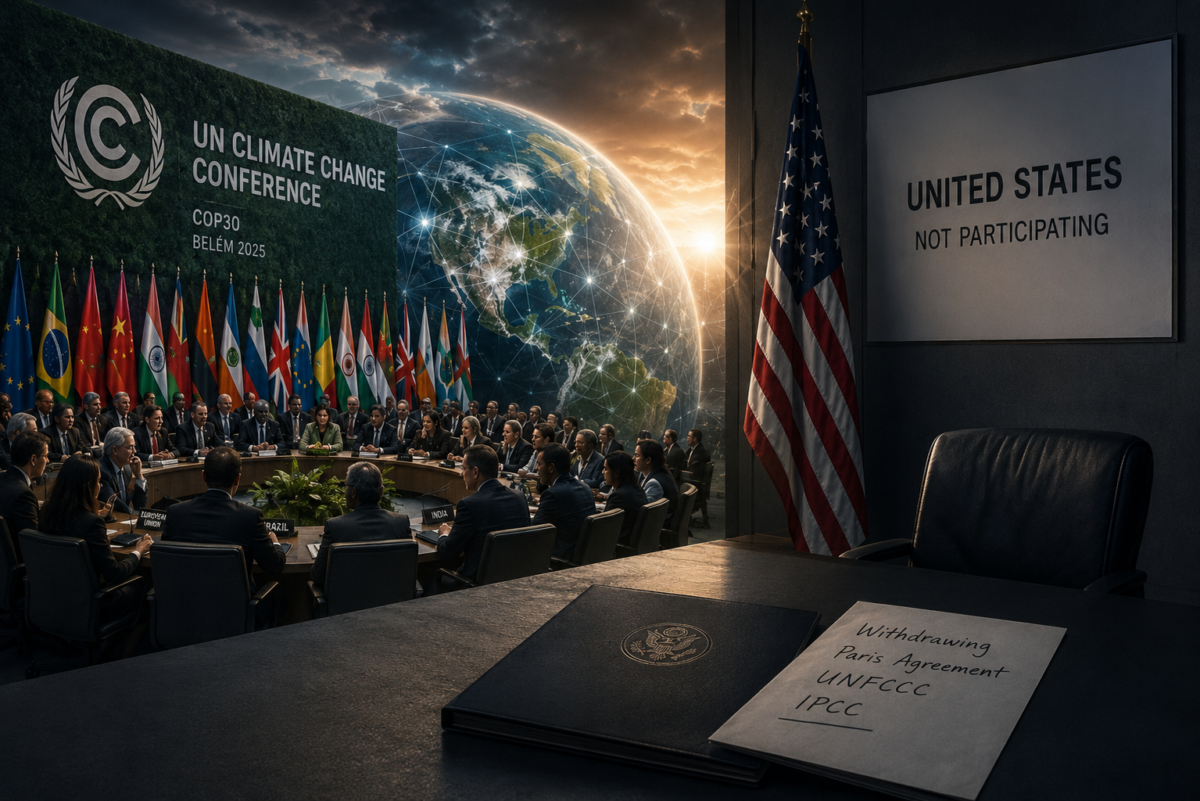
The United States is withdrawing from several of the institutions that have shaped international climate policy for more than three decades, reducing the federal government’s formal role in negotiations over emissions, energy investment and the global transition away from fossil fuels.
President Donald Trump directed the United States to leave the Paris Climate Agreement after returning to office in January 2025. That withdrawal became effective on January 27, 2026.
The administration subsequently notified the United Nations that the United States would also withdraw from the United Nations Framework Convention on Climate Change, or UNFCCC—the underlying treaty that established the international climate-negotiation process.
That second withdrawal is scheduled to take effect on February 27, 2027. Until then, the United States technically remains a party to the UNFCCC, even as the Trump administration declines to participate in several major climate forums.
The result is an unusual division: other countries continue negotiating international climate and energy policies that could affect trade, technology and investment, while the U.S. federal government increasingly pursues its energy strategy outside that process.
Key Takeaways
- The United States officially left the Paris Climate Agreement on January 27, 2026.
- The Trump administration formally notified the United Nations of its decision to leave the UNFCCC on February 27, 2026.
- The UNFCCC withdrawal is scheduled to take effect one year later, on February 27, 2027.
- No senior Trump administration officials represented the United States at COP30 in Brazil.
- The United States was not invited to an April 2026 conference focused on transitioning away from fossil fuels.
- Withdrawal reduces formal federal influence but does not prevent American states, cities, companies and nongovernmental groups from participating in international climate initiatives.
- Other countries may increasingly shape climate-related trade, finance and technology standards without direct U.S. federal input.
What Climate Agreements Is the United States Leaving?
The Paris Agreement and the UNFCCC are related, but they are not the same thing.
The UNFCCC is the foundational international climate treaty adopted in 1992. It created the broader framework through which countries share emissions information, hold annual Conferences of the Parties and negotiate collective climate policies.
The Paris Agreement was adopted under that framework in 2015. It asks participating countries to submit national plans for reducing emissions and adapting to climate change.
On January 20, 2025, Trump directed the U.S. ambassador to the United Nations to submit formal notice of withdrawal from the Paris Agreement. The United Nations received that notification on January 27, 2025, and the withdrawal became effective on January 27, 2026.
The departure marked the second time the United States had left the Paris Agreement.
The first withdrawal became effective in November 2020. President Joe Biden brought the country back into the agreement shortly after taking office in January 2021.
The Trump administration’s latest action reflects a much broader redirection of federal energy policy. ENMG previously explored that change in its analysis of Donald Trump’s energy policy legacy.
The UNFCCC Withdrawal Goes Further
Leaving the Paris Agreement removes the United States from the 2015 climate pact. Leaving the UNFCCC would remove the country from the underlying treaty framework itself.
On January 7, 2026, Trump issued a presidential memorandum directing federal agencies to withdraw from 66 international organizations, conventions and treaties that the administration said no longer served American interests.
The list included the UNFCCC and the Intergovernmental Panel on Climate Change.
The administration formally notified the United Nations of its UNFCCC withdrawal on February 27, 2026. Under Article 25 of the convention, the withdrawal takes effect one year after the depositary receives the notice.
The United Nations Treaty Collection therefore lists February 27, 2027, as the effective withdrawal date.
This timeline matters. As of September 2026, the United States has left the Paris Agreement but remains formally party to the UNFCCC for several more months.
The Trump administration describes these withdrawals as part of an effort to protect American sovereignty, economic competitiveness and energy security. Critics argue that leaving the institutions reduces U.S. influence over decisions that other governments will continue making with or without American participation.
Why Is the Trump Administration Leaving?
The administration rejects the basic structure of international climate agreements that it believes constrain U.S. energy production or impose unequal economic burdens.
Trump has repeatedly argued that international climate commitments weaken industrial economies while allowing some developing countries to continue expanding fossil-fuel consumption.
His administration has instead prioritized domestic oil, natural gas, coal and nuclear development, streamlined energy permitting and reduced federal support for several renewable-energy and emissions-reduction programs.
The policy change extends beyond international agreements. ENMG previously reported on the shift in climate and energy terminology at the Department of Energy, including reported instructions to avoid terms such as “climate change,” “green” and “decarbonization.”
The administration’s fiscal priorities reflect the same philosophy. Its federal budget proposals have redirected attention toward national security, conventional energy and grid reliability. That broader change is examined in ENMG’s analysis of the U.S. defense-first energy budget.
What Happened at COP30?
COP30 took place in Belém, Brazil, from November 10 through November 21, 2025.
The Trump administration did not send senior federal representatives to the conference. That decision limited the federal government’s involvement in negotiations over climate finance, national emissions commitments and implementation of the Paris Agreement.
The absence did not mean that every American participant stayed home. State and local officials, businesses, academic institutions and advocacy organizations could still participate in related events or attend through observer organizations.
However, those groups could not negotiate on behalf of the United States government.
This distinction is important. The United States was not entirely absent as a society, but the federal government chose not to exercise the formal diplomatic role it had held during previous climate negotiations.
COP30 ultimately concluded with countries continuing discussions over climate finance, implementation and support for developing economies. The conference did not depend on U.S. participation to proceed, but Washington’s absence meant other governments played a larger role in shaping the outcome.
Does the United States Still Have a Voice in Climate Negotiations?
For now, technically yes—but its formal influence has been sharply reduced by the administration’s decision not to participate.
The United States remains a UNFCCC party until February 27, 2027. In legal terms, that means it retains its status within the convention during the withdrawal period.
In practical terms, a country cannot exercise much influence if its government is not sending senior representatives, submitting policy commitments or participating actively in negotiations.
Once the UNFCCC withdrawal becomes effective, the United States could potentially attend certain future proceedings as an observer, subject to the convention’s rules. It would no longer possess the same rights as a party to the treaty.
American influence could still be exercised through:
- State and municipal governments
- Private companies and investors
- Universities and research institutions
- Environmental organizations
- Industry associations
- Technology developers
- Bilateral agreements with individual countries
Those participants can shape projects and public discussion, but they cannot replace the federal government in formal treaty negotiations.
Why Does International Participation Matter?
Climate negotiations are not limited to debates over environmental targets. They increasingly affect energy finance, industrial policy, technology standards and international trade.
Countries are developing policies involving:
- Carbon-related import requirements
- Methane measurement and reporting
- Clean-energy subsidies
- Climate-related financial disclosures
- Carbon-credit markets
- Shipping and aviation fuels
- Critical-mineral supply chains
- Technology transfers
- Financing for developing countries
If the United States does not participate in the institutions developing those policies, other governments may establish standards that still affect American companies.
That does not mean international participation automatically produces rules favorable to the United States. It means participation provides an opportunity to negotiate, object, build alliances or propose alternatives before standards are finalized.
The strategic question is therefore larger than whether the United States agrees with international climate targets. It is whether relinquishing a seat in the negotiating process reduces American leverage over policies that may influence global markets.
U.S. Withdrawal Does Not Stop the Global Energy Transition
The U.S. withdrawal will not end renewable-energy investment or international climate policy.
European countries, China, India and other major economies continue investing in renewable power, nuclear energy, storage, electric transportation and grid infrastructure. Their motivations include emissions reduction, industrial competition, domestic energy security and reduced exposure to imported fuels.
At the same time, global fossil-fuel consumption remains substantial. Oil, natural gas and coal continue supplying most of the world’s energy, particularly as developing economies industrialize and electricity demand grows.
ENMG’s analysis of what the energy-transition data actually show explains why renewable capacity is expanding rapidly without yet replacing fossil fuels at the scale implied by some political narratives.
The result is not a clean division between countries embracing fossil fuels and countries abandoning them. Most governments are pursuing some combination of conventional energy, renewable power, nuclear generation and energy-efficiency measures.
The political disagreement is largely over the pace, cost and government direction of that transition.
The Santa Marta Conference Excluded the United States
In April 2026, representatives from dozens of countries gathered in Santa Marta, Colombia, for the First International Conference on the Transition Away from Fossil Fuels.
Colombia and the Netherlands organized the meeting to discuss how countries might implement the commitment to transition away from fossil fuels that emerged from COP28.
The Colombian government said the participating countries represented a significant portion of global fossil-fuel production and consumption. Delegations included developed economies, developing countries and governments with very different levels of dependence on oil, gas and coal.
The United States was not invited, according to reporting from The New York Times.
The conference was not a formal UNFCCC Conference of the Parties and did not possess the authority to impose global requirements. However, it provided participating countries with an opportunity to build coalitions and develop proposals that could later influence formal negotiations.
Being excluded from one conference does not establish that the United States will be barred from every climate or energy forum. It does demonstrate how sustained federal disengagement can cause other countries to organize discussions without Washington.
Energy Security Is Complicating the Debate
International climate policy is unfolding alongside wars, trade disputes and disruptions affecting global energy transportation.
Recent threats to shipping through the Strait of Hormuz have demonstrated how heavily the global economy depends on a small number of energy corridors. Oil and LNG supply disruptions can raise fuel, electricity, fertilizer and manufacturing costs far beyond the region where the conflict occurs.
ENMG examined that exposure in The Great Energy Realignment: AI, Hormuz and Energy Security.
Supporters of renewable energy argue that expanding domestic wind, solar, nuclear and storage capacity can reduce exposure to volatile international fossil-fuel markets.
Supporters of expanded U.S. oil and gas production argue that abundant domestic resources provide a more immediate and reliable defense against foreign supply disruptions.
Those positions are not entirely incompatible. A country can expand domestic fuel production while also investing in technologies that reduce long-term fuel dependence. The harder questions involve timing, infrastructure, affordability and reliability.
ENMG’s coverage of the growth of American solar power provides additional context on how quickly one part of the domestic energy mix has expanded.
Could Withdrawal Affect American Businesses?
Potentially.
American companies selling products overseas may still have to comply with foreign carbon-reporting, methane, supply-chain and product standards even if the U.S. government does not participate in creating them.
Energy producers could face requirements involving methane intensity or lifecycle emissions. Manufacturers could encounter carbon-related import costs. Financial institutions may have to navigate different disclosure systems across major markets.
U.S. withdrawal could also create opportunities for other countries to gain influence over clean-energy technologies, critical-mineral processing and international climate finance.
However, supporters of the administration’s approach argue that avoiding international commitments gives American businesses greater freedom and protects them from policies that raise domestic energy and production costs.
The ultimate commercial impact will vary by sector. A domestic producer selling entirely within the United States may experience the policy differently from a multinational energy, manufacturing or technology company operating across several regulatory systems.
The Bigger Picture
The Trump administration has made a deliberate choice to separate U.S. federal energy policy from the international climate framework that Washington previously helped build.
The United States officially left the Paris Agreement in January 2026 and is scheduled to leave the UNFCCC in February 2027. Its absence from COP30 and exclusion from the Santa Marta conference demonstrate how quickly formal influence can diminish when a government steps away from international negotiations.
That does not mean the United States has withdrawn from global energy markets. American oil, LNG, technology, investment and diplomatic relationships remain enormously influential.
It does mean the federal government will have fewer opportunities to shape the climate rules, reporting systems and transition strategies being discussed by other countries.
Whether that tradeoff strengthens U.S. independence or weakens its international leverage will depend on what those institutions decide—and how significantly their decisions affect American industries after Washington has left the room.
Frequently Asked Questions
Is the United States still part of the Paris Agreement?
No. The United States’ withdrawal from the Paris Agreement became effective on January 27, 2026.
Has the United States left the UNFCCC?
Not yet. The United States submitted its withdrawal notice on February 27, 2026. Under the treaty’s rules, the withdrawal becomes effective on February 27, 2027.
Did the United States attend COP30?
The Trump administration did not send high-level federal representatives. American state, local, business and nongovernmental participants could still attend related activities, but they could not formally negotiate for the federal government.
Can the United States participate in future climate conferences?
After leaving the UNFCCC, the United States may be able to attend certain proceedings as an observer, but it would not have the full participation rights of a treaty party.
Keep In Touch with Shale Magazine
As the new era of energy unfolds, you can bet we’ll be the boots on the ground to keep you informed. Subscribe to Shale Magazine for sharp insight into the arenas that matter most to your life. And don’t forget to listen to our riveting podcast, The Energy Mixx Radio Show, where our very own Kym Bolado interviews the most extraordinary thought leaders, business innovators, and industry experts of our time.