
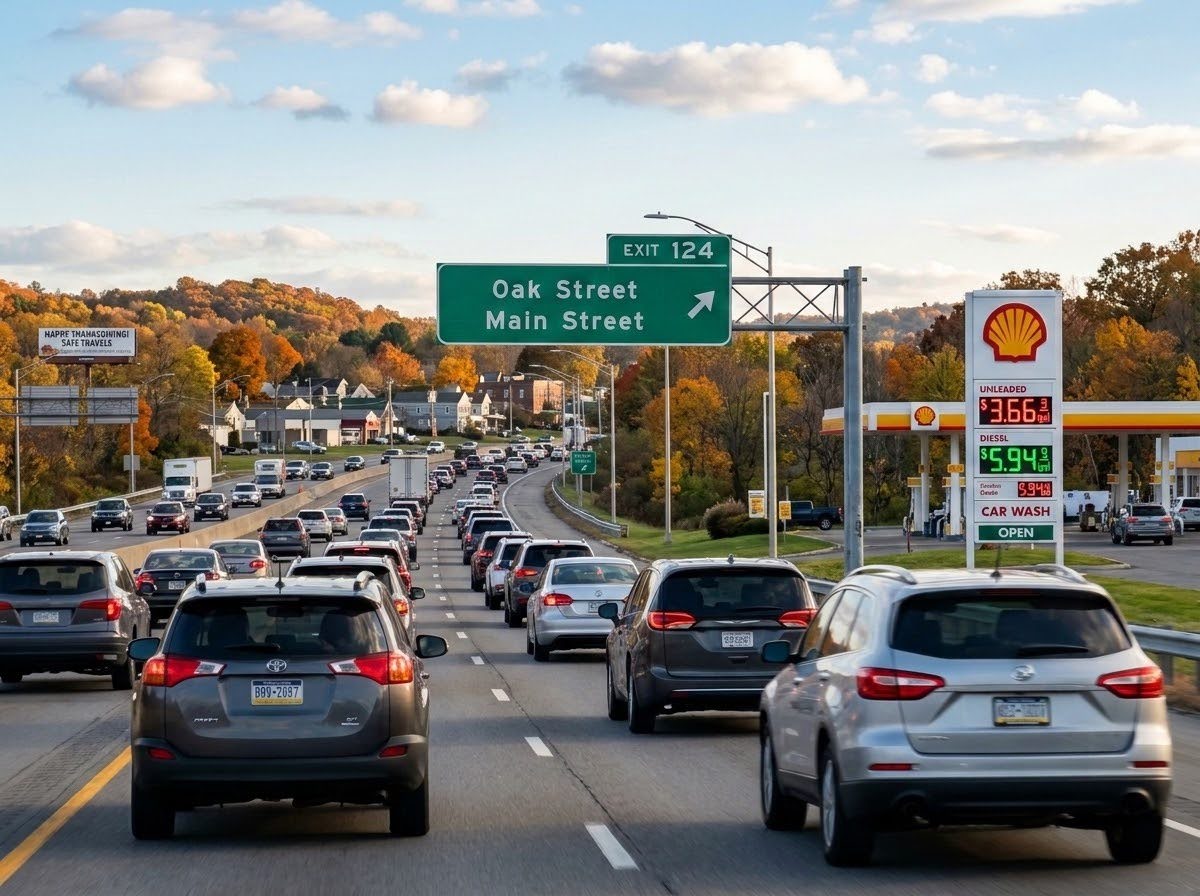
Americans heading into the Thanksgiving holiday are finally getting some relief at the gasoline pump. After months of elevated prices, the national average has fallen sharply in November, dropping to approximately $3.66 per gallon as of November 21. That’s a welcome development for millions of holiday travelers, although gasoline remains considerably more expensive than it was a year ago.
Diesel prices have also declined recently, but they remain much higher than gasoline. According to the Energy Information Administration (EIA), diesel averaged $5.94 per gallon during the week of November 16, compared with $3.81 for regular gasoline. As I explained in October, the enormous gap between gasoline and diesel prices reflects changes in fuel specifications, global demand, refinery economics, and increasingly tight distillate supplies.
The huge divergence has created an unusual situation for America’s oil refineries. While consumers are celebrating cheaper gasoline, refiners have been operating at exceptionally high rates to take advantage of strong diesel margins. They have also been making significant adjustments to the products they manufacture from crude oil, shifting production away from gasoline and toward diesel and jet fuel.
But if refiners are deliberately reducing gasoline yields, why are gasoline prices falling so rapidly? The answer illustrates how refinery economics, crude oil prices, and seasonal demand interact in ways that aren’t always obvious to consumers.
Refineries Can’t Simply Choose What to Produce
One of the important things to understand about petroleum refining is that gasoline and diesel are not produced independently. When a refinery processes crude oil, it produces a mixture of products, including gasoline, diesel, jet fuel, liquefied petroleum gases, and other materials. The proportions depend on the crude oil being processed, the refinery’s equipment, and the operating conditions.
As I’ve explained in an earlier analysis of America’s diesel shortage, having ample crude oil doesn’t necessarily mean having enough refining capacity configured to produce the petroleum products consumers need. Refineries have considerable flexibility, but they cannot simply convert every barrel of crude oil into diesel, regardless of how profitable it becomes.
Historically, U.S. refineries have produced approximately 45 to 50 barrels of gasoline for every 100 barrels of crude oil processed. But an EIA analysis published November 5 revealed that gasoline yields averaged less than 45% from January through August 2026. In fact, gasoline yields were below the previous five-year low in every one of those months.
At the same time, distillate yields were above their five-year average, and jet fuel yields reached historically elevated levels. Beginning in March, jet fuel yields reached at least 12% and remained at or above that level through August. These changes were not accidental. Refiners were responding to the greater profitability of producing middle distillates, particularly diesel and jet fuel, as global supplies remained constrained.
High Diesel Margins Are Keeping Refineries Busy
The financial incentive behind these operating decisions is straightforward. Refiners earn money on the difference between what they pay for crude oil and what they receive for the products they sell, after accounting for operating and other costs. One common measure of that opportunity is the crack spread, which compares the market price of a refined product with the cost of crude oil.
When diesel crack spreads are substantially higher than gasoline crack spreads, refiners have a strong incentive to maximize diesel production. That doesn’t mean gasoline becomes unprofitable, but it does change the relative attractiveness of the products. Refinery operators respond by adjusting their operations to capture as much of the higher-value product as their equipment will allow.
The result has been exceptionally high refinery utilization. According to an October 22 EIA report, U.S. refinery utilization averaged more than 95% of capacity between May and September, the highest for those months since 1998. The EIA specifically identified tight global supplies and strong diesel margins as major incentives for those elevated operating rates.
That doesn’t mean refineries are producing record volumes of petroleum products. U.S. refining capacity has declined since 2019, so even exceptionally high utilization rates don’t necessarily translate into record output.
But this creates an interesting distinction between gasoline yields and gasoline production. A refinery can reduce the percentage of each barrel of crude devoted to gasoline while still maintaining substantial gasoline output if it increases the total volume of crude processed.
Consider a simplified example. Suppose a refinery processes 100,000 barrels of crude per day with a gasoline yield of 48%. That would produce approximately 48,000 barrels of gasoline daily. If the refinery increases crude throughput to 110,000 barrels per day but reduces its gasoline yield to 44%, gasoline production would actually increase slightly to 48,400 barrels per day.
The refinery is producing a smaller percentage of gasoline, but more gasoline in absolute terms. Actual refinery operations are more complicated because of processing gains, blending components, and ethanol additions, but the illustration captures an important principle.
This doesn’t establish that refiners chasing diesel profits are responsible for the recent decline in gasoline prices. It does explain how strong diesel economics can help sustain gasoline supplies, even as refiners deliberately shift their product yields away from gasoline.
What’s Actually Driving Gasoline Prices Lower?
The most direct explanation for the recent gasoline price decline is falling crude oil prices. According to AAA, crude oil had retreated into the low $80-per-barrel range by November 19, helping pull gasoline prices lower. Because crude oil represents the largest underlying cost of producing gasoline, declining crude prices generally translate into lower retail prices, although the relationship isn’t instantaneous.
Seasonal demand is another important factor. As I’ve explained previously, gasoline prices typically decline in the fall as summer driving demand subsides and refiners transition to less expensive winter gasoline blends. Summer gasoline specifications restrict volatility to reduce evaporative emissions, while the return to winter specifications allows refiners to blend more inexpensive butane into gasoline. That increases available gasoline supplies while reducing production costs.
Inventories provide additional evidence that gasoline supplies are relatively comfortable. For the week ending November 13, EIA reported that U.S. gasoline inventories increased by 5.2 million barrels to 215.9 million barrels. That placed gasoline inventories approximately 3% above their five-year seasonal average.
Distillate inventories told a very different story. Although they increased by 1.6 million barrels during the same week, total distillate stocks stood at just 104.9 million barrels, approximately 7% below their five-year average. That difference helps explain why diesel continues to command such a substantial premium over gasoline.
It is important not to draw too much from a single weekly inventory report. Gasoline inventories reflect domestic production, imports, exports, and consumption, and movements in any of these categories can influence the weekly balance. Nevertheless, the contrast between relatively comfortable gasoline supplies and tight distillate inventories is consistent with the price divergence consumers are seeing.
The important conclusion is that falling gasoline prices are being driven by several factors working together. Lower crude oil prices and seasonal demand weakness are major contributors, while elevated refinery operating rates may be helping maintain gasoline supplies despite refiners’ efforts to favor diesel production.
Cheaper Gasoline Doesn’t Mean the Energy Crisis Is Over
The decline in gasoline prices is welcome news for motorists, but the continuing diesel premium presents a different economic challenge. Heavy-duty trucks, agricultural machinery, construction equipment, and freight transportation all depend heavily on diesel fuel. When diesel prices remain elevated, those costs can eventually work their way into the prices consumers pay for food, building materials, and other products.
This helps explain why falling gasoline prices don’t necessarily translate into an equally large reduction in the cost of living. Consumers may save money filling their personal vehicles while businesses continue paying elevated transportation and distribution costs. The economic impact of diesel extends well beyond the relatively small number of Americans who own diesel-powered passenger vehicles.
It also illustrates why the gasoline and diesel markets cannot be viewed entirely separately. Both products emerge from the same refining system, and refiners continually adjust their operations in response to changing prices and demand. Strong diesel margins can encourage higher refinery throughput, potentially supporting gasoline supplies, even when refiners are deliberately reducing gasoline’s share of their output.
The Bottom Line
The recent decline in gasoline prices is good news for consumers, but it doesn’t mean the pressures that drove fuel prices higher throughout 2026 have disappeared. Diesel supplies remain relatively tight, and refiners continue to face strong economic incentives to prioritize middle-distillate production.
The surprising development is that refiners have been reducing gasoline yields while maintaining unusually high operating rates. These are not contradictory trends. They reflect an industry responding to changing market conditions within the physical limitations of its equipment.
The biggest drivers of cheaper gasoline remain falling crude prices, seasonal demand, and relatively comfortable gasoline inventories. But strong diesel margins have created an additional incentive for refiners to operate at high rates, potentially helping sustain gasoline supplies even as they shift their product yields toward diesel and jet fuel.
For Thanksgiving travelers, that combination has helped create some welcome relief at the pump. For the broader economy, however, the persistent diesel premium is a reminder that cheaper gasoline doesn’t necessarily mean lower transportation costs across the board.