ENMG Analysis
The Western Gateway Pipeline has entered federal environmental review, giving landowners, communities, and local officials an opportunity to identify what the government should examine before deciding whether to authorize the proposed refined-products route.
On November 17, the Bureau of Land Management opened public scoping for an environmental impact statement covering the proposed pipeline from Borger, Texas, through El Paso and into Buckeye, Arizona. Comments are requested by December 17, and virtual public meetings are scheduled for December 1 and 2.
The announcement does not authorize construction. It begins the process BLM will use to evaluate whether to grant, grant with conditions, or deny a federal right-of-way for the project. The Federal Register notice identifies the proposed route, affected resources, preliminary alternatives, and additional permits that could be required.
What the Proposed Pipeline Would Carry
Western Gateway would transport finished petroleum products: gasoline, diesel, and jet fuel. It would not transport crude oil or natural gas.
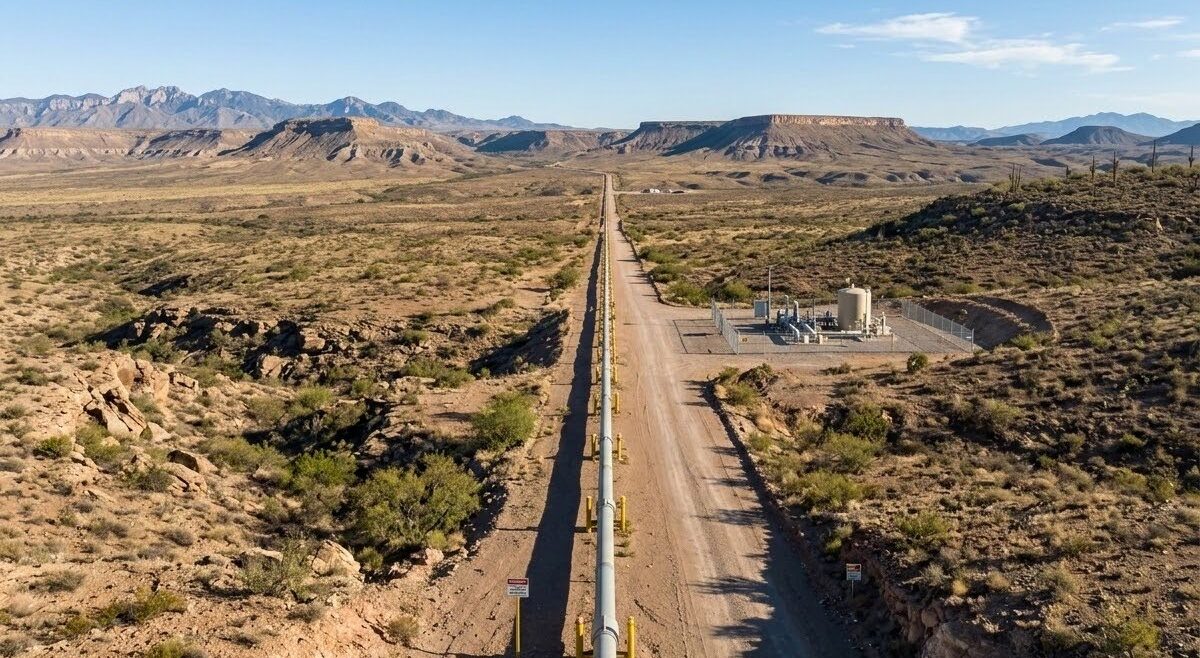
The federal proposal includes a new 20-inch pipeline from Borger to El Paso and a new 24-inch pipeline from El Paso to Buckeye. BLM describes approximately 887 miles of new construction across federal, state, county, and private land in Texas, New Mexico, and Arizona.
In Texas, the proposed route would cross Hutchinson, Carson, Potter, Oldham, Deaf Smith, Parmer, Hudspeth, and El Paso counties. Additional infrastructure could include access roads, pump stations, mainline valves, breakout facilities, and electrical connections.
Refined-products pipelines can transport different fuels through the same line in separate batches. Gasoline, diesel, and jet fuel are scheduled sequentially, with testing needed where batches meet because limited mixing can occur. The U.S. Energy Information Administration explains that pipelines move much of the nation’s diesel and other finished fuels from refineries and ports to regional terminals.
This system would therefore move products that have already been manufactured. It would not refine crude oil or increase refinery capacity by itself.
Why the Project Has Two Different Mileage Figures
The 887-mile figure in the federal notice covers the new pipeline proposed between Borger and Buckeye. The companies describe Western Gateway as a roughly 1,300-mile system because it would also use and reverse portions of existing infrastructure.
The proposal would connect with Phillips 66’s Gold Pipeline, which runs between Borger and St. Louis. Reversing that line would allow finished products to move toward Borger from the east.
At the western end, the new construction would connect with Kinder Morgan’s Santa Fe Pacific Pipeline system. A portion running between Colton, California, and Arizona would be reversed to support east-to-west movement into California.
Those connections would create a longer route between Midcontinent and Gulf Coast supply points and fuel markets in Arizona and California. The Kinder Morgan project page describes the full linked system and its planned connections.
The distinction is important: approximately 887 miles would be new construction under the current federal review, while approximately 1,300 miles describes the broader network that would include existing assets.
A Final Investment Decision Is Not a Construction Permit
Phillips 66, Kinder Morgan, and HF Sinclair announced a joint venture and final investment decision for Western Gateway on August 11. Phillips 66 would own 49.9% of the system, Kinder Morgan 35.1%, and HF Sinclair 15%.
The companies estimate a design capacity of approximately 230,000 barrels per day and are targeting completion in 2029, subject to permits and regulatory approvals. The system would be supported primarily by 10-year take-or-pay contracts, under which customers commit to paying for reserved transportation capacity even if they do not use all of it.
The sponsors place the project’s enterprise value at approximately $5 billion. That figure includes about $1.5 billion assigned to existing Kinder Morgan assets that would be contributed to the joint venture. It should not be described as $5 billion of new pipeline-construction spending.
The companies’ joint announcement confirms the investment decision, ownership structure, contractual support, capacity, and target schedule. Those remain company-reported plans rather than completed operating results.
A final investment decision indicates that the sponsors have decided to advance the project. It does not substitute for the federal right-of-way, environmental review, state permits, land agreements, or other authorizations needed before construction can proceed.
What the Public Can Ask BLM to Study
BLM’s scoping process is intended to identify the alternatives, resources, and potential effects that should be examined in the environmental impact statement.
The federal notice says the review is expected to consider:
- Agriculture and farmland
- Groundwater, wells, and water supplies
- Floodplains and aquatic resources
- Air quality and noise
- Public health and pipeline safety
- Wildlife and protected species
- Cultural and historic resources
- Transportation and construction access
- Recreation and visual resources
- Economic and community effects
- Alternative routes and the no-action alternative
These are subjects for analysis, not findings that the pipeline has already caused or will cause a particular harm.
Landowners can submit site-specific information about wells, drainage, farm access, sensitive habitat, cultural resources, construction routes, and emergency-response concerns. Local officials and emergency responders can ask how agencies and the developer would coordinate spill planning, notification, equipment, training, and access along the proposed corridor.
ENMG’s coverage of the Amarillo Expansion Project explains a similar regulatory distinction: opening an environmental review gives the public a chance to shape the analysis, but it does not authorize pipeline construction.
How to Participate
BLM will hold two virtual meetings:
- December 1: 9–10 a.m. Mountain Standard Time
- December 2: 6–7 p.m. Mountain Standard Time
Registration information and comment instructions are available through the BLM participation page.
Comments are requested by December 17. BLM advises participants that submitted comments, including identifying information, may become publicly available.
Why Distribution Capacity Is Not Refinery Output
For Texas refiners, another westbound route could provide access to additional markets when local supply exceeds regional demand or another transportation path is constrained. It could also give buyers in the Southwest and California another source of finished fuel.
Those possibilities are not guaranteed outcomes.
The pipeline would provide transportation capacity, not additional refining capacity. It would not restart an offline refinery, increase crude-processing capability, or guarantee that 230,000 barrels move through the system every day. Actual throughput would depend on refinery production, customer nominations, terminal capacity, product specifications, maintenance, and regional demand.
That distinction helps explain why diesel prices can remain high even when crude oil is available. Fuel prices reflect crude costs, refinery operations, inventories, transportation capacity, terminal conditions, taxes, and local demand.
Similarly, ENMG’s analysis of the latest Texas diesel waiver shows why regulatory flexibility or transportation capacity does not automatically create new fuel supplies or guarantee lower prices.
For a South Texas trucking company, the proposed route does not establish a measurable price benefit. Western Gateway would begin in the Texas Panhandle and move fuel west. Determining its effect on other Texas markets would require evidence about product origins, terminal connections, contracted volumes, and changes in wholesale supply patterns.
What Comes Next
BLM anticipates releasing the final environmental impact statement in February 2028 and issuing a record of decision in May 2028. The agency could grant the right-of-way, approve it with conditions, modify the proposed route, or deny the application. Other federal, state, and local permits would still be required.
The next reporting questions are practical:
- What route alternatives will BLM examine?
- Which refineries and terminals would supply the system?
- How much capacity is already contractually committed?
- What emergency-response resources would be available along the route?
- How would construction affect wells, agricultural access, and private land?
- Can the sponsors obtain the required approvals while maintaining the 2029 target?
Western Gateway has advanced beyond an early concept because its sponsors have approved investment and secured long-term commercial support. It has not advanced to construction.
For now, the latest development is the opening of a federal environmental review—and the public’s opportunity to help determine what that review must address.