ENMG Analysis
NeuVentus announced on October 13 that it is expanding the first phase of its Texas Reliability Underground Hub, or TRU Hub, in Liberty County from about 20 billion cubic feet of working-gas capacity to 28 billion. The 8 Bcf addition is a 40% increase. The project is still under development, and its value will depend on customer contracts, financing, construction and operating performance.
Key figures: TRU Hub Phase 1 (planned design)
- Working-gas capacity: 28 Bcf, up from about 20 Bcf
- Caverns: three natural gas salt caverns
- Injection capacity: 840 MMcf/d, up from 600 MMcf/d
- Withdrawal capacity: 1,680 MMcf/d (1.68 Bcf/d), up from 1,200 MMcf/d
- Pipeline header: 35 miles, north to south, with 10 interconnections to interstate and intrastate pipelines
These are design figures, not operating capacity available to customers today.
What the Texas gas storage expansion includes
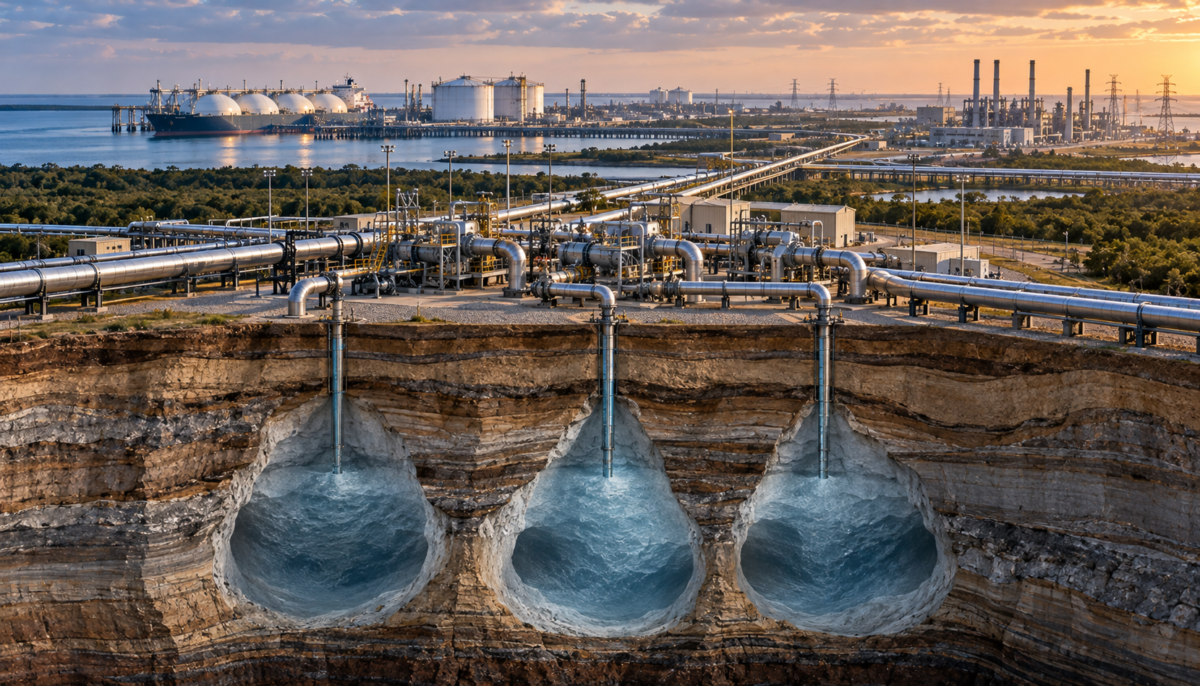
The expanded first phase would include three underground salt caverns and a large-diameter pipeline header. NeuVentus says the header would connect with 10 interstate and intrastate natural gas pipelines serving the Texas Gulf Coast.
The injection and withdrawal rates are planned capabilities, not guaranteed daily performance. Actual withdrawal can change as inventory and cavern pressure decline. Compression, surface equipment, pipeline conditions and contract terms can also limit how much gas is delivered at a given time.
The project sits on the Moss Bluff salt dome in southern Liberty County. In 2025, the Railroad Commission of Texas issued a final order allowing NeuVentus to develop up to 12 salt caverns there. The order covers eight gas caverns under Statewide Rule 97 and four liquids caverns under Rule 95. NeuVentus says full buildout could provide up to 96 Bcf of gas working capacity, 128 million barrels of natural gas liquids, or a combination of the two, depending on customer demand. The 96 Bcf figure is the company’s full-buildout estimate, not what is planned for the first phase.
Capacity versus deliverability
Working-gas capacity is the volume of gas in a storage facility that can be withdrawn and sold, above the base gas that must stay in place to maintain pressure. The U.S. Energy Information Administration uses this definition.
Deliverability is how fast that gas can be withdrawn, usually measured in millions or billions of cubic feet per day. A site can hold a large volume and still be limited by its wells, compressors and connecting pipelines.
That difference matters when demand changes quickly. Having enough gas over a month is not the same as having it at the right pipeline connection on the day a power plant or LNG terminal needs it. The TRU Hub’s 28 Bcf shows how much gas the first phase is designed to hold. Its 1.68 Bcf/d withdrawal rate shows the fastest rate the current design could deliver under specified conditions.
Why salt caverns respond quickly
Salt caverns are formed by solution mining: water is injected into an underground salt formation to dissolve the salt and create a controlled storage space. The resulting brine must be removed and managed before the cavern can be prepared for gas service.
The Federal Energy Regulatory Commission notes that salt-cavern facilities generally offer high injection and withdrawal rates and can cycle their working gas more than once a year. That makes them useful for short periods of elevated demand. Salt caverns also generally need less cushion gas than depleted oil and gas reservoirs.
There are tradeoffs. The EIA notes that building salt caverns can cost more per unit of working capacity than converting depleted fields. Development also requires suitable geology, brine management, compression, integrity testing and pipeline access. In Texas, the Railroad Commission regulates cavern creation and operation under Statewide Rule 97, with technical, safety, monitoring and reporting requirements.
Why connectivity matters
The planned header is meant to give customers access to multiple pipeline systems rather than a single route. That can provide flexibility in where gas arrives from and where it goes.
Storage does not replace pipelines. Pipelines move gas between production areas, storage and customers. Storage provides an inventory buffer that helps manage mismatches in the timing of production, transportation and consumption. The hub’s usefulness will depend on connecting pipeline capacity, the terms of the interconnections, and customers’ ability to nominate and receive gas when they need it.
Potential benefits for LNG and power customers
NeuVentus has identified LNG exporters, industrial and petrochemical users, midstream operators and power generators as potential customers.
LNG terminals need sustained gas deliveries to keep liquefaction running. Nearby storage could give them another way to manage temporary changes in feed-gas supply or pipeline scheduling. Gas-fired power plants have a different profile: their fuel needs can change quickly with electricity demand, weather and the availability of other generation. High-deliverability storage could help supply contracted gas when plants ramp up fast.
That shouldn’t be read as a guaranteed reliability improvement. Storage can only deliver gas that has been injected and retained, and the gas must be commercially available to the customer. Storage addresses fuel availability and timing. It does not fix generation outages, electric transmission limits or pipeline constraints downstream. ENMG has separately examined how a Texas transmission bottleneck can limit electricity flows even when generation is available.
The commercial test comes first
The October 13 announcement describes the expanded scope and design but does not include a revised construction or in-service schedule. NeuVentus’s current project page says final front-end engineering and design studies are expected to be completed in 2027. Subject to securing firm storage-service contracts, the company plans to make a final investment decision in 2027, begin construction afterward and start phased service in 2030. Those dates remain company targets rather than completed milestones.
What to watch next:
- Binding customer commitments for storage service
- Completion of engineering and pipeline permitting
- A final investment decision and financing
- Construction progress and confirmed in-service dates
- Real-world injection and withdrawal performance once operating
Texas already produces large volumes of natural gas. The TRU Hub proposal raises a separate question: whether the state can store that gas, connect it to multiple delivery routes, and make it available when Gulf Coast customers need it most.
Keep In Touch with Shale Magazine
As the new era of energy unfolds, you can bet we’ll be the boots on the ground to keep you informed. Subscribe to Shale Magazine for sharp insight into the arenas that matter most to your life. And don’t forget to listen to our riveting podcast, The Energy Mixx Radio Show, where our very own Kym Bolado interviews the most extraordinary thought leaders, business innovators, and industry experts of our time.