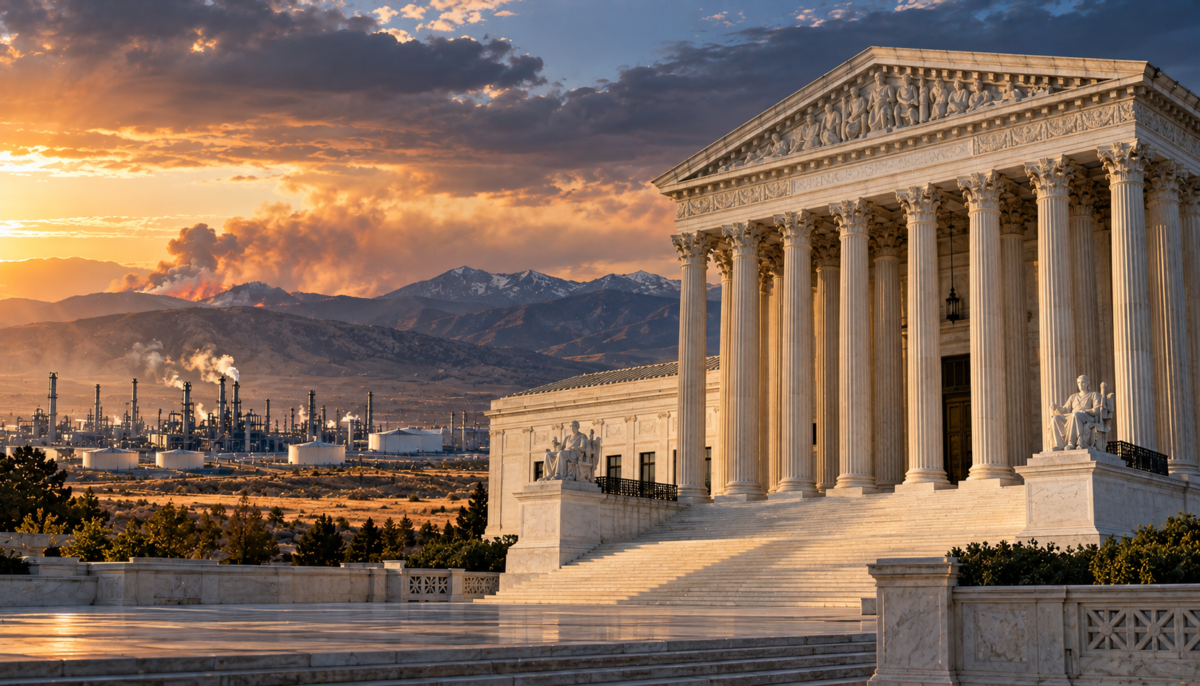
Almost a decade ago, Boulder County and the city of Boulder sued Exxon Mobil and Suncor Energy over alleged climate-related damages. The U.S. Supreme Court is now considering whether those state-law claims can proceed toward trial.
A ruling allowing the case to continue could strengthen dozens of similar lawsuits seeking billions of dollars from fossil fuel companies. A ruling for Exxon and Suncor could sharply limit the ability of environmental groups and states seeking to hold fossil fuel companies liable for damages for years of greenhouse gas emissions that contributed to global warming.
The justices heard the first arguments in the case from the lawyers when the new Supreme Court term began on October 5.
The Boulder Lawsuit
Boulder’s lawsuit claims that Exxon and Suncor should have to pay damages to local governments for extreme weather and wildfires caused by climate change, which was exacerbated by the burning of fossil fuels. The two firms say the lawsuit should be thrown out of court because it was filed under state law, when federal law should take precedence.
The lawsuit has divided public opinion, with several business groups, conservative legal theorists, and Republican lawmakers backing Exxon and Suncor. “Every locality in the country could sue essentially anyone in the world for contributing to global climate change,” lawyers for the Trump administration warned in a brief they filed in support of the energy industry.
Meanwhile, various environmental groups and local organizations, including Earthjustice, the National League of Cities, and the International Municipal Lawyers Association, have expressed support for the lawsuit. In addition, in May 2025, the Colorado Supreme Court ruled 5-2 that the case could proceed to discovery and toward trial, thereby upholding a state trial court’s decision that federal law did not pre-empt Boulder’s claims.
The county commissioner for Boulder, Ashley Stolzmann, said in a statement, “The U.S. Supreme Court must allow our case to continue, not bail out the oil companies before hearing the facts.”
The lawsuit argues that Exxon and Suncor caused physical harm to Colorado by selling fossil fuels and not divulging their knowledge about the dangers of climate change to drive up sales. It also alleges that the firms paid for campaigns to undermine the scientific consensus that burning oil, gas, and coal contributes to global warming, an action that a 2025 report found some fossil fuel firms had taken.
Boulder is essentially seeking to hold companies liable for the costs of mitigating the harm caused by climate change, rather than taxpayers. A Colorado Fiscal Institute 2026 report estimates that climate change could cost Colorado up to $37 billion over the next 25 years, underscoring the magnitude of the financial damages.
What the Supreme Court Climate Liability Case Could Decide
Almost 60 state and local governments have brought similar lawsuits, seeking billions of dollars from fossil fuel companies, with more continuing to be filed.
Those who support the oil companies worry that if Boulder’s claims about the link between burning fossil fuels and climate change are upheld, it could provide states with sweeping power over conduct taking place beyond their borders.
“The stakes are enormous here. There are billions of damages that are sought,” said attorney Deepak Gupta, who regularly argues before the Supreme Court. “And the underlying subject here is maybe the most consequential thing we could be litigating.”
However, several energy companies operating in the United States have won similar cases in the past, largely based on the limited reach of federal environmental regulation. In 2011, the Supreme Court held in American Electric Power v. Connecticut that the Clean Air Act displaced federal common-law claims seeking court-ordered reductions in carbon dioxide emissions. Since then, climate plaintiffs have increasingly relied on state tort and consumer-protection laws instead.
Possible Outcomes
Michael Gerrard, director of the Sabin Center for Climate Change Law at Columbia, has suggested that there are four possible outcomes for the case. One, that the justices permit the case to continue; two, that they disregard some of Boulder’s claims; or three, that they deem it too early to decide, which would allow either the case or similar lawsuits to continue.
The fourth scenario sees the justices definitively knocking out all of Boulder’s claims. They could do this if they decide that another federal policy already addresses the issue, such as the Clean Air Act, meaning that these would be deemed as international issues that cannot be decided by state courts. Gerrard said that “If that’s what happens, all these other cases will go away.”
The Supreme Court’s decision could therefore have significant consequences for the U.S. energy industry and the communities seeking compensation for climate-related damages. A ruling allowing Boulder’s case to proceed could expose fossil fuel companies to further litigation and potentially substantial financial liabilities, while a dismissal could sharply limit efforts to pursue climate damages through state courts. Either way, the case could help define the legal and financial risks facing the oil industry as climate-related litigation continues to evolve.
Keep In Touch with Shale Magazine
As the new era of energy unfolds, you can bet we’ll be the boots on the ground to keep you informed. Subscribe to Shale Magazine for sharp insight into the arenas that matter most to your life. And don’t forget to listen to our riveting podcast, The Energy Mixx Radio Show, where our very own Kym Bolado interviews the most extraordinary thought leaders, business innovators, and industry experts of our time.